On this page
Key takeaways
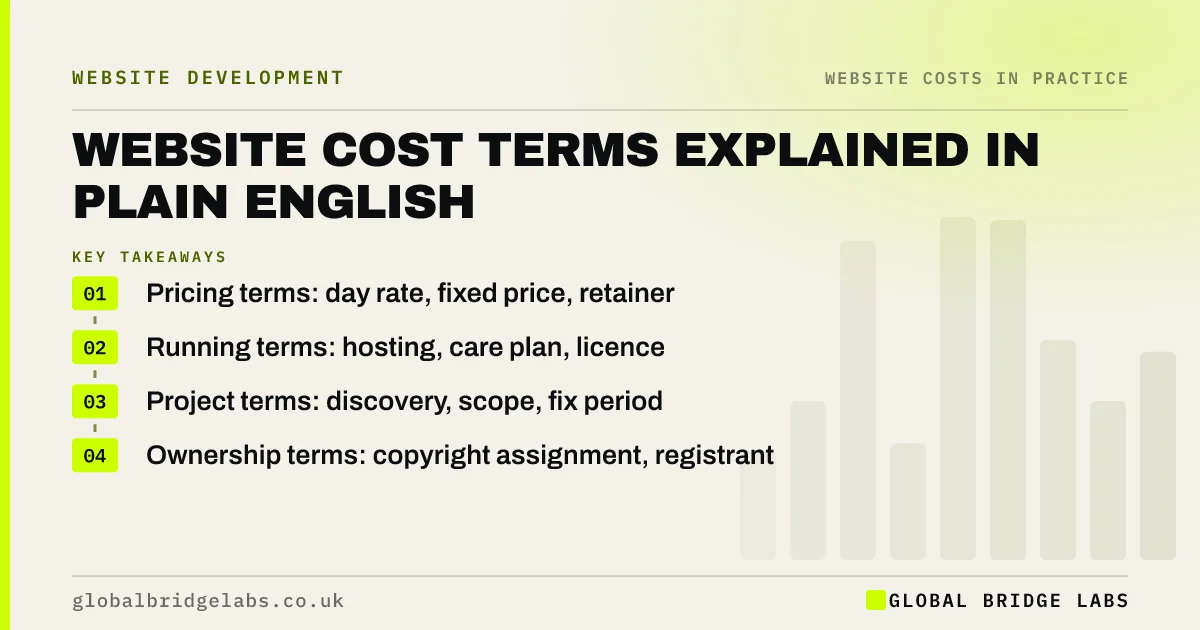
Website quotes use jargon that hides what you are paying for. Knowing about 20 terms, such as day rate, retainer, care plan, licence, discovery, fix period and copyright assignment, makes quotes easier to compare and helps you spot missing items. This glossary explains each in one or two plain sentences.
- Pricing terms: day rate, fixed price, retainer.
- Running terms: hosting, care plan, licence.
- Project terms: discovery, scope, fix period.
- Ownership terms: copyright assignment, registrant.
Want a quote translated into plain English? Message us on WhatsApp.
Chat on WhatsApp →Why do website cost terms matter?
Website cost terms matter because quotes use them to describe what is included, and similar words can mean different things between suppliers. Understanding them lets you ask the right questions, compare like for like and avoid paying twice for the same thing.
Pricing terms
These terms describe how you are charged.
- Day rate: the price for one day of a person's work.
- Fixed price: one agreed price for a defined scope.
- Retainer: a monthly fee for a set amount of ongoing work.
- Subscription: a monthly fee bundling build, hosting and care.
- Change request: work outside the agreed scope, priced separately.
Want your quote's terms explained? Message us on WhatsApp and we will discuss your requirements.
Chat on WhatsApp →Running cost terms
These terms describe what you pay to keep the site live.
- Hosting: the server space where the site lives.
- Domain: your web address, renewed yearly.
- Care plan: monthly updates, backups and fixes.
- Licence: a paid right to use a theme, plugin or font.
- SSL: the certificate behind the padlock and HTTPS.
Project and ownership terms
These terms describe how the project runs and what you own.
- Discovery: a paid planning stage before design.
- Scope: the written list of what will be delivered.
- Fix period: time after launch when defects are fixed free.
- Key event: an action, such as an enquiry, tracked in analytics.
- Copyright assignment: transfer of ownership of design, code or words to you.
- Registrant: the legal owner of a domain.
When does jargon signal a problem?
Jargon signals a problem when a supplier cannot explain a term simply or uses vague phrases such as "SEO-ready" or "full support" without detail. Ask what each includes in practice.
What does this look like in practice?
At Global Bridge Labs (GBL), a UK craft brewery's quote listed "support" at £90 a month. Asked to define it, the supplier said it meant hosting only, with updates and changes extra. Knowing the difference between hosting and a care plan let the brewery compare quotes properly.
Glossary checklist
- Highlight every term in your quote.
- Ask suppliers to define unclear ones.
- Check hosting and care are separated.
- Confirm what support includes.
- Check copyright assignment is stated.
- Confirm you are the domain registrant.
Next step
Highlight every term in your quote you could not explain to a colleague. Ask the supplier to define each in writing.
Message us on WhatsApp for a plain-English quote review, or book a 30-minute consultation.
Chat on WhatsApp →Sources and further reading
- How copyright protects your work · GOV.UK
- VAT rates · GOV.UK
- About key events · Google Analytics Help
Frequently asked questions
What is a care plan for a website?
A care plan is a monthly service covering routine website upkeep, usually software updates, backups, security checks, uptime monitoring and small content changes. What is included varies widely between suppliers, so ask for a written list of tasks and response times before comparing prices.
What is the difference between hosting and maintenance?
Hosting is the server space where your website lives and is served to visitors. Maintenance is the work of keeping the site updated, secure, backed up and working. Some suppliers bundle both; others charge separately. A quote listing only hosting may not include any maintenance work.
What does copyright assignment mean in a website contract?
Copyright assignment means the supplier transfers legal ownership of the design, code or written content to you, usually on final payment. Without it, copyright stays with the creator, which can limit what you can do with the site or make moving supplier harder.
Written by

Global Bridge Labs (GBL) is a UK–Sri Lanka partner for social media, websites and BPO. Everything here comes from client delivery, not theory.