On this page
- 01Key takeaways
- 02How do you compare website quotes fairly?
- 03What should go in the comparison table?
- 04How should you score quotes beyond price?
- 05Why do ownership terms matter in a comparison?
- 06When is the cheapest quote the right pick?
- 07What does this look like in practice?
- 08Quote comparison checklist
- 09Next step
- 10Sources and further reading
- 11Frequently asked questions
Key takeaways
To compare website quotes like for like, put every quote against one written scope, list exclusions, add three-year running costs and check ownership terms. Then score each on fit, process and support, not price alone. Most UK small businesses find the ranking changes once copy, tracking and care are priced in.
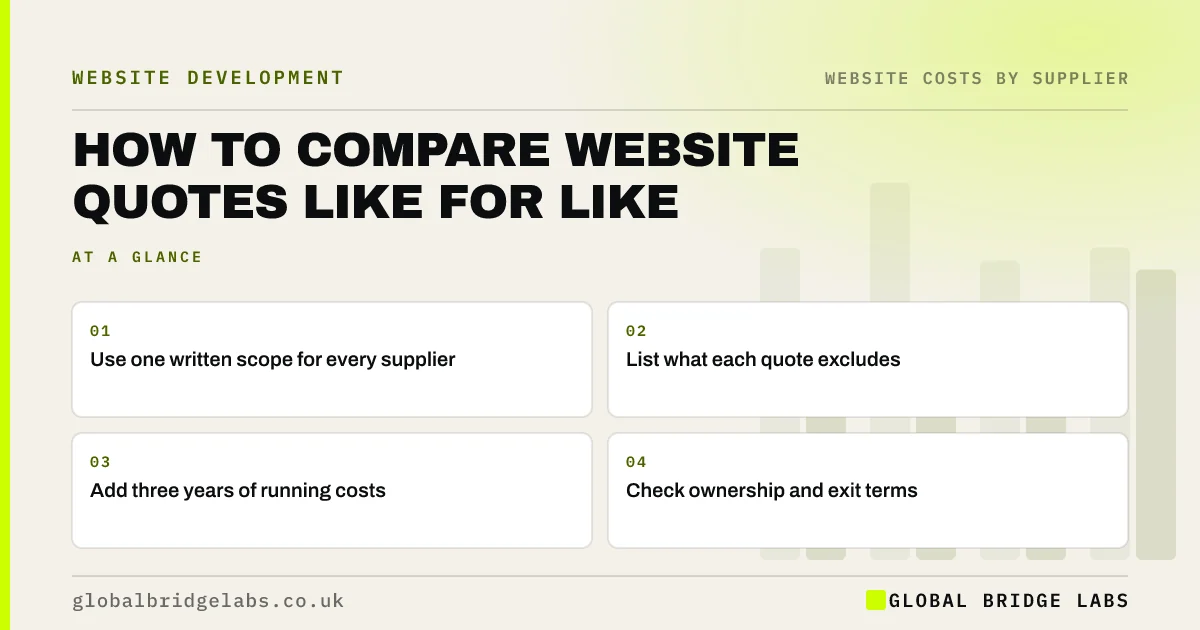
- Use one written scope for every supplier.
- List what each quote excludes.
- Add three years of running costs.
- Check ownership and exit terms.
Want your quotes compared for you? Message us on WhatsApp.
Chat on WhatsApp →How do you compare website quotes fairly?
Compare website quotes fairly by sending every supplier the same written scope, asking them to state inclusions and exclusions, and adding three years of running costs to each. Then check ownership, process and support. Comparing totals alone rewards the supplier who left the most out.
What should go in the comparison table?
A good comparison table has the same rows for every supplier, so gaps are obvious. Fill blanks by asking, not assuming.
- Build price and payment stages.
- Copy, photos and content loading.
- SEO, tracking and accessibility.
- Integrations and features.
- Fix period and care cost.
- Ownership of domain, code and content.
- Three-year total.
Want a filled comparison for your quotes? Message us on WhatsApp and we will discuss your requirements.
Chat on WhatsApp →How should you score quotes beyond price?
Score each quote out of five on fit to your goals, relevant portfolio, process clarity, support after launch and ownership terms. Weight fit and support highest, because they decide whether the site keeps working. Use price to choose between quotes that score similarly.
- Fit: understands what the site must produce.
- Portfolio: similar sites that work on phones.
- Process: clear stages, demos and sign-offs.
- Support: fix period and care terms.
- Ownership: you own domain, code and content.
Why do ownership terms matter in a comparison?
Ownership terms matter because they decide what moving supplier will cost later. Copyright in code and design belongs to the creator unless assigned in writing. A quote that keeps ownership with the supplier can cost far more over time, even if the build price is lower.
When is the cheapest quote the right pick?
The cheapest quote is the right pick when it covers the same scope, the supplier scores well on fit and support, and ownership terms are fair. That happens more often than people expect, especially with efficient teams using a good template.
What does this look like in practice?
At Global Bridge Labs (GBL), a UK property maintenance firm compared three quotes with our table. The cheapest, at £2,900, excluded copy and care. The middle one, at £4,800, included both and assigned copyright. Over three years with care, the middle quote cost £400 less than the cheapest once the missing items were added.
Quote comparison checklist
- Send one written scope to every supplier.
- Use the same table rows for each quote.
- Fill blanks by asking suppliers.
- Add three-year running costs.
- Score fit, portfolio, process, support, ownership.
- Decide on value, then price.
Next step
Build your table before the quotes arrive. It forces suppliers to answer the same questions and saves you guessing.
Message us on WhatsApp for a website quote comparison table, or book a 30-minute consultation.
Chat on WhatsApp →Sources and further reading
- Consumer Rights Act 2015 · legislation.gov.uk
- How copyright protects your work · GOV.UK
- SEO Starter Guide · Google Search Central
Frequently asked questions
How do I compare two website quotes?
Put both against the same scope, list what each includes and excludes, add three years of hosting and care, and check who owns the domain, code and content. Then score each on fit, portfolio, process and support. Choose on value first and price second.
What should a website quote comparison include?
It should include build price, payment stages, content responsibilities, SEO and tracking, integrations, testing, fix period, care cost, ownership terms and a three-year total. Using the same rows for every supplier makes missing items obvious and stops the quote with the fewest inclusions looking cheapest.
How many website quotes should I get?
Three is usually enough for a small business site. Fewer gives little comparison; more takes time and rarely changes the outcome. Make sure all three receive the same written scope and answer the same questions, otherwise you are comparing three different projects.
Written by

Global Bridge Labs (GBL) is a UK–Sri Lanka partner for social media, websites and BPO. Everything here comes from client delivery, not theory.