On this page
- 01Key takeaways
- 02Which website costs renew every year?
- 03How much do renewals add up to?
- 04What happens when a renewal is missed?
- 05How do you build a renewal calendar?
- 06When is a monthly plan better than annual?
- 07What does this look like in practice?
- 08Renewal calendar checklist
- 09Next step
- 10Sources and further reading
- 11Frequently asked questions
Key takeaways
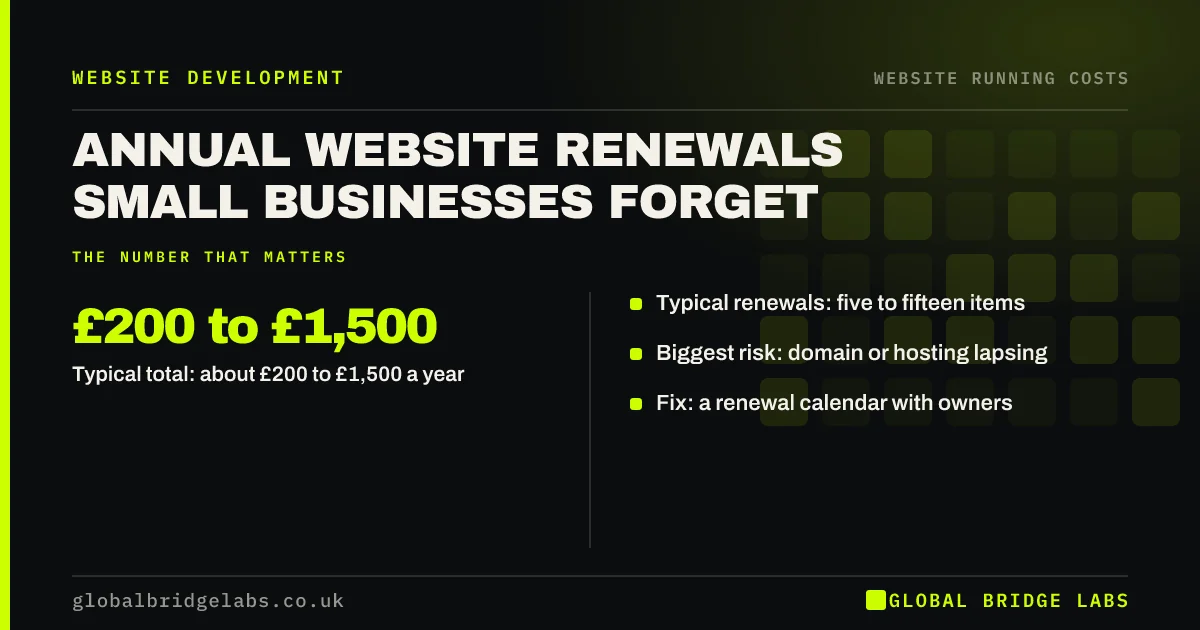
A typical UK small business website has five to fifteen annual renewals, together often costing £200 to £1,500 a year: domain, hosting, email, plugin and theme licences, booking or form tools and sometimes certificates. Missed renewals can take a site or email offline. A one-page renewal calendar with dates, costs and owners prevents both surprises and outages.
- Typical renewals: five to fifteen items.
- Typical total: about £200 to £1,500 a year.
- Biggest risk: domain or hosting lapsing.
- Fix: a renewal calendar with owners.
Want a renewal calendar for your site? Message us on WhatsApp.
Chat on WhatsApp →Which website costs renew every year?
The website costs that usually renew every year are the domain, hosting, business email, premium plugins and themes, booking and form tools, and any paid certificates or security services. Some bill monthly, which hides their yearly total. List them all in one place.
- Domain registration.
- Hosting plan.
- Business email licences.
- Plugin, theme and app licences.
- Booking, forms and chat tools.
- Security services and certificates.
How much do renewals add up to?
Renewals typically add up to about £200 to £1,500 a year for a small business site, based on common prices. Online stores and sites with many tools often spend more. Prices often rise at renewal, especially after introductory offers end, and VAT may be added.
Want your renewals totalled and trimmed? Message us on WhatsApp and we will discuss your requirements.
Chat on WhatsApp →What happens when a renewal is missed?
A missed domain or hosting renewal can take the site and email offline. A missed licence usually stops updates, which leaves the site exposed to security risks over time. Expired cards on file are the most common cause.
How do you build a renewal calendar?
Build a renewal calendar by listing each item, its renewal date, cost, how it is paid, who owns the account and whether it is still needed. Set reminders a month before each date. Review the list once a year to cancel what you no longer use.
When is a monthly plan better than annual?
Monthly plans are better while you are testing a tool or unsure you will keep it. Annual plans are usually cheaper for tools you rely on. Switch to annual once a tool has proved its worth.
What does this look like in practice?
At Global Bridge Labs (GBL), a UK florist found 12 website renewals across four cards and three people. Two tools duplicated each other, and one belonged to a former designer's account. Consolidating onto one card with a shared calendar saved about £300 a year and avoided a near-miss on the domain.
Renewal calendar checklist
- List every website subscription.
- Record date, cost and owner.
- Put renewals on one business card.
- Set reminders a month ahead.
- Cancel what you no longer use.
- Review the calendar yearly.
Next step
Search your bank statements for the last year for website-related charges. Each one goes on your renewal calendar.
Message us on WhatsApp for a website renewal calendar template, or book a 30-minute consultation.
Chat on WhatsApp →Sources and further reading
- Small Business Guide: cyber security · National Cyber Security Centre
- Updating WordPress · WordPress.org
- VAT rates · GOV.UK
Frequently asked questions
What are the yearly costs of running a website?
Yearly costs usually include the domain, hosting, business email, plugin or app licences, booking or form tools and sometimes security services. For a typical small business site these renewals total about £200 to £1,500 a year, plus any care plan or growth work you pay for separately.
What happens if I forget to renew my website hosting?
Your site, and sometimes your email, can go offline until the bill is paid. Some hosts delete data after a grace period, so you may lose the site entirely without a backup. Keep a current card on file, set reminders and hold your own off-site backup.
How can I keep track of website subscriptions?
Keep a single list or calendar with every subscription, its renewal date, cost, payment method and account owner. Put renewals on one business card where possible, set reminders a month ahead and review the list yearly to cancel tools you no longer use.
Written by

Global Bridge Labs (GBL) is a UK–Sri Lanka partner for social media, websites and BPO. Everything here comes from client delivery, not theory.