On this page
- 01Key takeaways
- 02What is the five-line website budget?
- 03What goes in each line?
- 04How much should each line be for a small business?
- 05Which line should you cut first if money is tight?
- 06When does the five-line budget not fit?
- 07What does this look like in practice?
- 08Five-line budget checklist
- 09Next step
- 10Sources and further reading
- 11Frequently asked questions
Key takeaways
The GBL five-line website budget splits website spending into build, content, platform, care and growth, so nothing is left out. For a typical UK small business site, plan the first three lines as a one-off £3,000 to £10,000 and the last two as £100 to £400 a month. A budget that only covers the build line will run out within the first year.
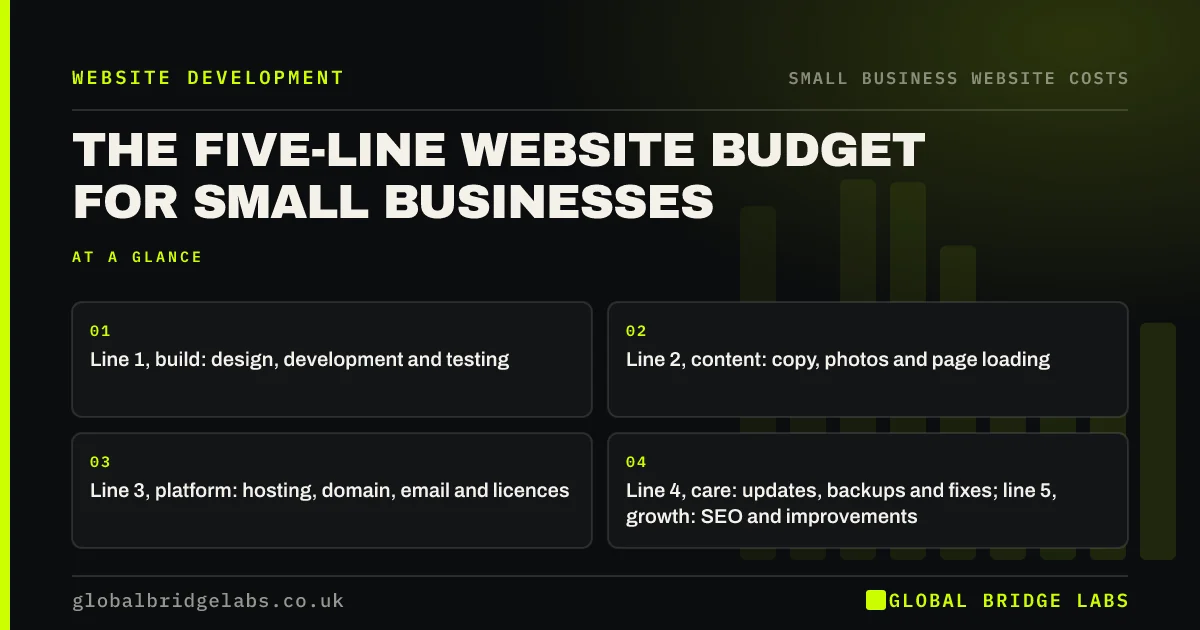
- Line 1, build: design, development and testing.
- Line 2, content: copy, photos and page loading.
- Line 3, platform: hosting, domain, email and licences.
- Line 4, care: updates, backups and fixes; line 5, growth: SEO and improvements.
Want the five-line budget template? Message us on WhatsApp.
Chat on WhatsApp →What is the five-line website budget?
The five-line website budget is a method from Global Bridge Labs (GBL) that splits every website cost into build, content, platform, care and growth. Each line has an owner and a figure before any quote is accepted. It stops the most common budgeting failure: paying for a build and then finding no money left to run or improve the site.
What goes in each line?
Each line covers a different kind of spend, some one-off and some recurring. Build and content are mostly one-off. Platform is a fixed annual or monthly bill. Care and growth are monthly and flex with ambition. Writing each line down separately shows what a website really costs to own, not just to launch.
- Build: design, development, integrations, testing, launch.
- Content: copywriting, photography, video, page population.
- Platform: hosting, domain, business email, plugins, apps.
- Care: security updates, backups, uptime checks, small edits.
- Growth: SEO, new pages, conversion tests, reporting.
How much should each line be for a small business?
For a typical UK small business lead generation site, indicative market ranges are build £2,000 to £7,000, content £500 to £2,500, platform £150 to £600 a year, care £50 to £200 a month and growth £0 to £500 a month. These are orientation figures, not a GBL price list.
- Build: £2,000 to £7,000 one-off.
- Content: £500 to £2,500 one-off.
- Platform: £150 to £600 a year.
- Care: £50 to £200 a month.
- Growth: £0 to £500 a month, flexing with goals.
Want the five lines filled in for your business? Message us on WhatsApp and we will discuss your requirements.
Chat on WhatsApp →Which line should you cut first if money is tight?
Cut growth first, then reduce content by supplying your own words and photos. Do not cut care: an unpatched site is a security risk, and the NCSC small business guide treats updates as a basic control. Build can shrink by starting from a good template rather than a custom design.
When does the five-line budget not fit?
It fits less well for pay monthly website plans, where build, platform and care are bundled into one subscription. Even then, list what the subscription covers against the five lines. Any line it does not cover, usually content and growth, still needs its own budget.
What does this look like in practice?
A UK cleaning company with eight staff had budgeted £3,500 for a new site. Filling in all five lines showed £4,200 for build and content, £300 a year for platform and £120 a month for care. They phased growth spend to month four, kept care in place from day one, and launched without a gap in cover.
Five-line budget checklist
- Write a figure against each of the five lines.
- Name an owner for each line.
- Separate one-off from monthly costs.
- Keep care funded from launch day.
- Review growth spend every quarter.
- Revisit the whole budget once a year.
Next step
Copy the five lines into a spreadsheet and fill in what you know. The blanks show where you need a quote or a decision.
Message us on WhatsApp for the five-line website budget template, or book a 30-minute consultation.
Chat on WhatsApp →Sources and further reading
- Business population estimates for the UK and regions 2025 · Department for Business and Trade
- SEO Starter Guide · Google Search Central
- Small Business Guide: cyber security · National Cyber Security Centre
Frequently asked questions
How do I budget for a small business website?
Split the budget into five lines: build, content, platform, care and growth. Put a figure against each before you request quotes. Treat build and content as one-off costs, platform as an annual bill, and care and growth as monthly costs, so the site is funded for its whole life, not just launch.
What ongoing costs should a website budget include?
A website budget should include hosting, domain, business email and any plugin or app licences, plus care for updates, backups and security. Most small businesses should also set aside a growth amount for SEO and improvements. Together these often run £100 to £400 a month for a typical lead generation site.
Is it better to spend more on build or on ongoing work?
For most small businesses, a sound mid-range build plus steady care and improvement beats an expensive build that is then left alone. A site that is updated, measured and improved each month tends to keep producing enquiries. Spend on build what you need for launch, and keep money for the months after.
Written by

Global Bridge Labs (GBL) is a UK–Sri Lanka partner for social media, websites and BPO. Everything here comes from client delivery, not theory.