On this page
- 01Key takeaways
- 02What does a web designer do?
- 03What does a conversion specialist do?
- 04How do they compare?
- 05Which do you need?
- 06What does each cost in the UK?
- 07What are the risks of choosing the wrong one?
- 08What does this look like in practice?
- 09Choosing checklist
- 10Next step
- 11Sources and further reading
- 12Frequently asked questions
Key takeaways
A web designer makes a website look right and work well. A conversion specialist makes it produce more enquiries or sales from the same traffic, using data, copy and testing. Most small businesses need both skills, but not always two suppliers. The right choice depends on whether your problem is how the site looks and works, or what it achieves.
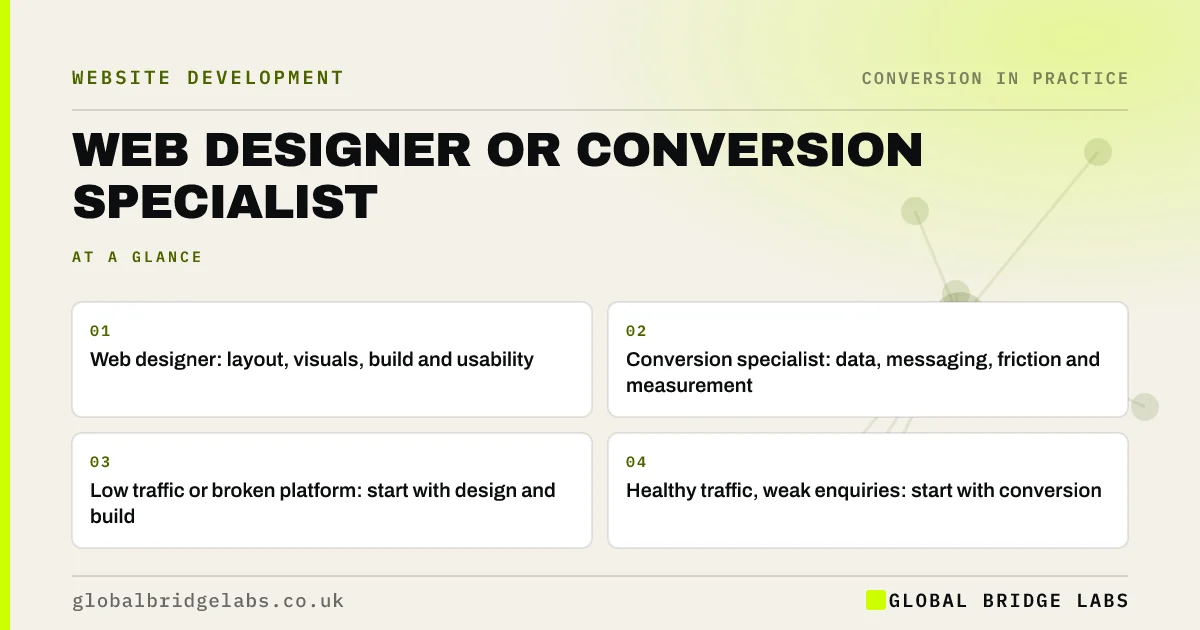
- Web designer: layout, visuals, build and usability.
- Conversion specialist: data, messaging, friction and measurement.
- Low traffic or broken platform: start with design and build.
- Healthy traffic, weak enquiries: start with conversion.
Not sure which you need? Send us your URL and numbers on WhatsApp.
Chat on WhatsApp →What does a web designer do?
A web designer plans and creates the look, layout and structure of a website, and often builds it. Good designers also consider usability and accessibility. Their measure of success is usually a site that looks professional, fits the brand and works on every device. That is a good website.
What does a conversion specialist do?
A conversion specialist, sometimes called a CRO (conversion rate optimisation) specialist, works on turning more visitors into customers. They set up tracking, analyse where visitors drop out, rewrite headlines and calls to action, add proof, reduce friction and test changes. Their measure of success is qualified enquiries or revenue per visitor.
How do they compare?
The two roles overlap but start from different questions.
- Starting question: designer asks 'how should this look?'; specialist asks 'why are visitors leaving?'
- Main tools: designer uses design software and code; specialist uses analytics, recordings and copy.
- Output: designer delivers a site; specialist delivers a stream of measured changes.
- Measure: designer judges quality and brand fit; specialist judges enquiries and revenue.
- Timing: designer works in projects; specialist works continuously.
Which do you need?
Start with a designer when the site is broken, badly dated, impossible to update or built on an unsupported platform. Start with a conversion specialist when the site works, gets steady traffic and still produces too few enquiries. If you are commissioning a new site, choose a supplier who brings conversion thinking into the design brief from the start.
- Broken, dated or unsupported site: designer and developer first.
- Working site, 1,000+ visits a month, weak enquiries: conversion first.
- New build: a team that does both, or both briefed together.
- Very low traffic: visibility before either.
Want a straight answer on which you need? Ask us on WhatsApp.
Chat on WhatsApp →What does each cost in the UK?
Indicative UK market ranges: a small business website redesign typically costs £3,000 to £12,000, and a rebuild £5,000 to £20,000 or more. Focused conversion work on existing pages typically costs £500 to £3,000 as a project, with ongoing conversion support often priced monthly. Ask any supplier what they will measure and how.
What are the risks of choosing the wrong one?
Hiring only a designer to fix a conversion problem often produces a better-looking site with the same enquiry rate. Hiring only a conversion specialist for a broken platform means fighting the technology on every change. Ask candidates for before-and-after numbers, not just portfolios.
What does this look like in practice?
A UK recruitment agency hired a designer twice to 'fix' low candidate and client enquiries. Each new site looked better and performed about the same. A conversion review found untracked calls, a 14-field client form and job pages with no apply button above the fold. Fixing those on the existing site lifted enquiries more than either redesign.
Choosing checklist
- Decide whether the problem is how the site works or what it achieves.
- Check whether tracking shows enquiries by source.
- Check traffic: over 1,000 visits a month suits conversion work.
- Ask suppliers for before-and-after numbers.
- Ask what they will measure and report.
- For a new build, brief design and conversion together.
Next step
Global Bridge Labs (GBL) brings design, build and conversion together for UK businesses, so the site looks right and earns its keep. If you are unsure which problem you have, we will tell you honestly.
Message us on WhatsApp for advice on who you need, or book a 30-minute consultation.
Chat on WhatsApp →Sources and further reading
- About key events · Google Analytics Help
- Minimise A/B testing impact in Google Search · Google Search Central
- About Microsoft Clarity (heatmaps and session recordings) · Microsoft
Frequently asked questions
What is the difference between a web designer and a CRO specialist?
A web designer creates the look, layout and build of a website. A conversion rate optimisation (CRO) specialist improves how many visitors become customers, using data, copy, friction fixes and testing. Designers deliver a site; conversion specialists deliver measured improvements.
Do I need a CRO specialist for a small business website?
If your site works, gets steady traffic and produces too few enquiries, conversion skills will help more than a redesign. You may not need a dedicated specialist; a web team that includes conversion work can cover it. Check your tracking first.
Can a web designer improve conversions?
Many can, especially when briefed with conversion goals and given access to data. Ask for evidence of results, such as before-and-after enquiry numbers, rather than only portfolio screenshots. Brief them with a conversion goal for each key page, and share analytics access so they can see how visitors actually behave.
How much does conversion optimisation cost in the UK?
Indicative UK market ranges for focused conversion work on existing pages are £500 to £3,000 as a project, with ongoing support often priced monthly. The value depends on your traffic and enquiry value, so compare cost with the likely lift.
Written by

Global Bridge Labs (GBL) is a UK–Sri Lanka partner for social media, websites and BPO. Everything here comes from client delivery, not theory.