On this page
- 01Key takeaways
- 02Is X still worth using for B2B?
- 03What does each platform do well?
- 04How do you test whether your sector is still there?
- 05What does keeping X cost if you are not using it?
- 06Where does LinkedIn genuinely fall short?
- 07What does this look like in practice?
- 08What should a maintained handle contain?
- 09Next step
- 10Sources and further reading
- 11Frequently asked questions
Key takeaways
LinkedIn is the default for UK B2B and X is now a specialist tool. X still works for technology, media, policy and finance communities where the conversation genuinely lives there. For everyone else it is a maintained handle, not a channel.
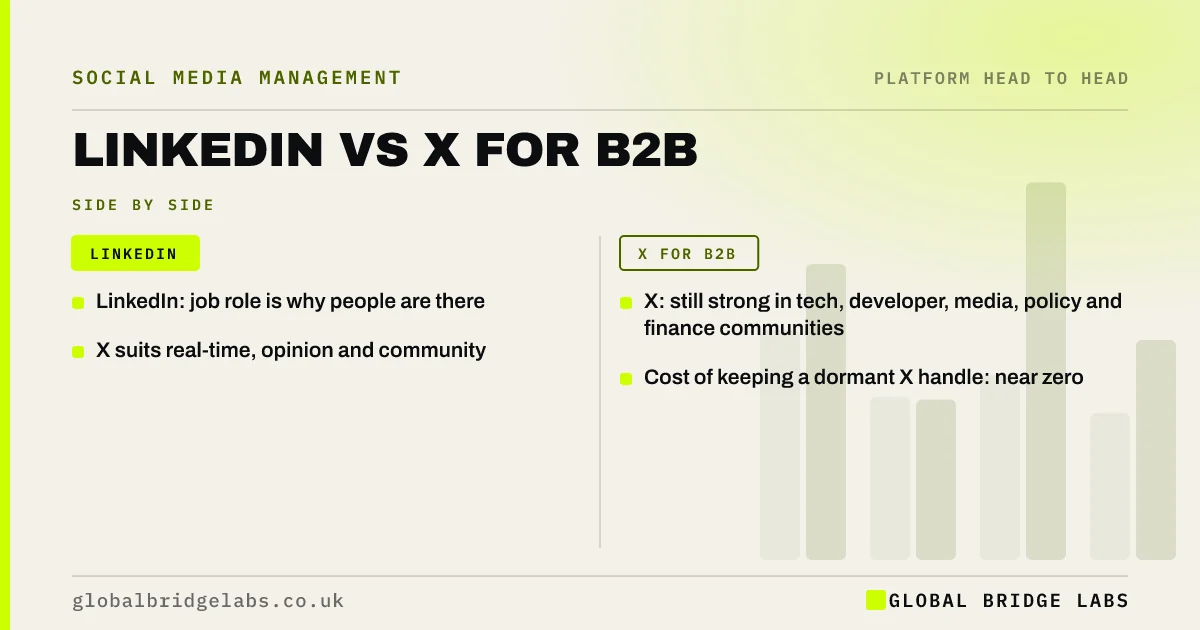
- LinkedIn: job role is why people are there. Default for almost all UK B2B.
- X: still strong in tech, developer, media, policy and finance communities.
- X suits real-time, opinion and community. It suits lead generation poorly.
- Cost of keeping a dormant X handle: near zero. Cost of half-running it: real.
- Decide on where your buyers talk, not on platform reach claims.
Unsure whether your sector still lives on X? Ask us on WhatsApp and we will check.
Chat on WhatsApp →Is X still worth using for B2B?
Only where your specific professional community still congregates there, which is a much shorter list than it was. Technology, software development, media, politics, policy and parts of finance retain genuinely active UK communities on X.
Outside those, most UK B2B conversation has moved to LinkedIn, and a business posting to X in, say, manufacturing, logistics or professional services is usually talking to an audience of bots, competitors and nobody.
What does each platform do well?
They are genuinely different tools rather than competing versions of the same thing, which is why the comparison confuses people.
- LinkedIn: credibility, job-role targeting, long-cycle B2B, and being checked before a call.
- X: real-time reaction, public conversation, reaching journalists and niche communities.
- LinkedIn content has a multi-day life. X content has a multi-hour life.
- LinkedIn rewards considered posts. X rewards presence and speed.
- LinkedIn produces enquiries. X produces relationships that sometimes become enquiries.
How do you test whether your sector is still there?
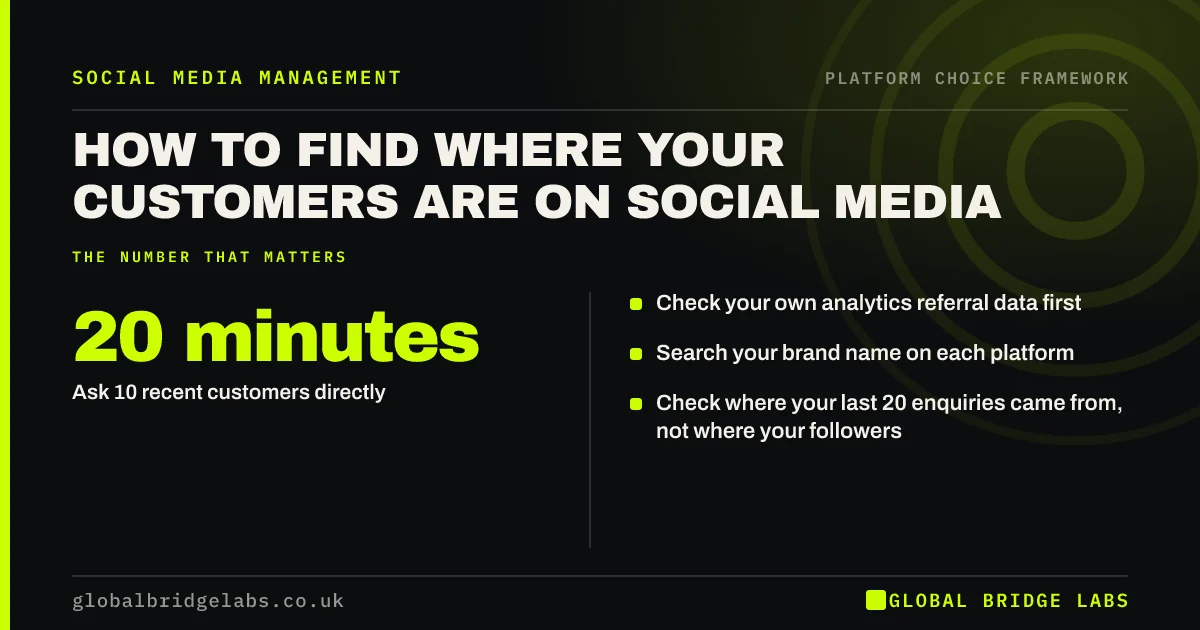
Search X for the three terms your buyers would use and read the last two weeks of results. You are looking for real practitioners talking to each other, not brands broadcasting and marketing accounts replying to each other.
Then check the five most relevant industry figures in your field. If they post weekly and get substantive replies, the community is live. If their last post is eight months old and links to a different platform, you have your answer without needing to argue about reach statistics.
We will run this check for your sector in an afternoon. Message us on WhatsApp.
Chat on WhatsApp →What does keeping X cost if you are not using it?
Almost nothing, if you do it properly, which is the argument for keeping the handle. Claim it, complete the profile, pin one post explaining what you do and where to find you, and leave it.
What costs is the middle position: posting sporadically, leaving replies unanswered, and letting the most recent post age into the previous year. A dormant-looking profile ranks for your brand name and suggests a business that may have stopped trading, which is a real cost for something producing no benefit.
Where does LinkedIn genuinely fall short?
Two places worth naming. It is poor for real-time reaction, so if your value is commentary on things as they happen, the format fights you. And its culture penalises informality in a way that makes some genuinely useful voices sound stilted.
It is also increasingly crowded, which raises the bar for being noticed. None of this outweighs job-role targeting for most UK B2B firms, but it explains why some technical and creative businesses still get better conversations elsewhere.
What does this look like in practice?
A UK software consultancy kept both channels running for a year. X produced almost no enquiries and three of its five best hires, because the developer community it needed genuinely lived there and saw the team talking about real engineering problems.
The correct decision was not to close X but to change what it was for. It became a recruitment and reputation channel with a stated goal and a named owner, at about an hour a week. LinkedIn kept the commercial job. Both worked because each was finally being judged on the right outcome.
What should a maintained handle contain?
Four things and nothing else: your real business name, a one-line description of what you do and for whom, a link to the channel you actually use, and a profile image that matches your other profiles.
Then pin one post saying where to find you. That is the whole job. It takes ten minutes, it costs nothing to maintain, and it means anyone who searches your brand name finds a profile that confirms you exist and points them somewhere useful rather than one that suggests you gave up in 2024.
Next step
Spend twenty minutes reading your sector's last two weeks on X. If practitioners are talking to each other, decide what the channel is for and give it a named owner and an hour a week. If they are not, complete the profile, pin a redirect and stop.
Message us on WhatsApp and we will tell you whether your community is still on X.
Chat on WhatsApp →Sources and further reading
- LinkedIn Pages best practices · LinkedIn
- Online Nation: how the UK uses online services · Ofcom
Frequently asked questions
Is X better than LinkedIn for B2B?
Rarely. LinkedIn is the default for UK B2B because job role is the reason people are there. X remains genuinely useful in technology, developer, media, policy and finance communities where practitioners still talk to each other publicly.
Should I delete my business X account?
No. Keep the handle, complete the profile and pin one post explaining what you do and where to find you. The damaging position is sporadic posting with unanswered replies, which makes the business look like it may have stopped trading.
How do I tell if my industry is still active on X?
Search your buyers' three key terms and read the last two weeks of results, looking for practitioners rather than brands. Then check five industry figures in your field: if they post weekly and get substantive replies, the community is live.
Can X be used for recruitment rather than sales?
Yes, and for technical businesses it is often the better use. Developer and specialist communities that ignore corporate marketing will engage with genuine discussion of the work, which makes X a reputation and hiring channel rather than a lead channel.
Written by
Global Bridge Labs (GBL) is a UK–Sri Lanka partner for social media, websites and BPO. Everything here comes from client delivery, not theory.