On this page
- 01Key takeaways
- 02Why is office space a scaling decision?
- 03What does a desk really cost?
- 04Which roles need to be in the building?
- 05What are the options before a bigger lease?
- 06How do the costs compare?
- 07When is a bigger office the right move?
- 08What does this look like in practice?
- 09Office space checklist
- 10Next step
- 11Sources and further reading
- 12Frequently asked questions
Key takeaways
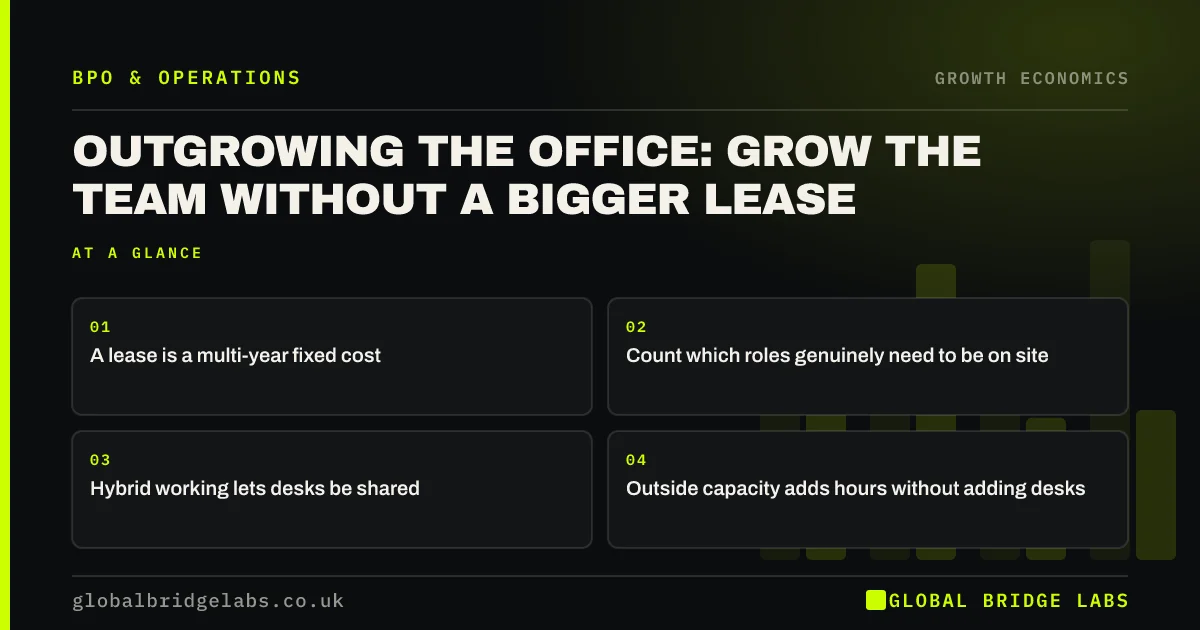
Outgrowing office space is a growth decision disguised as a property one. A bigger lease is a multi-year fixed cost taken on to house roles that may not need a desk. Before signing, check which work has to happen on site, share desks for hybrid staff, and consider supplying routine capacity from outside the building.
- A lease is a multi-year fixed cost. Demand is rarely that certain.
- Count which roles genuinely need to be on site.
- Hybrid working lets desks be shared.
- Outside capacity adds hours without adding desks.
About to sign for more space? Message us on WhatsApp with the roles you are making room for.
Chat on WhatsApp →Why is office space a scaling decision?
Office space is a scaling decision because it is one of the largest step costs a small business takes. Space comes in fixed sizes on fixed terms. A move made to fit three more desks commits the business to rent, rates, fit-out and service charges for years, whatever happens to sales.
What does a desk really cost?
A desk costs more than rent. Add business rates, service charge, utilities, insurance, furniture, equipment, connectivity and cleaning. If the total comes to an illustrative £350 a month per desk, five more desks are £21,000 a year before anyone sits at them. Work out your own figure from last year's premises costs divided by desks.
Which roles need to be in the building?
Fewer than most firms assume. Roles that handle physical goods, meet customers in person or use specialist equipment need to be on site. Roles that work entirely on a screen, such as customer email, order processing, invoicing, data entry and content production, can be done from anywhere with secure access.
- On site: warehouse, workshop, reception, client meetings.
- Anywhere: inbox, bookings, invoicing, data, marketing production.
What are the options before a bigger lease?
There are four options short of moving. Share desks among hybrid staff. Rent flexible space for the overflow on a monthly basis. Employ some roles remotely. Or supply screen-based work through a managed team, which adds capacity with no desk, equipment or premises cost on your side.
- Desk sharing for hybrid roles.
- Flexible or serviced space on short terms.
- Remote employees.
- A managed outside team for routine work.
- Remote employees vs outsourcing: which scales better?
- Scaling an outsourced team up and down: how it works
Want to discuss your requirements for capacity that needs no desk? Send us the roles on WhatsApp.
Chat on WhatsApp →How do the costs compare?
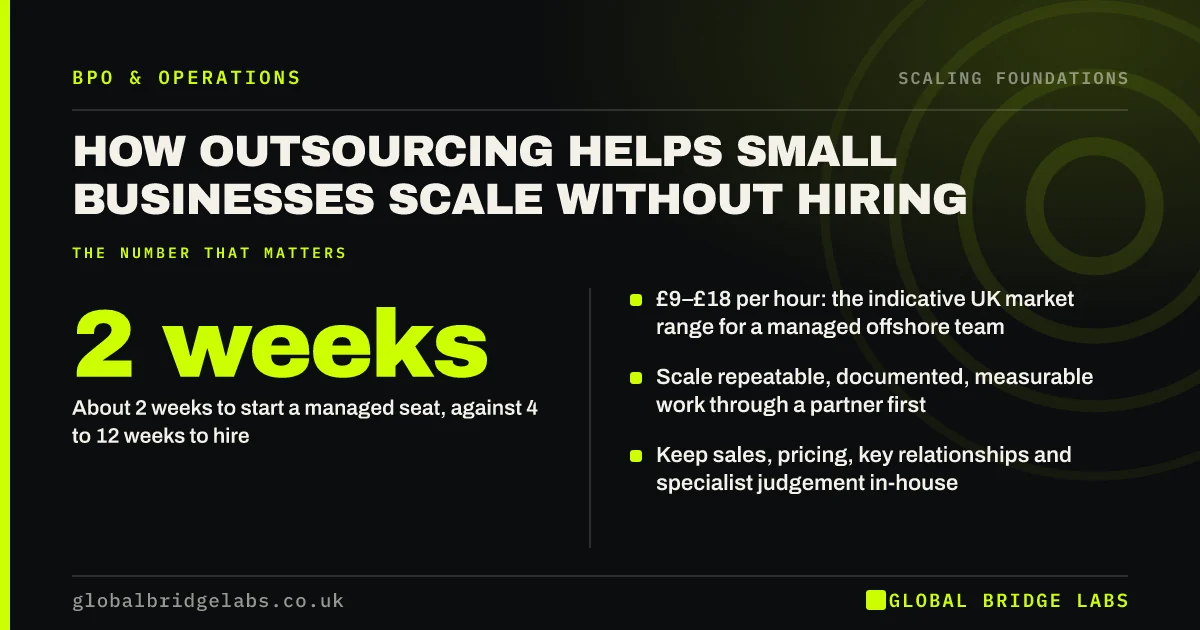
Compare the full annual cost of each planned role on site with the alternative. An employee adds the loaded employment cost, about £34,500 a year at a £30,000 salary, plus the desk. Managed offshore capacity is indicatively £9–£18 per hour with equipment and premises included in the rate.
When is a bigger office the right move?
A bigger office is right when the work must be done together or on site, when the current space is harming productivity or safety, or when the business has contracted growth that justifies the commitment. Culture and collaboration are real reasons too. They should be weighed against the fixed cost, not assumed.
What does this look like in practice?
A pattern we see in UK firms at about 15 people: the office is full, and the plan is a five-year lease on a larger unit to fit four new administrative hires. Looking at the roles, all four are screen-based. Running that work through a managed team keeps the existing office and avoids both the lease and the fit-out.
Office space checklist
Complete this before talking to an agent.
- Calculate your true annual cost per desk.
- List planned roles and whether each must be on site.
- Check actual desk occupancy across a normal week.
- Price flexible space for any overflow.
- Price screen-based roles as a managed service.
- Compare a new lease term with your revenue certainty.
Next step
Tell us how many desks you have, how many roles you plan to add and what they do. We will show which could be supplied without more space.
Message us on WhatsApp for a space and capacity review, or book a 30-minute consultation.
Chat on WhatsApp →Sources and further reading
- Rates and thresholds for employers 2026 to 2027 · HM Revenue & Customs
- National Minimum Wage and National Living Wage rates · GOV.UK
- Employing staff for the first time · GOV.UK
Frequently asked questions
What should I do when my business outgrows its office?
First check whether the roles you are adding need to be on site. Then consider desk sharing for hybrid staff, short-term flexible space, remote employees or a managed outsourced team for screen-based work. Move to a larger office when on-site work or collaboration justifies the long-term cost.
How much does office space cost per employee?
It varies widely by location and building. To find your own figure, add last year's rent, business rates, service charge, utilities, insurance, cleaning and connectivity, then divide by the number of desks. Add furniture and equipment for each new desk to get the cost of expansion.
Can a business grow without a bigger office?
Yes. Many businesses grow revenue and capacity in the same space by using hybrid working, remote staff and outsourced teams for work that does not need to be on site. The office then serves the roles and meetings that benefit from being together.
Is it better to lease a bigger office or use flexible space?
A lease is cheaper per desk over time but commits you for years. Flexible space costs more per desk but can be ended at short notice. Where growth is uncertain, flexible space or outside capacity limits risk. Where growth is contracted, a lease may be better value.
Written by

Global Bridge Labs (GBL) is a UK–Sri Lanka partner for social media, websites and BPO. Everything here comes from client delivery, not theory.