On this page
- 01Key takeaways
- 02Why does a trial need phases?
- 03What happens in the first four weeks?
- 04What changes in the optimisation phase?
- 05Why should the last four weeks be unchanged?
- 06Why review only once?
- 07What does this look like in practice?
- 08Who runs the trial?
- 09Next step
- 10Sources and further reading
- 11Frequently asked questions
Key takeaways
Run a channel trial in three phases across 13 weeks: four weeks of production discipline, five weeks of optimisation, four weeks of measurement. Review only at week 13, because reviewing earlier produces panic rather than information.
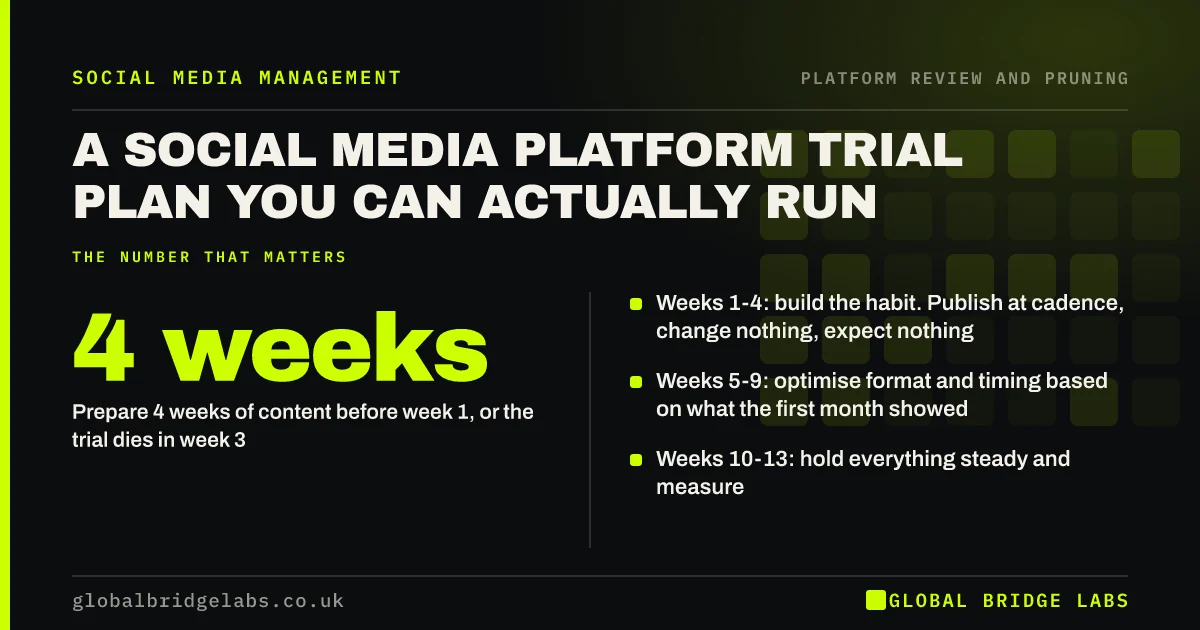
- Weeks 1-4: build the habit. Publish at cadence, change nothing, expect nothing.
- Weeks 5-9: optimise format and timing based on what the first month showed.
- Weeks 10-13: hold everything steady and measure. No changes during this phase.
- Review once, at week 13. Mid-trial reviews destroy more trials than poor results.
- Prepare 4 weeks of content before week 1, or the trial dies in week 3.
Want the 13-week trial plan for your business? Ask for it on WhatsApp.
Chat on WhatsApp →Why does a trial need phases?
Because doing everything at once produces a result you cannot interpret. If you change format, timing and frequency simultaneously while also learning the platform, you will have no idea what caused what.
Phasing separates habit-building from optimisation from measurement. Each phase answers a different question, and the sequence means the final four weeks measure a settled operation rather than a moving target.
What happens in the first four weeks?
Production discipline, and nothing else. The only goal is publishing at the required cadence without missing, which is harder than it sounds and is where most trials fail.
- Prepare 4 weeks of content before week 1 begins. This is non-negotiable.
- Publish at cadence. Do not change format based on early results.
- Reply to everything within one working day.
- Record time spent honestly each week. You will need it at week 13.
- Expect poor numbers. Every new account performs badly for a month.
What changes in the optimisation phase?
One variable at a time, with a week between changes so you can attribute the effect. Weeks five to nine are where you learn what this specific platform rewards for your specific business.
Typical changes in order of return: the opening three seconds or first line, posting time, format mix, and call to action. Change one, hold for a week, note the effect, then change the next. Resist the urge to overhaul everything after a single good post.
We will run the optimisation phase for you. Message us on WhatsApp.
Chat on WhatsApp →Why should the last four weeks be unchanged?
Because you need a stable period to measure. If you are still adjusting in week 12, your week-13 numbers describe an experiment in progress rather than a channel you could run for a year.
Hold format, cadence and timing steady from week 10 and record the results. This is the period that answers the actual question: if we ran this channel like this indefinitely, what would it produce?
Why review only once?
Because mid-trial reviews kill more trials than poor results do. Week-three numbers are always bad, and a review at week three produces either abandonment or a panicked change of direction, both of which waste the work already done.
Tell everyone involved, in advance, that there will be no review until week 13. That single agreement is worth more to the success of a trial than any tactical decision you will make during it.
What does this look like in practice?
A UK veterinary practice trialled a new channel with four weeks of content prepared in advance, a fixed cadence, and a stated week-13 review. In week four the owner wanted to stop; the agreement held.
By week nine the format had settled into short clips answering the questions asked at reception. By week 13 the channel was producing consistent new client registrations. It would have been abandoned in week four under any normal review cycle, which is the whole argument for the plan.
Who runs the trial?
One named person, for the full thirteen weeks, with the time genuinely protected. A trial shared between two people without an owner reliably produces gaps, because each assumes the other posted.
That person also needs the authority to make the small decisions during the optimisation phase without asking. A trial where every format change requires a meeting will not complete five weeks of optimisation in five weeks.
If the person running it changes mid-trial, restart the clock. Handovers reset the learning, and a trial completed by two people in sequence tells you about the handover rather than about the channel.
Give them a named backup for holidays, agreed before week one. A fortnight's gap in the middle of a thirteen-week trial invalidates the result, and holidays are the most predictable interruption there is.
If nobody can own thirteen weeks, that is a capacity finding and worth acting on before the trial rather than after it.
Next step
Before you start any new channel, block four weeks of content production and put a single review date 13 weeks out in the calendar. Those two acts do more for the outcome than any amount of tactical planning.
Message us on WhatsApp and we will build your 13-week trial schedule.
Chat on WhatsApp →Sources and further reading
- Meta Business Help Centre · Meta
- Google Search Console · Google
Frequently asked questions
How should you structure a social media channel trial?
Three phases across 13 weeks: four weeks building production discipline with no changes, five weeks optimising one variable at a time, then four weeks holding everything steady in order to measure. Review once, at week 13, and not before.
Why should you not review a channel trial early?
Because week-three numbers are always poor for a new account, so an early review produces either abandonment or a panicked change of direction, and both waste the work already done. Mid-trial reviews kill more trials than genuinely poor results ever do.
How much content do you need before starting a trial?
Four weeks of content, prepared before week one begins. Trials that start with only a fortnight in hand reliably fail in week three, when the production pressure arrives at exactly the same moment as the first disappointing set of numbers.
What should you optimise first in a channel trial?
The opening three seconds or first line, then posting time, then format mix, then call to action. Change one variable at a time with a week between changes, so you can attribute any effect to the change that caused it.
Written by
Global Bridge Labs (GBL) is a UK–Sri Lanka partner for social media, websites and BPO. Everything here comes from client delivery, not theory.