On this page
- 01Key takeaways
- 02How often should social media be reviewed?
- 03What belongs in the weekly review?
- 04What belongs in the quarterly review?
- 05What belongs in the annual review?
- 06Which reviews do harm?
- 07What does this look like in practice?
- 08What should you record at each review?
- 09Next step
- 10Sources and further reading
- 11Frequently asked questions
Key takeaways
Review content weekly, channel performance quarterly and channel choice annually. Reviewing channel choice monthly is the most common and most damaging reporting mistake, because no channel can prove itself in four weeks.
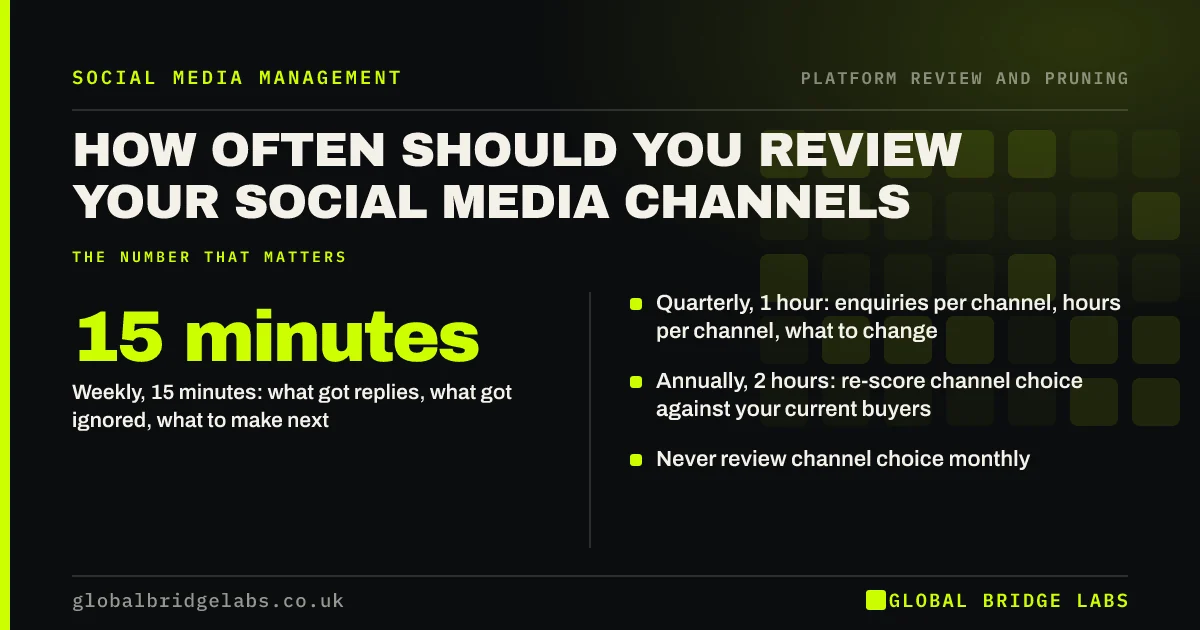
- Weekly, 15 minutes: what got replies, what got ignored, what to make next.
- Quarterly, 1 hour: enquiries per channel, hours per channel, what to change.
- Annually, 2 hours: re-score channel choice against your current buyers.
- Never review channel choice monthly. It produces churn, not improvement.
- The same metrics every time. Changing definitions destroys the trend.
Want a review rhythm that produces decisions? Message us on WhatsApp.
Chat on WhatsApp →How often should social media be reviewed?
At three different frequencies, because three different questions need answering. Weekly for content, quarterly for channel performance, annually for channel choice. Collapsing these into one monthly review is where most reporting goes wrong.
The failure mode is reviewing strategic questions at tactical frequency. Asking whether a channel is working every month guarantees the answer is no, because most channels take two to three quarters to produce a reliable signal.
What belongs in the weekly review?
Fifteen minutes, content only, and no strategic questions allowed.
- Which posts got replies or messages, not which got likes.
- Any question asked twice, which is next week's content.
- Anything unanswered in the inbox. Clear it before anything else.
- What to make next week, decided now rather than on the day.
- Nothing about whether the channel is working. That is a quarterly question.
What belongs in the quarterly review?
One hour, channel performance, with the same numbers every time. Enquiries per channel, hours spent per channel, average reply time, and what changed since last quarter.
This is the review where you decide to change cadence, format or effort split. It is not where you close channels, unless the evidence has been accumulating for two consecutive quarters. Quarterly reviews that produce closures on one quarter's data are just monthly reviews with a longer gap.
We will run your quarterly channel review with you. Ask on WhatsApp.
Chat on WhatsApp →What belongs in the annual review?
Two hours, and a genuine re-examination of whether these are still the right channels for who you now sell to. Businesses change faster than their marketing does, and a channel chosen for the customer you had three years ago may be entirely wrong for the customer you have now.
Re-score every channel against your current buyers, your current capacity and your current goals. This is also when you check whether any channel has drifted into being maintained out of habit, which is easy to spot annually and invisible quarterly.
Which reviews do harm?
Monthly strategic reviews, reviews with changing metric definitions, and reviews with no decision attached.
The last one is the quietest problem. A review that produces a report and no change is a cost with no return, and after three of them people stop preparing properly. Every review should end with something specific that will be different next period, even if that something is deliberately nothing.
What does this look like in practice?
A UK electrical contractor reviewed social media monthly with a detailed report, and changed direction roughly every other month based on what the previous four weeks showed.
Two years produced no cumulative progress, because nothing ran long enough to work. Moving to a 15-minute weekly content review and a proper quarterly performance review, with no monthly meeting at all, produced the first year of genuine improvement, mainly because a strategy finally survived long enough to be tested.
What should you record at each review?
The same fields every time, in the same place, so a year of reviews reads as a trend rather than as a pile of separate documents.
For the quarterly review that is: enquiries per channel, hours spent per channel, average reply time, what changed since last quarter, and one decision. Five fields. Anything more elaborate stops being filled in by the third quarter, which is exactly when the trend becomes useful.
Keep them where the next person can find them. Channel decisions get reversed most often when the reasoning was in someone's head and that person has moved on.
For the weekly review, record nothing formal at all. Fifteen minutes is not long enough to both think and write, and a weekly log that nobody reads is exactly the kind of process that makes people resent reviewing anything. The quarterly record is the one that has to survive.
One person owns the record, and it lives somewhere the whole team can open. A review history kept in a personal inbox is a review history that ends when that person leaves, which is exactly when you most need to know why a channel was chosen.
Next step
Put three recurring entries in the calendar: 15 minutes weekly, one hour quarterly, two hours annually. Then cancel any monthly social media meeting you currently hold, because it is almost certainly producing churn rather than improvement.
Message us on WhatsApp and we will set up your review rhythm and templates.
Chat on WhatsApp →Sources and further reading
- Google Search Console · Google
- About key events · Google Analytics Help
Frequently asked questions
How often should you review social media performance?
Content weekly in 15 minutes, channel performance quarterly in an hour, and channel choice annually in two hours. Three different questions need three different frequencies, and collapsing them into one monthly review causes most reporting problems.
Why are monthly social media reviews a problem?
Because they ask strategic questions at tactical frequency. Most channels take two to three quarters to produce a reliable signal, so a monthly assessment of whether a channel works guarantees the answer is no and produces constant direction changes.
What should a quarterly channel review cover?
Enquiries per channel, hours spent per channel, average reply time, and what changed since last quarter, using the same definitions every time. Decide on cadence, format and effort split, but close channels only on two consecutive quarters of evidence.
What makes a social media review useless?
Changing metric definitions between reviews, which quietly destroys the trend, and producing a report with no decision attached to it. After three reviews that change nothing, people stop preparing properly and the whole exercise becomes a cost with no return.
Written by
Global Bridge Labs (GBL) is a UK–Sri Lanka partner for social media, websites and BPO. Everything here comes from client delivery, not theory.