On this page
- 01Key takeaways
- 02What makes a platform test valid?
- 03How long should the test run?
- 04Where do the hours come from?
- 05What should you measure?
- 06What does a fair stop rule look like?
- 07What does this look like in practice?
- 08What do you do if the test nearly passes?
- 09Next step
- 10Sources and further reading
- 11Frequently asked questions
Key takeaways
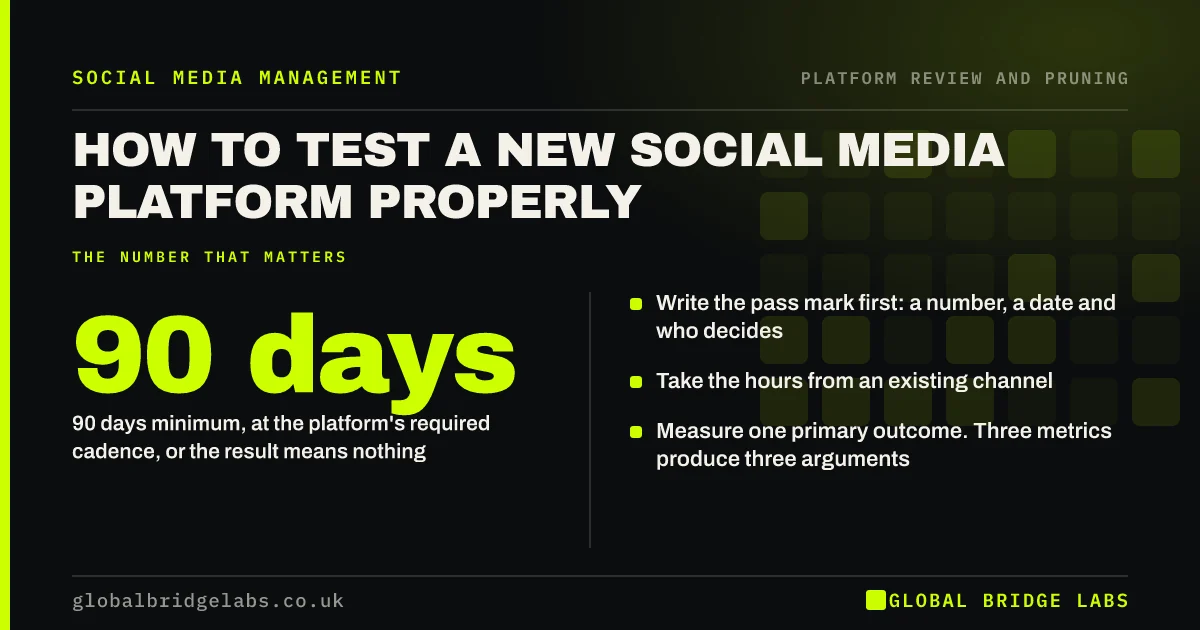
Write the success threshold before the first post, run for 90 days at the cadence the platform requires, and take the hours from an existing channel rather than from nowhere. A test without a threshold is not a test, it is an addition.
- Write the pass mark first: a number, a date and who decides.
- 90 days minimum, at the platform's required cadence, or the result means nothing.
- Take the hours from an existing channel. Nobody has spare hours.
- Measure one primary outcome. Three metrics produce three arguments.
- Agree the stop rule in advance so ending it is not a defeat.
Thinking of trying a new channel? We will design the test on WhatsApp.
Chat on WhatsApp →What makes a platform test valid?
A written threshold, a fixed duration and a real commitment of hours. Without all three, what you run is not a test but a slow drift into an extra channel nobody decided to keep.
The threshold is the part almost everyone skips. Write down, before you start, what result would make you commit and what result would make you stop. It takes ten minutes and it prevents the far more expensive outcome of a channel that continues indefinitely because nobody wants to call it.
How long should the test run?
Ninety days, at the cadence that platform genuinely requires. Shorter tests measure the cold-start problem rather than the channel, because every platform performs badly for a new account in the first few weeks.
- TikTok: 90 days at 4-7 posts a week. Below that, no signal.
- Instagram: 90 days at 2-3 reels and a feed post weekly.
- LinkedIn: 120 days, because B2B cycles are longer than the test window.
- Pinterest: 120 days minimum. It accumulates rather than spikes.
- Any platform: replies within one working day for the whole period.
Where do the hours come from?
From an existing channel, temporarily and explicitly. This is uncomfortable and it is the only honest way to run a test, because nobody in a small business has spare hours and a test funded from nowhere will be starved within a fortnight.
Name the channel that will get less attention during the test and accept the dip. If no channel can spare the hours, you do not have capacity for a test, and knowing that is a useful result in itself.
We can run the test channel so your existing ones do not suffer. Ask on WhatsApp.
Chat on WhatsApp →What should you measure?
One primary outcome and two supporting indicators, decided in advance. Measuring everything guarantees that someone can argue for any conclusion at the end.
For most UK small businesses the primary outcome should be qualified conversations started, because it is the closest measure to revenue that a 90-day window can produce. Reach and follower growth are supporting indicators at best; they tell you whether the content is working, not whether the channel is worth keeping.
What does a fair stop rule look like?
Specific, and agreed by the person who will have to accept it. For example: if this produces fewer than four qualified conversations by day 90, we close it and return the hours to the primary channel, and the marketing lead makes that call without needing to justify it.
The value of writing it down is that stopping stops being a personal failure. Tests that end cleanly make the next test easier to fund; tests that drift make everyone reluctant to try anything.
What does this look like in practice?
A UK kitchen manufacturer tested short-form video with a written threshold of six qualified enquiries in 90 days, at five posts a week, with hours taken from a channel that was under-performing anyway.
It produced two. The channel was closed on day 91 without argument, because the threshold had been agreed in February and nobody had to defend a position in May. The business then tested a different channel the following quarter, which it would not have done if the first test had ended in a row.
What do you do if the test nearly passes?
Decide in advance that nearly passing means stopping, because otherwise every test nearly passes. A threshold you are willing to soften afterwards was never a threshold.
The defensible exception is a clear upward trend in the final month with a specific reason behind it, such as a format that only settled in week ten. In that case extend by one quarter with the same threshold, once, and state that it is the only extension.
What you must not do is convert a failed test into an ongoing channel through inertia. That is how a business with two working channels ends up with four, and it happens gradually enough that nobody notices the decision being made.
Next step
Before you post anything on a new channel, write one sentence: by [date] this must produce [number] of [outcome] or we stop. If you cannot write that sentence, you are not ready to test the channel.
Message us on WhatsApp and we will write the test plan and threshold with you.
Chat on WhatsApp →Sources and further reading
- TikTok for Business · TikTok
- Pinterest Business help: get started · Pinterest
Frequently asked questions
How long should you test a new social media platform?
Ninety days at the cadence the platform genuinely requires, and 120 days for LinkedIn or Pinterest, where results accumulate slowly rather than spiking. Shorter tests mostly measure the cold-start problem every new account faces rather than the channel itself.
What should you measure when testing a channel?
One primary outcome, usually qualified conversations started, plus two supporting indicators, all decided before you begin. Measuring everything guarantees that someone can argue for any conclusion at the end, which defeats the point of testing anything.
Where should the hours for a new channel come from?
From an existing channel, explicitly and temporarily. Nobody has spare hours, so a test funded from nowhere gets starved within a fortnight. If no channel can spare them, you lack capacity, which is itself a useful finding.
How do you stop a channel test without it feeling like failure?
Agree the stop rule in writing before you start, including who makes the call. Tests that end cleanly make the next one easier to fund; tests that drift make everyone reluctant to try anything new again.
Written by

Global Bridge Labs (GBL) is a UK–Sri Lanka partner for social media, websites and BPO. Everything here comes from client delivery, not theory.