On this page
- 01Key takeaways
- 02What are social media platform selection criteria?
- 03Which seven criteria actually predict success?
- 04Why is buyer presence weighted double?
- 05How do you score production cost honestly?
- 06What does a scored comparison look like?
- 07When do these criteria give you the wrong answer?
- 08What does this look like in practice?
- 09Who should be in the room when you score?
- 10Next step
- 11Sources and further reading
- 12Frequently asked questions
Key takeaways
Social media platform selection criteria are the fixed tests a channel must pass before it earns a place in your plan. Score every candidate on seven criteria, weight the first three double, and keep only the two highest scorers. Everything else is a handle you claim and leave.
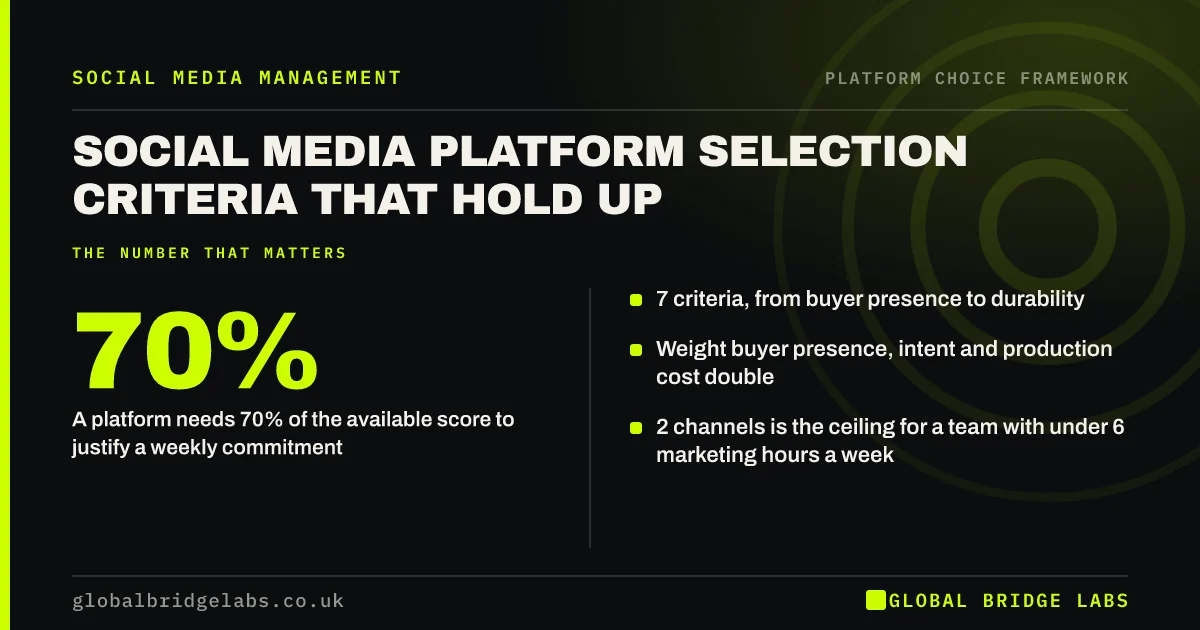
- 7 criteria, from buyer presence to durability. Three are weighted double.
- Weight buyer presence, intent and production cost double. They cause most failed channels.
- A platform needs 70% of the available score to justify a weekly commitment.
- 2 channels is the ceiling for a team with under 6 marketing hours a week.
- Re-score every 12 months. Platform fit decays faster than brand or product fit.
Want your channels scored against these seven criteria? Send us your sector on WhatsApp.
Chat on WhatsApp →What are social media platform selection criteria?
They are the written tests you apply to every candidate channel so the decision stops being a matter of taste. Without them, platform choice defaults to whichever channel the loudest person in the room enjoys using, which is how UK small businesses end up with five half-maintained profiles.
Global Bridge Labs (GBL) uses seven. Three are about the buyer, two are about you, and two are about whether the result can be trusted over time. The order matters, because a platform that fails the first criterion cannot be rescued by scoring well on the rest.
Which seven criteria actually predict success?
Each criterion is scored 0 to 5. The first three are doubled, giving a maximum of 50 points. Anything under 35 is not a channel, it is a hobby.
- Buyer presence (x2): do the people who sign your invoices use this platform weekly?
- Buying intent (x2): do people arrive open to discovering a supplier, or only to be entertained?
- Production cost (x2): can you make the native format every week for a year without heroics?
- Format fit: does your work look good in the format the platform rewards right now?
- Competitive gap: is there room to be noticed, or are ten better-funded rivals already there?
- Measurability: can you trace an enquiry back to the channel within 30 days?
- Durability: will the format still exist in three years, or is it a trend surface?
Why is buyer presence weighted double?
Because it is the only criterion you cannot influence. You can lower production cost with better systems and you can find a competitive gap with a sharper angle, but you cannot move your buyers onto a platform they do not use.
Ofcom's Online Nation research shows UK platform use is broad in aggregate and sharply segmented by age and purpose. A platform used by 70% of UK adults may still be used by almost none of the facilities managers who buy from you. Aggregate reach figures are the most misleading numbers in platform selection.
How do you score production cost honestly?
Score it against your worst month, not your best. The question is not whether you can make four reels this week. It is whether you can make four reels in the week a major client project goes wrong and two people are off sick.
As a working guide, a text-first channel costs 2-3 hours a week, a photo-led channel 4-6 hours, and a video-led channel 5-8 hours once editing and community replies are counted. Businesses routinely score video channels at 4 out of 5 on production cost, then discover the honest answer was 2.
We will cost your channel plan in real weekly hours before you commit. Message us on WhatsApp.
Chat on WhatsApp →What does a scored comparison look like?
A worked example for a UK commercial cleaning firm selling to office managers, scored out of 50.
- LinkedIn: presence 5, intent 4, production 4, fit 3, gap 3, measurability 4, durability 4. Total 41. Keep as primary.
- Facebook: presence 3, intent 2, production 4, fit 3, gap 4, measurability 3, durability 4. Total 32. Reject.
- Instagram: presence 2, intent 2, production 3, fit 4, gap 3, measurability 3, durability 4. Total 28. Reject.
- TikTok: presence 1, intent 1, production 1, fit 2, gap 5, measurability 2, durability 3. Total 18. Handle only.
- Google Business Profile: presence 5, intent 5, production 5, fit 3, gap 3, measurability 5, durability 5. Total 46. Keep.
When do these criteria give you the wrong answer?
Three situations. When your buyer is not your influencer, as in healthcare and education, where the person who chooses is not the person who lobbies for you. When you are hiring rather than selling, because candidate presence and buyer presence are rarely the same platform. And when you are building a brand deliberately ahead of demand, where a low intent score is the point rather than the problem.
The criteria also under-rate channels whose value is defensive. A maintained profile that stops a prospect wondering whether you are still trading earns its keep at almost zero effort, and no scoring model captures that well.
What does this look like in practice?
A pattern we see across UK professional services: four channels, all scoring in the twenties, because the firm chose by habit rather than by test. Reach looks acceptable, enquiries from social sit near zero, and nobody can say which channel to cut because nobody wrote down what good looked like.
Scoring the channels takes about 40 minutes with the marketing lead and one salesperson in the room. The salesperson matters more than the marketer, because they are the one who hears where enquiries actually come from. The usual result is two channels kept, two closed properly, and the freed hours moved into the channel that scored highest on intent.
Who should be in the room when you score?
Whoever owns marketing, whoever owns sales, and whoever will actually produce the content. Three people, 40 minutes. Scoring alone produces a defensible document that nobody else believes, which is worse than no document at all.
The salesperson matters most because they hear where enquiries come from, and their answer frequently contradicts the marketing assumption. The producer matters because they are the only person who can score production cost honestly, and production cost is the criterion most often inflated by people who will not be doing the work.
Next step
Write the seven criteria across the top of a sheet, list every platform you currently touch down the side, and score them with a salesperson present. The channels you should close are usually obvious within 20 minutes, and closing them is what frees the hours that make the remaining two work.
Message us on WhatsApp and we will run the platform scoring session with your team.
Chat on WhatsApp →Sources and further reading
Frequently asked questions
How many criteria should you use to choose a social media platform?
Seven is enough: buyer presence, buying intent, production cost, format fit, competitive gap, measurability and durability. Fewer than five misses a failure mode. More than ten makes the scores impossible to agree on, which defeats the purpose of writing criteria down at all.
What is the most important criterion when choosing a platform?
Buyer presence, because it is the only one you cannot change. You can improve production systems, sharpen your angle and fix measurement. You cannot move your buyers onto a platform they do not use, so a low presence score should end the discussion.
Should small businesses use the same criteria as large brands?
The criteria are the same; the weightings are not. A small business should weight production cost far higher, because it is the constraint that actually breaks the plan. A large brand with an agency retainer can afford channels a two-person team cannot sustain.
How often should platform selection criteria be re-scored?
Once a year, and immediately after any change to what you sell or who you sell it to. Platform fit decays faster than brand or product fit, because formats, algorithms and audience ages all shift underneath a channel that was well chosen two years ago.
Written by
Global Bridge Labs (GBL) is a UK–Sri Lanka partner for social media, websites and BPO. Everything here comes from client delivery, not theory.