On this page
- 01Key takeaways
- 02What is a social media discount code?
- 03When does a discount code pay off?
- 04How big should the discount be?
- 05How do you track sales from codes?
- 06What UK rules apply to discount codes?
- 07What are the risks of discount codes?
- 08What does this look like in practice?
- 09Discount code checklist
- 10Next step
- 11Sources and further reading
- 12Frequently asked questions
Key takeaways
Discount codes for social media followers pay off when they win a first purchase from someone likely to buy again, and when they let you track which posts drive sales. They lose money when they go to people who would have paid full price anyway. Use one code per channel, set a limit and an end date, and check repeat purchases.
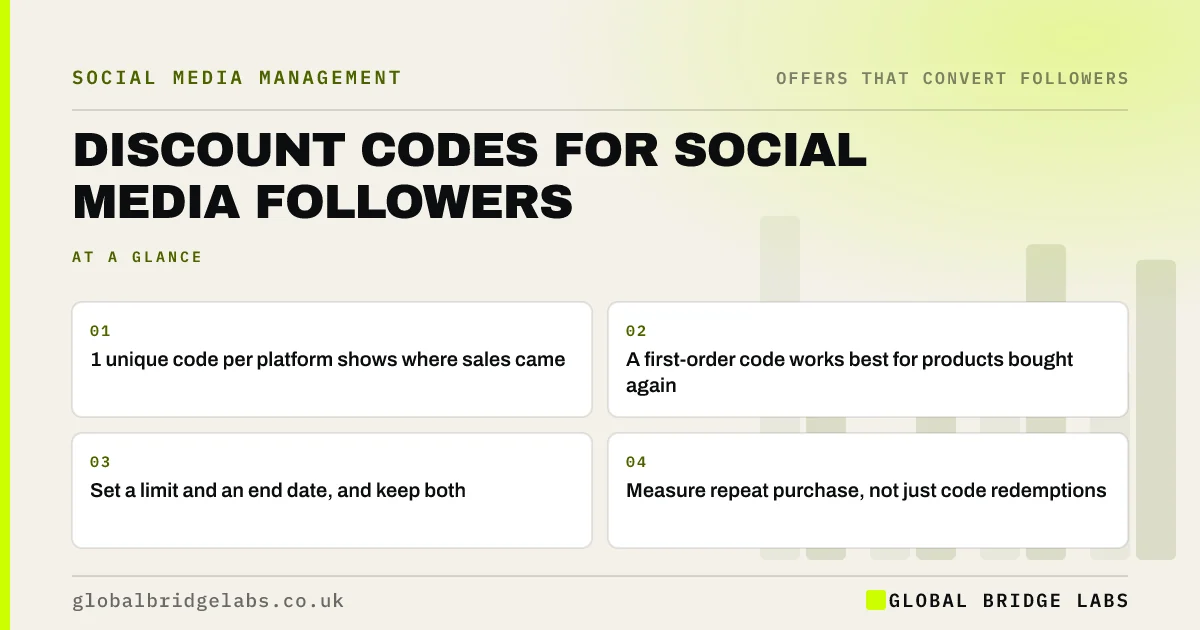
- 1 unique code per platform shows where sales came from.
- A first-order code works best for products bought again.
- Set a limit and an end date, and keep both.
- Measure repeat purchase, not just code redemptions.
Want your discount strategy checked? Message us on WhatsApp.
Chat on WhatsApp →What is a social media discount code?
A social media discount code is a word or string, such as INSTA10, that followers enter at checkout or quote to receive a reduced price, shared only through a business's social media accounts. It acts as both an incentive to buy and a simple way to track which channel produced the sale.
When does a discount code pay off?
A discount code pays off when the extra customers it wins, and their later purchases, are worth more than the margin given away. It suits products people buy repeatedly, such as food, beauty and consumables, because the first order is the hard one. It rarely suits one-off high-value services, where it signals that the price is negotiable.
- Good fit: repeat products, first orders, slow periods.
- Poor fit: one-off services, premium positioning, busy periods.
How big should the discount be?
Set the discount by working back from margin. An illustrative case: a £40 product with a 50% gross margin makes £20. A 10% code costs £4 and leaves £16. A 30% code costs £12 and leaves £8, so you would need 2.5 times as many extra sales just to stand still. Small, clear discounts with free delivery often beat large ones.
Want to know what discount your margin can afford? Message us on WhatsApp and we will discuss your requirements.
Chat on WhatsApp →How do you track sales from codes?
Track sales by giving each platform its own code, such as IG10 and FB10, and recording redemptions in your shop or till. Pair this with tagged links in Google Analytics 4 (GA4) for online sales. Codes also catch in-store and phone sales that links miss.
What UK rules apply to discount codes?
A discount code is a sales promotion under the CAP Code, so state significant conditions such as minimum spend, exclusions and the closing date. Any "was" price you compare against must be genuine. Under the Digital Markets, Competition and Consumers Act 2024, misleading price claims and fake deadlines can lead to Competition and Markets Authority fines.
What are the risks of discount codes?
The risks are training followers to wait for a code, attracting bargain hunters who do not return, and codes leaking to voucher sites so that full-price buyers use them. Limit uses per customer, set end dates, and stop codes that appear on voucher sites.
What does this look like in practice?
A pattern we see in e-commerce: one generic code that runs all year, shared everywhere, so nobody knows where sales come from and margin leaks steadily. Separate codes per channel with end dates usually show quickly which platform earns its discount.
Discount code checklist
- Work out the discount from your margin.
- Create one code per platform.
- State minimum spend, exclusions and the end date.
- Limit uses per customer.
- Track redemptions and repeat orders.
- Retire codes that leak to voucher sites.
Next step
Check how many current customers used a code on their first order, and how many came back. That tells you whether the code is buying customers or just discounts.
Message us on WhatsApp and we will review your codes, or book a 30-minute consultation.
Chat on WhatsApp →Sources and further reading
- UK Code of Non-broadcast Advertising and Direct & Promotional Marketing (CAP Code) · ASA / CAP
- Digital Markets, Competition and Consumers Act 2024 · legislation.gov.uk
- Unfair commercial practices guidance (CMA207) · Competition and Markets Authority
- URL builders: collect campaign data with custom URLs · Google Analytics Help
Frequently asked questions
Do discount codes work on social media?
They work for winning first orders on products people buy again, and for tracking which platform drives sales. They work less well for one-off services, where they suggest prices are negotiable. Judge them on repeat purchases and margin, not on how many codes were redeemed.
What percentage discount should I offer followers?
Work back from your margin. Small discounts of around 10%, or free delivery, often win first orders without destroying profit. Larger discounts need many more extra sales to break even. Check how much gross profit is left on the order after the discount before deciding.
Do I need terms and conditions for a discount code?
Yes. The CAP Code expects significant conditions, such as minimum spend, exclusions, limits and the closing date, to be clear before people take part. Keep them short and link to them from the post or the page where the code is used.
Written by

Global Bridge Labs (GBL) is a UK–Sri Lanka partner for social media, websites and BPO. Everything here comes from client delivery, not theory.