On this page
- 01Key takeaways
- 02What are urgency and scarcity in marketing?
- 03What does UK law say?
- 04Which urgency tactics are not allowed?
- 05Which honest reasons to act now work?
- 06Does urgency actually help small businesses sell?
- 07When should you not use urgency?
- 08What does this look like in practice?
- 09Fair urgency checklist
- 10Next step
- 11Sources and further reading
- 12Frequently asked questions
Key takeaways
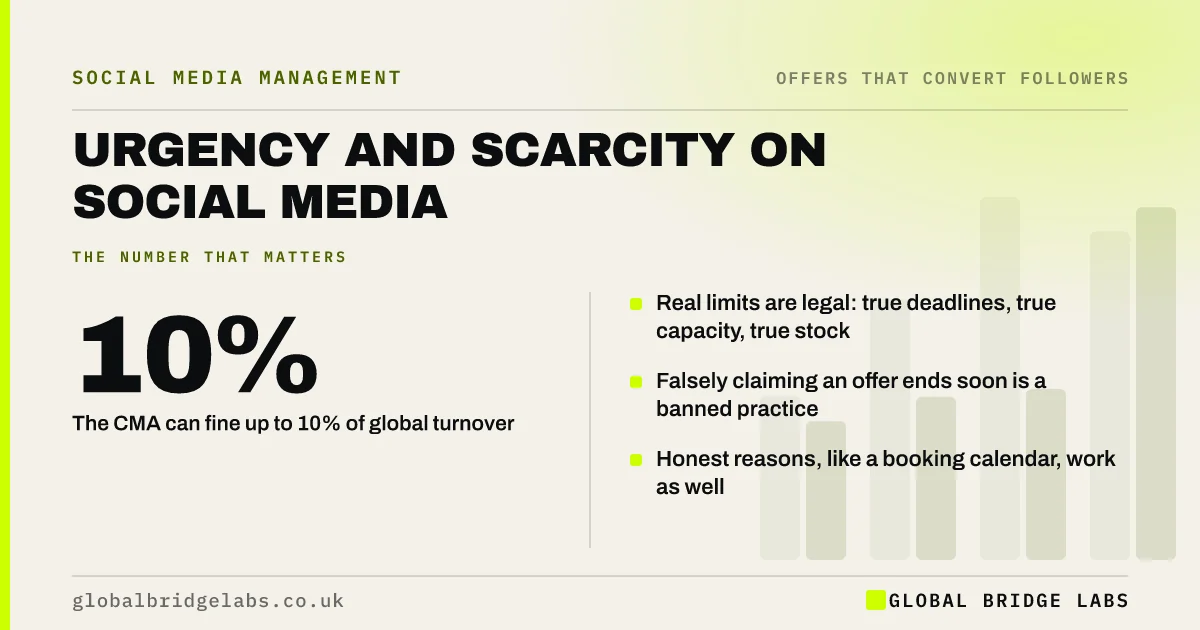
Urgency and scarcity prompt followers to act now instead of later, and they are legal in the UK when they are true. Fake deadlines, invented stock levels and countdown timers that reset are banned under consumer protection law, which the Competition and Markets Authority (CMA) can now enforce directly with fines of up to 10% of global turnover.
- Real limits are legal: true deadlines, true capacity, true stock.
- Falsely claiming an offer ends soon is a banned practice.
- The CMA can fine up to 10% of global turnover.
- Honest reasons, like a booking calendar, work as well.
Want your offer wording checked for fairness? Message us on WhatsApp.
Chat on WhatsApp →What are urgency and scarcity in marketing?
Urgency in marketing is a reason to act by a certain time, such as an offer end date. Scarcity is a reason to act because supply is limited, such as ten appointments left. Both work because people put off decisions without a reason not to. Both must be true to be lawful.
What does UK law say?
Under the Digital Markets, Competition and Consumers Act 2024, which replaced the Consumer Protection from Unfair Trading Regulations from April 2025, falsely stating that a product will only be available for a very limited time, to push an immediate decision, is a banned practice in all circumstances. The CMA can investigate and fine directly. The CAP Code also requires closing dates for promotions to be stated and kept.
This is general information, not legal advice. Take advice on any campaign you are unsure about.
Which urgency tactics are not allowed?
Tactics that create pressure from something untrue are not allowed. The CMA's work on online choice architecture names several of them.
- Countdown timers that restart when the page reloads.
- "Last chance" offers that run again next week.
- "Only 3 left" when there are more.
- "20 people are looking at this" when they are not.
- Extending a "final day" sale repeatedly.
Which honest reasons to act now work?
Honest reasons work because small businesses have real limits. A booking calendar has finite slots, a seasonal service has a window, a batch of products is a set size, and prices do rise. Say what the limit is and why it exists.
- "We have six installation slots left before Christmas."
- "Spring garden bookings close on 15 March."
- "This batch is 40 jars; the next is in June."
- "Prices rise on 1 April because our suppliers' do."
Unsure whether your wording is fair? Message us on WhatsApp and we will discuss your requirements.
Chat on WhatsApp →Does urgency actually help small businesses sell?
Real urgency helps because it gives undecided followers a reason to decide. It works best on people who already want the product. It does little for people who do not trust you yet, and overuse teaches followers that every deadline is soft, which cancels the effect.
When should you not use urgency?
Do not use urgency for high-value or sensitive purchases where pressure feels inappropriate, such as healthcare, financial products or care services. Regulators in those sectors take a stricter view, and buyers value time to think. A clear next step and good information convert better there.
What does this look like in practice?
A pattern we see: a "final week" offer that has run for three months because it worked once. Replacing it with a true limit, such as the number of slots in next month's calendar, keeps the prompt to act and removes the legal risk.
Fair urgency checklist
- Every deadline is real and kept.
- Every stock or slot number is accurate.
- Timers do not reset.
- Closing dates and conditions are stated.
- Offers are not rerun as "last chance".
- Sensitive services avoid pressure.
Next step
Read your current offer posts and highlight every time-limited claim. For each one, ask whether it is literally true today.
Message us on WhatsApp and we will review your offer wording, or book a 30-minute consultation.
Chat on WhatsApp →Sources and further reading
- Digital Markets, Competition and Consumers Act 2024 · legislation.gov.uk
- Online choice architecture: how digital design can harm competition and consumers · Competition and Markets Authority
- Unfair commercial practices guidance (CMA207) · Competition and Markets Authority
- UK Code of Non-broadcast Advertising and Direct & Promotional Marketing (CAP Code) · ASA / CAP
Frequently asked questions
Is fake urgency illegal in the UK?
Yes. Falsely stating that a product is only available for a very limited time to push an immediate decision is a banned practice under the Digital Markets, Competition and Consumers Act 2024. The Competition and Markets Authority can fine businesses directly. Genuine deadlines and limits remain lawful.
Can I use a countdown timer on an offer?
Yes, if it counts down to a real end time that applies to everyone and the offer actually ends then. Timers that reset for each visitor, or offers that restart after the timer ends, are misleading and should not be used.
How can a small business create urgency honestly?
Use real limits: slots in your diary, seasonal windows, batch sizes, booking deadlines or price rises you know are coming. State the limit and the reason. Honest limits are lawful and tend to be more believable than generic "ends soon" claims.
Written by

Global Bridge Labs (GBL) is a UK–Sri Lanka partner for social media, websites and BPO. Everything here comes from client delivery, not theory.