On this page
- 01Key takeaways
- 02What is repeat purchase rate?
- 03How do you calculate it?
- 04Why does it matter for social media?
- 05How do you raise repeat purchases?
- 06What UK rules apply to staying in touch?
- 07When does repeat purchase rate not apply?
- 08What does this look like in practice?
- 09Repeat purchase checklist
- 10Next step
- 11Sources and further reading
- 12Frequently asked questions
Key takeaways
Repeat purchase rate is the share of customers who buy more than once in a period. It matters because winning a follower as a first-time customer is the expensive part; a second purchase costs far less and makes the first worthwhile. Measure it quarterly and raise it with follow-up, reminders and content for existing customers.
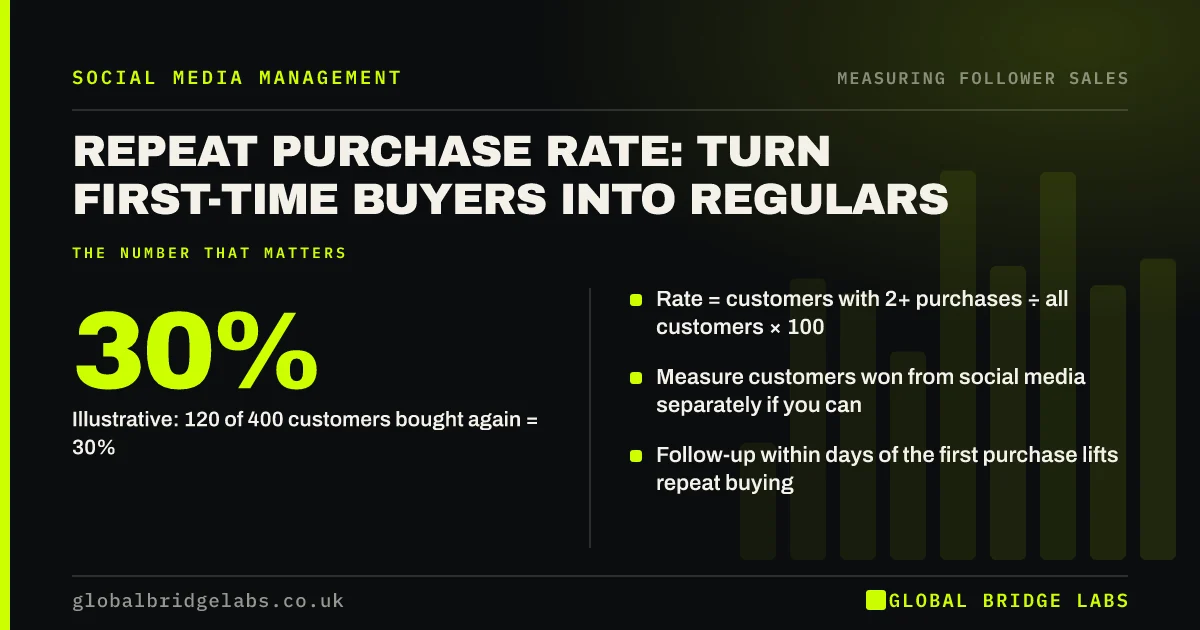
- Rate = customers with 2+ purchases ÷ all customers × 100.
- Illustrative: 120 of 400 customers bought again = 30%.
- Measure customers won from social media separately if you can.
- Follow-up within days of the first purchase lifts repeat buying.
Want to know your repeat purchase rate? Message us on WhatsApp.
Chat on WhatsApp →What is repeat purchase rate?
Repeat purchase rate is the percentage of a business's customers in a given period who made more than one purchase. It shows how well a business keeps customers after the first sale, and is a core driver of customer lifetime value.
How do you calculate it?
Choose a period, often 12 months. Count the customers who bought in that period and how many of them bought two or more times. Divide the second by the first and multiply by 100. Shops can pull this from their platform; service businesses can use their booking or invoicing system.
Why does it matter for social media?
It matters because social media often wins the first purchase at a cost close to its profit. If a third of those customers come back, the channel is profitable. If none do, it is not. Judging social media on first purchases alone undervalues it for any business with repeat customers.
How do you raise repeat purchases?
Raise repeat purchases by staying in touch after the first sale. Send a thank-you and care tips, a reminder when the next purchase is due, an easy rebooking link and occasional content for existing customers. Ask for consent to stay in touch at the first purchase.
- Day 1: thank you and what to expect.
- Week 1 to 2: a tip or check-in.
- When due: a reminder with a rebooking link.
- Ongoing: posts and messages for existing customers.
Want a simple after-sale routine designed? Message us on WhatsApp and we will discuss your requirements.
Chat on WhatsApp →What UK rules apply to staying in touch?
Under PECR, the soft opt-in lets you email or text existing customers about similar products if you collected their details during a sale, gave them a chance to opt out then, and offer an opt-out in every message. Marketing beyond that generally needs consent. Service messages about their order do not need marketing consent.
When does repeat purchase rate not apply?
It applies less to one-off purchases, such as a wedding or a house extension. For those businesses, referrals and reviews play the role of repeat purchases. Track referral rate instead: the share of customers who send you someone new.
What does this look like in practice?
A pattern we see in e-commerce and salons: plenty of first-time customers from social media, and no contact after the first purchase. A thank-you message, a reminder at the right time and a rebooking link are usually the cheapest growth available.
Repeat purchase checklist
- Calculate your rate for the last 12 months.
- Separate social media customers if you can.
- Collect consent or soft opt-in at first purchase.
- Send a thank-you and a timely reminder.
- Make rebooking or reordering one tap.
- Recalculate quarterly.
Next step
Pull last year's customer list and count how many bought twice or more. Then write the reminder message you will send this month.
Message us on WhatsApp and we will help raise repeat purchases, or book a 30-minute consultation.
Chat on WhatsApp →Sources and further reading
- Electronic and telephone marketing under PECR · Information Commissioner's Office
- Direct marketing and privacy and electronic communications · Information Commissioner's Office
- UK Customer Satisfaction Index · Institute of Customer Service
Frequently asked questions
How do you calculate repeat purchase rate?
Count the customers who bought in a period, usually 12 months, and how many of them bought two or more times. Divide the second number by the first and multiply by 100. For example, 120 repeat customers out of 400 is 30%.
How can a small business get more repeat customers?
Stay in touch after the first purchase: a thank-you, a useful tip, a reminder when the next purchase is due and an easy way to rebook or reorder. Good service and fast replies matter too. Collect consent or a soft opt-in at the first sale.
Can I email customers without consent?
Under the soft opt-in in PECR, you can email existing customers about similar products if you collected their details during a sale, offered an opt-out then and include one in every message. Other marketing generally needs consent. Order-related service messages do not.
Written by

Global Bridge Labs (GBL) is a UK–Sri Lanka partner for social media, websites and BPO. Everything here comes from client delivery, not theory.