On this page
- 01Key takeaways
- 02Does a faster website build cost more?
- 03What speeds a project up for free?
- 04What does rushing risk?
- 05How do you hit a deadline without a rush fee?
- 06When is paying a rush fee worth it?
- 07What does this look like in practice?
- 08Deadline checklist
- 09Next step
- 10Sources and further reading
- 11Frequently asked questions
Key takeaways
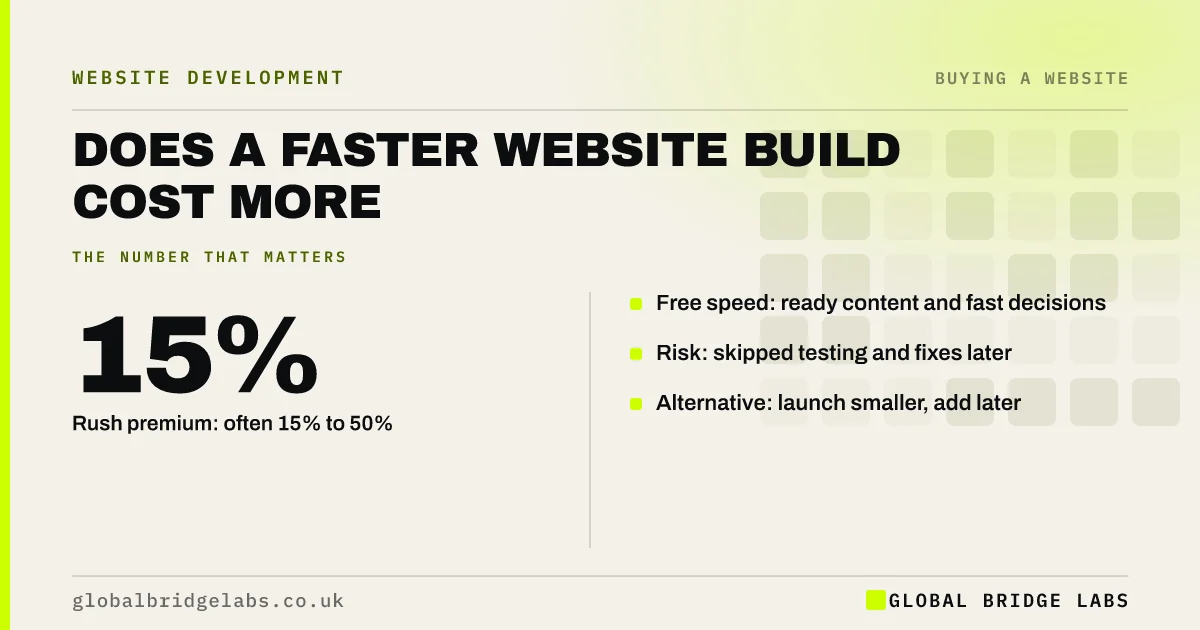
A rushed website build often costs 15% to 50% more, because suppliers must reschedule other work or add people. Many projects can move faster for free with ready content, quick decisions and a tight scope. Rushing also risks skipped testing and post-launch fixes, so launch a smaller site on time rather than a full site in a hurry.
- Rush premium: often 15% to 50%.
- Free speed: ready content and fast decisions.
- Risk: skipped testing and fixes later.
- Alternative: launch smaller, add later.
Want to know how fast your site could launch? Message us on WhatsApp.
Chat on WhatsApp →Does a faster website build cost more?
A faster build often costs more when it means the supplier must move other projects or add staff, with rush premiums commonly 15% to 50%, based on typical UK practice. But much of a project's time is waiting for content and decisions, which you control at no cost.
What speeds a project up for free?
The biggest free accelerators are having content ready, one decision-maker, quick feedback and a tight scope. Projects often stall for weeks waiting for copy, photos or approvals.
- Copy and photos ready before build.
- One decision-maker.
- Feedback within two working days.
- A tight scope with extras parked.
Want a realistic timeline for your launch date? Message us on WhatsApp and we will discuss your requirements.
Chat on WhatsApp →What does rushing risk?
Rushing risks skipped testing, accessibility gaps, missed redirects and forms that fail, which lead to lost enquiries and paid fixes after launch. Cutting testing to hit a date is often the most expensive way to save time.
How do you hit a deadline without a rush fee?
Launch a smaller first version on time: the key pages, enquiry route and tracking. Add the rest in a second phase. This hits event or campaign deadlines without paying a premium or skipping quality checks.
When is paying a rush fee worth it?
A rush fee is worth it when a fixed date drives significant revenue, such as a launch, trade show or regulatory deadline, and a smaller first version will not do. Agree what quality checks will still happen.
What does this look like in practice?
At Global Bridge Labs (GBL), a UK festival organiser needed a site before ticket sales opened in four weeks. Instead of paying a rush premium for the full site, they launched five essential pages with ticket links and tracking on time, then added the programme and gallery pages in month two.
Deadline checklist
- Confirm the real deadline and why.
- Have content ready before build.
- Name one decision-maker.
- Commit to fast feedback.
- Launch a smaller first version.
- Keep testing in the plan.
Next step
List the pages that must exist on your deadline day. Everything else becomes phase two, and the rush fee may disappear.
Message us on WhatsApp for a website launch plan, or book a 30-minute consultation.
Chat on WhatsApp →Sources and further reading
- About key events · Google Analytics Help
- SEO Starter Guide · Google Search Central
- Web Content Accessibility Guidelines (WCAG) 2.2 · W3C
Frequently asked questions
Do web designers charge extra for urgent work?
Many do, often 15% to 50% extra, because urgent work means rescheduling other clients or adding staff. Some do not charge if they have capacity. Ask upfront, and consider launching a smaller first version on your deadline to avoid the premium.
How can I get my website built faster?
Have copy and photos ready before the build, name one decision-maker, give feedback within two working days and keep the scope tight. Much project time is spent waiting for content and approvals, so these steps can shorten timelines without extra cost.
Is it risky to rush a website launch?
It can be. Rushing often cuts testing, accessibility checks and redirects, leading to broken forms, lost search traffic and paid fixes after launch. Launching fewer pages on time, with full testing, is usually safer than launching everything in a hurry.
Written by

Global Bridge Labs (GBL) is a UK–Sri Lanka partner for social media, websites and BPO. Everything here comes from client delivery, not theory.