On this page
- 01Key takeaways
- 02What does a £1,000 website include?
- 03What does a £10,000 website include?
- 04How do the two compare side by side?
- 05Which level does your business need?
- 06When is an expensive website a waste?
- 07What does this look like in practice?
- 08Spend level checklist
- 09Next step
- 10Sources and further reading
- 11Frequently asked questions
Key takeaways
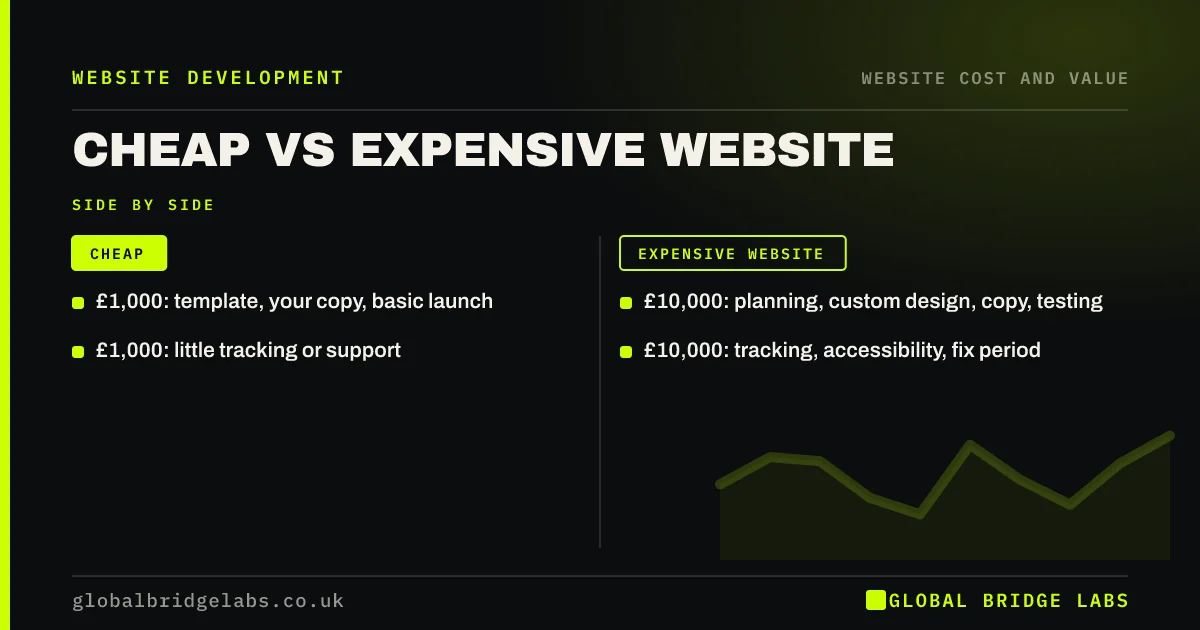
A £1,000 website usually buys a template with your copy and a contact form; a £10,000 website usually buys planning, custom design, written copy, tracking, testing and support. The cheap site proves you exist; the expensive one is built to win enquiries. Neither is right by default: match the spend to how much new business the site must produce.
- £1,000: template, your copy, basic launch.
- £10,000: planning, custom design, copy, testing.
- £1,000: little tracking or support.
- £10,000: tracking, accessibility, fix period.
Want to know which level your business needs? Message us on WhatsApp.
Chat on WhatsApp →What does a £1,000 website include?
A £1,000 website usually includes an adapted template, three to six pages using your copy and photos, a contact form, basic mobile checks and launch. It rarely includes written copy, SEO set-up, enquiry tracking, accessibility testing or support after launch. It is a solid way to look legitimate.
What does a £10,000 website include?
A £10,000 website usually includes discovery, custom or heavily adapted design, written copy, photography direction, SEO set-up, tracking of enquiries as key events, accessibility testing to WCAG 2.2 AA, speed work, training and a fix period. The extra money goes on planning and the details that affect results.
Want a site scoped at the right level for your goals? Message us on WhatsApp and we will discuss your requirements.
Chat on WhatsApp →How do the two compare side by side?
Side by side, the difference is mostly in planning, content and measurement rather than looks. Both can appear smart at first glance.
- Planning: none vs discovery and page plan.
- Copy: yours vs professionally written.
- Tracking: rarely vs set up and tested.
- Testing: basic vs devices, accessibility, speed.
- Support: none vs fix period and training.
Which level does your business need?
Choose the cheap level if most work comes from referrals and the site just confirms you exist. Choose the higher level if the website is expected to bring regular new enquiries from search or ads. Many businesses sit between, at £3,000 to £6,000.
When is an expensive website a waste?
An expensive website is a waste when nobody will keep it updated, when traffic is tiny, or when the money goes on visual effects rather than copy, proof and tracking. Spending more does not fix an unclear offer.
What does this look like in practice?
At Global Bridge Labs (GBL), a UK commercial electrician moved from a £1,000 site to a £7,500 one. The design change was modest; the difference was written service pages, case studies and call tracking. They could now see that most new contracts came from two service pages and invested there.
Spend level checklist
- Decide what the site must produce.
- Estimate how much new work comes online.
- Price planning, copy and tracking separately.
- Avoid paying for effects over substance.
- Consider a middle option.
- Plan care either way.
Next step
Estimate how many new customers a year you want from your website and what each is worth. That figure tells you which level makes sense.
Message us on WhatsApp for a website spend calculator, or book a 30-minute consultation.
Chat on WhatsApp →Sources and further reading
- SEO Starter Guide · Google Search Central
- Web Content Accessibility Guidelines (WCAG) 2.2 · W3C
- About key events · Google Analytics Help
Frequently asked questions
What is the difference between a cheap and an expensive website?
The main differences are planning, content, measurement and support. Cheap sites usually adapt a template with your copy and little testing. Expensive sites include discovery, written copy, tracking, accessibility and speed testing, training and a fix period. Both can look similar, but they perform differently.
Is a £10,000 website worth it for a small business?
It is worth it if the site needs to bring regular new enquiries and those enquiries are valuable. If one new client is worth several thousand pounds, a £10,000 site can pay back quickly. If work mostly comes from referrals, a smaller site may be enough.
Can a cheap website still get enquiries?
Yes, if it is clear, fast on phones and shows proof and contact details. Many cheap sites bring steady enquiries, especially with a good Google Business Profile. Their limits are measurement, ranking for many services and support, which matter more as you grow.
Written by

Global Bridge Labs (GBL) is a UK–Sri Lanka partner for social media, websites and BPO. Everything here comes from client delivery, not theory.