On this page
- 01Key takeaways
- 02Which platform drives the most footfall?
- 03Why does reach matter less for footfall?
- 04What content actually moves people through a door?
- 05How do you measure footfall from social?
- 06When is social the wrong lever for footfall?
- 07What does this look like in practice?
- 08How does weather change what you post?
- 09Next step
- 10Sources and further reading
- 11Frequently asked questions
Key takeaways
For footfall, a Google Business Profile beats every social channel per hour spent, because it reaches people searching nearby right now. Among social channels, Facebook local groups drive more visits than Instagram for most UK high street businesses.
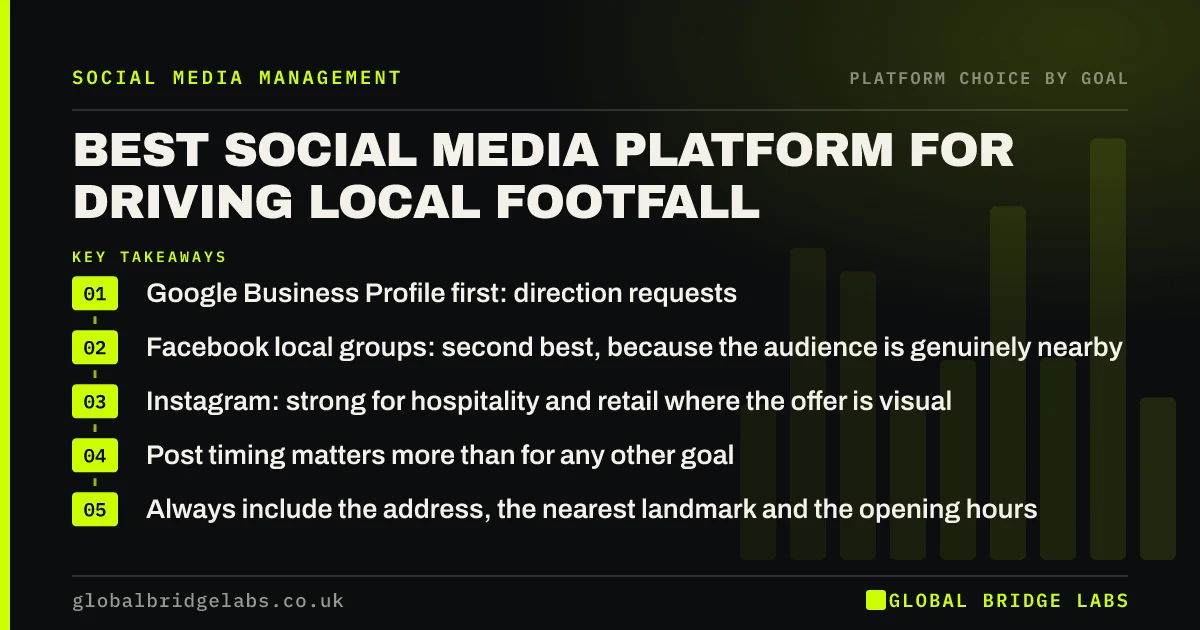
- Google Business Profile first: direction requests and calls are footfall you can count.
- Facebook local groups: second best, because the audience is genuinely nearby.
- Instagram: strong for hospitality and retail where the offer is visual.
- Post timing matters more than for any other goal. Lunch decisions happen at 11am.
- Always include the address, the nearest landmark and the opening hours.
Want a footfall plan for your location? Send us your postcode on WhatsApp.
Chat on WhatsApp →Which platform drives the most footfall?
The Google Business Profile, which most businesses do not think of as social media at all. Someone searching coffee near me or hardware shop open now is a person who will walk through a door in the next thirty minutes, and the profile decides whose door.
Among true social channels, local Facebook groups come next, because membership is geographically real. Instagram follows, and its strength is specific: it works where the decision is visual and the visit is planned rather than immediate.
Why does reach matter less for footfall?
Because a person 40 miles away has no footfall value, however engaged they are. A post reaching 5,000 people nationally is worth less than a post reaching 300 people within two miles, and most social dashboards will show you the opposite conclusion.
This is the single most common misreading of social analytics by UK high street businesses. When you review performance, filter by location before you look at anything else, or you will keep optimising for an audience that cannot visit.
What content actually moves people through a door?
Specific, time-bound and local. Five formats that consistently work for UK high street businesses.
- What is available today: the specials board, the new stock, the last two appointments.
- Right now posts: queue-free, just opened, table free at 7. Immediacy beats production.
- The address and a landmark in every post. People do not know where you are.
- Faces of staff, which converts far better than product photography for local visits.
- Weather-reactive posts, which are the most under-used footfall lever in the UK.
We will write a week of footfall-focused posts with you. Message us on WhatsApp.
Chat on WhatsApp →How do you measure footfall from social?
Directly, by asking, because no analytics tool tracks a walk-in. Three measures that work without any technology.
Ask at the till or the front desk how people heard about you and log it for a month. Use a distinct offer per channel, such as a phrase to mention. And watch direction requests in your Google Business Profile insights, which is the closest thing to a footfall metric that exists online.
When is social the wrong lever for footfall?
When the problem is location, opening hours, or the shopfront itself, none of which a post can fix. If people walk past and do not come in, the issue is usually visible from the pavement rather than solvable in a feed.
It is also the wrong lever when your catchment is too small to sustain a channel. A business serving a village of 2,000 people may find that a notice board, a local paper and a Google Business Profile do the whole job, and that a daily posting habit is effort with nowhere to go.
What does this look like in practice?
A UK independent bakery posted beautifully styled product photography and saw steady engagement from other bakers across the country. Footfall did not move.
The change was unglamorous: a daily photograph of the actual counter at 8am with what was on it, the street name in every caption, and a weather-reactive post on wet mornings. Engagement fell because the national audience lost interest. Morning trade rose, because the 300 people within walking distance finally knew what was there today.
How does weather change what you post?
More than most UK businesses use. A wet Tuesday changes lunch plans, shopping trips and appointment attendance, and a post that acknowledges it lands far better than one written a fortnight earlier.
The mechanic is simple: keep three weather-reactive posts drafted and ready, then send the one that fits. Something warm on a cold morning, somewhere dry on a wet one, something cold when it is unexpectedly hot. It takes five minutes on the day and it is the closest thing to a reliable footfall lever available to a small business.
The same logic applies to anything local and unplanned: roadworks, a match, a school holiday, a delayed train line. Each is a reason someone changes their plans, and being the business that mentions it is cheap relevance.
Next step
Check your Google Business Profile insights for direction requests this month, then filter your social analytics by location. If most of your reach is outside your catchment, you have found the problem and it is not content quality.
Message us on WhatsApp and we will build a local-first posting plan for your shop.
Chat on WhatsApp →Sources and further reading
- Tips to improve your local ranking on Google · Google Business Profile Help
- Meta Business Help Centre · Meta
Frequently asked questions
Which social media platform is best for local footfall?
A Google Business Profile beats every social channel per hour spent, because it reaches people searching nearby at the moment they will walk through a door. Among social channels, local Facebook groups drive the most visits for most UK high street businesses.
How do you measure footfall from social media?
Ask at the till how people heard about you and log it for a month, use a distinct phrase per channel, and watch direction requests in Google Business Profile insights. No analytics tool tracks a walk-in directly.
Does high engagement mean more footfall?
No. Engagement from people outside your catchment has no footfall value at all. Filter your analytics by location before you review anything else, or you will keep optimising for a national audience that is never going to physically visit you.
What should a shop post to get people in today?
What is available right now, with the street name and a nearby landmark in every caption. Immediacy beats production quality here: a plain photograph of today's counter taken at 8am reliably outperforms styled product photography for driving local visits.
Written by

Global Bridge Labs (GBL) is a UK–Sri Lanka partner for social media, websites and BPO. Everything here comes from client delivery, not theory.