On this page
- 01Short answer
- 02What do hashtags actually do now?
- 03Which hashtags work for a UK small business?
- 04How many should you use?
- 05Should you create a branded hashtag?
- 06What matters more than hashtags now?
- 07How do you find hashtags worth using?
- 08Do hashtags work differently in paid campaigns?
- 09Next step
- 10Sources and further reading
- 11Frequently asked questions
Short answer
Hashtags now do far less than they did, and their remaining value is categorisation rather than reach. Use three to five specific ones including your location and your niche. Large generic tags are effectively worthless for small accounts because the content is buried within seconds.
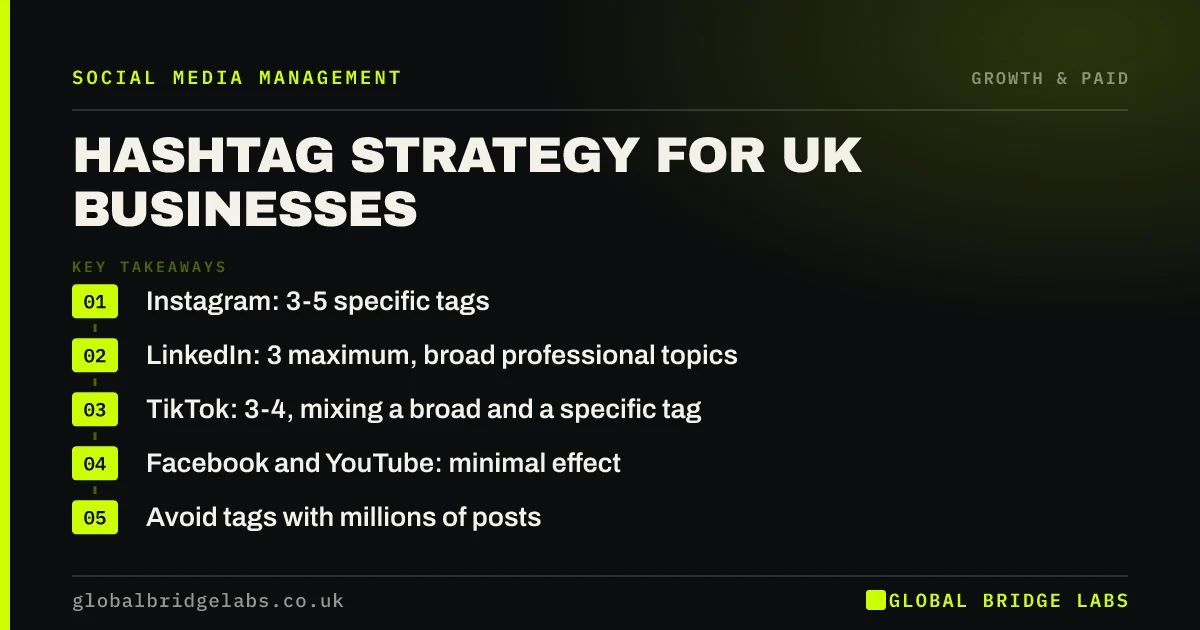
- Instagram: 3-5 specific tags. Location plus niche plus service.
- LinkedIn: 3 maximum, broad professional topics.
- TikTok: 3-4, mixing a broad and a specific tag. Spoken and on-screen words matter more.
- Facebook and YouTube: minimal effect. One or two at most.
- Avoid tags with millions of posts. Your content is invisible in them.
Want a hashtag set built for your area and service? Message us on WhatsApp.
Chat on WhatsApp →What do hashtags actually do now?
They tell the platform what your content is about, which supports how it decides who to show it to. That is a categorisation function, not a distribution one.
The shift matters because it changes the objective. The goal is no longer to appear in a hashtag feed, which almost nobody browses, but to give the recommendation system a clear signal. That favours a small number of precise tags over a large number of broad ones.
Which hashtags work for a UK small business?
Specific ones with genuine communities behind them, and location tags that match how people actually describe where they are.
A useful structure is one location tag, one niche tag, one service tag, and one community tag. For a Leeds kitchen fitter that might be the city, the specific trade, the service, and a relevant UK trade community tag. Total reach from this is modest, but the relevance is high, which is what determines whether reach converts.
- Location: the town or city name, and the county for wider reach.
- Niche: the specific trade or specialism, not the broad category.
- Service: what the post is about, phrased as a customer would.
- Community: an active UK industry or local tag with real participation.
How many should you use?
Three to five on Instagram and TikTok, up to three on LinkedIn, one or two elsewhere. Thirty-tag blocks were a tactic for a period when hashtag feeds drove discovery, and that period has passed.
There is also a readability cost. A caption followed by a wall of tags is harder to read and signals a certain kind of account, which affects whether people engage with what you wrote.
Should you create a branded hashtag?
Only if you have a genuine mechanism for people to use it, such as customers sharing finished work or an event. A branded hashtag with eleven posts, nine of them yours, achieves nothing.
Where it does work is as a collection point for user-generated content. If you can realistically get customers to tag their photos, the tag becomes a searchable library of proof, which is worth more than any reach effect.
We will build your hashtag and keyword set as part of a content review. Message us on WhatsApp.
Chat on WhatsApp →What matters more than hashtags now?
The words in your caption, the words spoken in your video, and the words shown on screen. Platforms read all three, and they carry substantially more weight than tags for deciding who sees your content.
Practically, this means writing captions that contain how a customer would describe the problem, and saying your service and area out loud in video. That does the job hashtags used to do, and it does it better.
How do you find hashtags worth using?
Start from your customers rather than from a generator. Look at what tags appear on posts by people who have bought from you or businesses like theirs, and at what your local community groups and trade bodies use.
Then test each candidate before adopting it. Search it, and look at the most recent posts rather than the top ones. If the recent posts are mostly spam or unrelated content, the tag is not a community and will not help you. If they are relevant and recent, it is worth keeping.
Build a set of about twelve validated tags and rotate four or five per post depending on the subject. Review the set twice a year, because tags die quietly and nobody notices for months.
- Source tags from customers and local groups, not from generators.
- Check recent posts under a tag, not top posts.
- Reject any tag whose recent content is spam or unrelated.
- Keep twelve validated tags, rotate four or five per post, review twice a year.
Do hashtags work differently in paid campaigns?
They do almost nothing in paid, and including them can actively hurt. Paid distribution is determined by your targeting and the platform's optimisation, not by tags, so hashtags in an advert mainly provide a route for someone to tap away from your campaign.
The exception is where an advert is also intended to live as an organic post on your profile, which is common when you promote a post that performed. In that case keep the tags minimal and relevant, and accept that they are there for the organic life of the post rather than the paid one.
The general rule holds: in paid, every element should either move someone towards the action or be removed. Hashtags rarely pass that test.
- Hashtags do not affect paid distribution.
- They provide an exit route away from your advert.
- Keep minimal tags only where the post also runs organically.
- In paid, remove anything that does not move someone towards the action.
Next step
Hashtags are a five-minute optimisation with a small ceiling. If you are still spending real time on them, that time is better spent on captions and replies.
Message us on WhatsApp for a content review covering captions, keywords and tags.
Chat on WhatsApp →Sources and further reading
- Meta Business Help Centre · Meta
- TikTok for Business · TikTok
Frequently asked questions
Do hashtags still work in 2026?
They work as categorisation rather than distribution. Platforms use them to understand what content is about, but almost nobody browses hashtag feeds. Three to five specific tags including your location outperform thirty generic ones for a small account.
How many hashtags should I use on Instagram?
Three to five, chosen for specificity rather than volume. Include your town or city, your specific trade and the service the post covers. Tags with millions of posts bury a small account's content within seconds of publishing.
Are local hashtags worth using?
Yes, they are among the few that still help small businesses, because they signal relevance to an audience you can actually serve. Use the town or city name as people locally describe it, plus the county for slightly wider reach.
What matters more than hashtags?
The words in your caption, spoken in your video and shown on screen. Platforms read all three and weight them more heavily than tags. Saying your service and area out loud in a video does more than any hashtag set.
Written by

Global Bridge Labs (GBL) is a UK–Sri Lanka partner for social media, websites and BPO. Everything here comes from client delivery, not theory.