On this page
- 01Key takeaways
- 02Is Pinterest or Instagram better for e-commerce?
- 03Why does Pinterest content keep working?
- 04Which product categories suit Pinterest?
- 05How do the conversion rates compare?
- 06Can one set of photography feed both?
- 07What does this look like in practice?
- 08How do you build a Pinterest library quickly?
- 09Next step
- 10Sources and further reading
- 11Frequently asked questions
Key takeaways
Pinterest is a search engine with pictures and Instagram is a feed. Pinterest sends fewer visits that convert better and keep arriving for months. Instagram sends more visits that convert worse and stop the day you stop posting. Most UK e-commerce brands should run both, with Instagram primary.
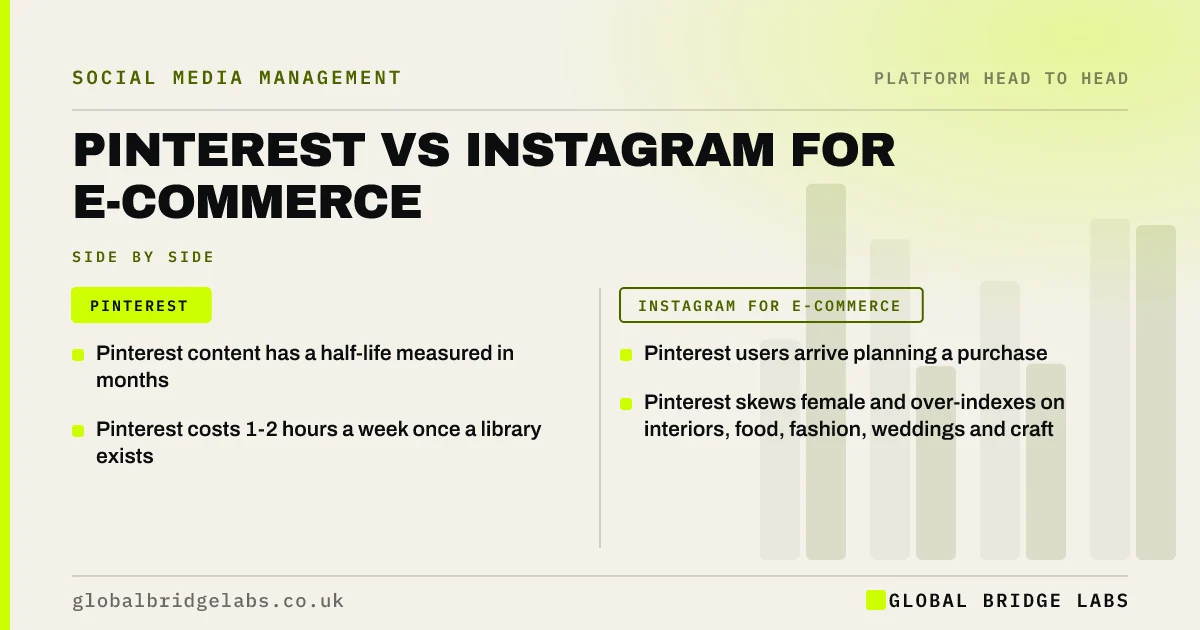
- Pinterest content has a half-life measured in months. Instagram posts fade in 48 hours.
- Pinterest users arrive planning a purchase. Instagram users arrive to browse.
- Pinterest costs 1-2 hours a week once a library exists. Instagram costs 4-6.
- Pinterest skews female and over-indexes on interiors, food, fashion, weddings and craft.
- Instagram builds the brand. Pinterest harvests the intent. They are not substitutes.
Selling online and unsure where to start? Send us your product category on WhatsApp.
Chat on WhatsApp →Is Pinterest or Instagram better for e-commerce?
Instagram for building a brand people recognise, Pinterest for capturing people who are already planning to buy. The two do different jobs and the usual mistake is judging Pinterest by Instagram's metrics.
Pinterest behaves like a visual search engine. People arrive with a project in mind, save things for later, and return weeks or months afterwards when the project becomes real. That delay makes Pinterest look weak in a 30-day attribution window and strong in a 90-day one.
Why does Pinterest content keep working?
Because a pin is indexed and searchable rather than pushed into a feed and forgotten. A pin created today can still be delivering traffic in a year, which is the opposite of almost every other social surface.
This changes the economics completely. On Instagram, stopping for a month costs you a month's reach. On Pinterest, a library built over one quarter keeps producing while you do nothing, which is why it repays a small e-commerce team more per hour than any feed channel.
Which product categories suit Pinterest?
Anything bought as part of a project or an occasion, because those are the purchases people plan rather than impulse into.
- Interiors, furniture, lighting, paint and home improvement: the strongest categories.
- Weddings and events: planned months ahead, which matches Pinterest behaviour exactly.
- Food, recipes and kitchenware: consistently high save and click-through rates.
- Fashion, jewellery and gifts: strong, especially seasonally.
- Weak fits: fast-moving consumables, B2B services, anything bought without planning.
We will tell you whether your category suits Pinterest. Message us on WhatsApp.
Chat on WhatsApp →How do the conversion rates compare?
Pinterest traffic typically converts better than Instagram traffic for e-commerce, because the visitor arrived with purchase intent rather than being interrupted mid-scroll. Instagram sends more visits with a lower conversion rate.
The honest caveat is that both depend far more on your product page than on the platform. A 1% site conversion rate will not become 3% by changing traffic source. Fix the product page, the delivery information and the checkout first, then worry about which platform sends the visits.
Can one set of photography feed both?
Partly, and this is where the practical saving lies. The same product shoot works for both, but the crops differ: Pinterest strongly favours tall vertical images, Instagram favours square and 4:5.
The text also differs. Pinterest pins need keyword-led descriptions because people search them, while Instagram captions need a hook because people scroll past them. Shoot once, export twice, write twice. That is roughly 90 extra minutes a week, not a second channel's full cost.
What does this look like in practice?
A UK independent homeware brand ran Instagram alone for two years and plateaued. Adding Pinterest with 40 pins built over six weeks, all keyword-titled and linking to product pages, produced a slow build rather than a spike.
By month four, Pinterest was sending roughly a third of the visits Instagram sent and a comparable number of orders, at around a quarter of the weekly effort. The important part was that the Pinterest traffic kept arriving during a quiet month when nobody had time to post anywhere.
How do you build a Pinterest library quickly?
From photography you already have, in one sitting. Forty pins is enough to start producing a signal, and most UK e-commerce brands already have forty product images sitting in a folder.
Crop them tall, write keyword-led titles and descriptions the way someone would search, and link each one to the specific product page rather than the homepage. Then leave it alone for three months. The temptation to judge it in week two is what stops most businesses from ever finding out whether it works.
After the first forty, add five to ten pins a week from whatever new photography you produce anyway. That is fifteen minutes and it keeps the library growing without ever becoming a separate job, which is how the channel stays worth its hours.
Next step
If your products are bought as part of a project or occasion, build 40 keyword-titled pins over six weeks and then judge the result at month four rather than month one. Pinterest rewards patience in a way no feed platform does.
Message us on WhatsApp and we will plan a Pinterest library from your existing photography.
Chat on WhatsApp →Sources and further reading
- Pinterest Business help: get started · Pinterest
- Meta Business Help Centre · Meta
Frequently asked questions
Does Pinterest work for UK e-commerce?
Yes for products bought as part of a project or occasion, such as interiors, weddings, food and gifts. Pinterest behaves like a search engine, so pins keep delivering traffic for months rather than fading within days like feed posts.
Which converts better, Pinterest or Instagram?
Pinterest traffic typically converts better because visitors arrive with purchase intent rather than being interrupted mid-scroll. Instagram sends more visits at a lower rate. Both depend far more on your product page than on the platform.
How long does Pinterest take to work?
Three to four months for a meaningful signal, because pins accumulate search visibility over time rather than spiking and fading. Judging Pinterest at month one against feed-platform expectations is the most common reason UK businesses abandon it before it has had any chance to work.
Can I use the same images on Pinterest and Instagram?
Yes, with different crops and different text. Pinterest favours tall vertical images with keyword-led titles and descriptions, because people search them. Instagram favours square or 4:5 images with a hook in the first line, because people are scrolling past them.
Written by

Global Bridge Labs (GBL) is a UK–Sri Lanka partner for social media, websites and BPO. Everything here comes from client delivery, not theory.