On this page
- 01Key takeaways
- 02Which platform sells the most for e-commerce?
- 03What works for low-value impulse products?
- 04What works for considered purchases?
- 05Why does the product page decide more than the platform?
- 06How should you attribute e-commerce sales from social?
- 07What does this look like in practice?
- 08What does a returning customer change?
- 09Next step
- 10Sources and further reading
- 11Frequently asked questions
Key takeaways
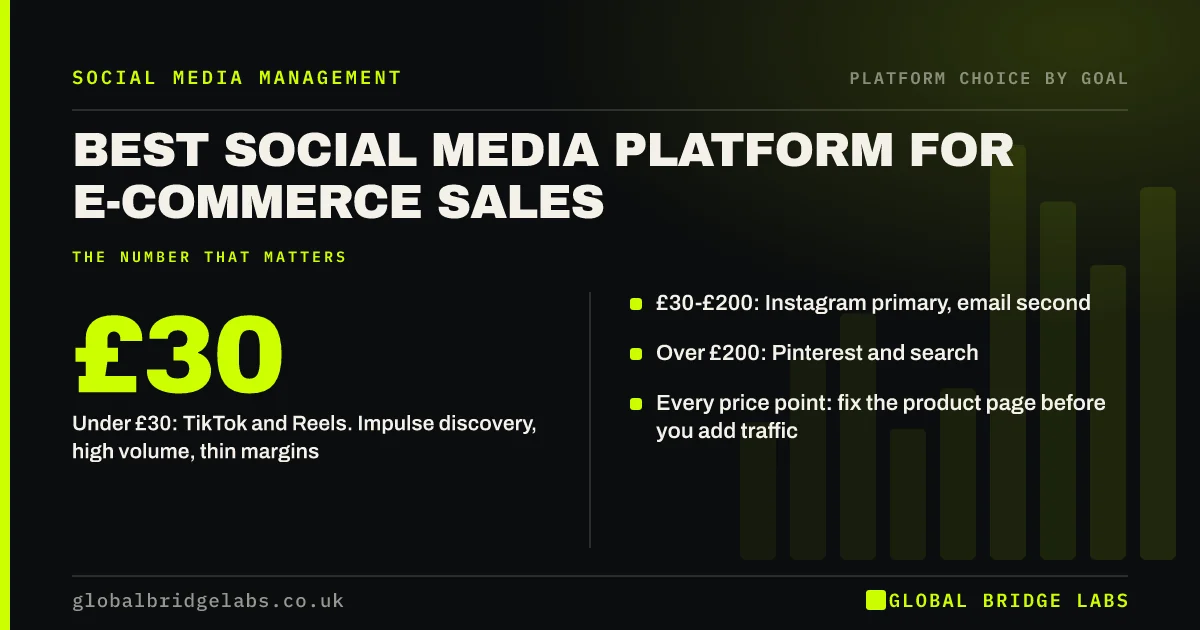
Price point decides the platform. Under about £30, TikTok and Instagram impulse discovery works. Between £30 and £200, Instagram plus email. Above £200, Pinterest and search, because people plan those purchases rather than impulsing into them.
- Under £30: TikTok and Reels. Impulse discovery, high volume, thin margins.
- £30-£200: Instagram primary, email second. Brand and repeat purchase matter.
- Over £200: Pinterest and search. Buyers research, save and return weeks later.
- Every price point: fix the product page before you add traffic.
- Assisted conversions matter more than last click. Social rarely gets the final credit.
Tell us your average order value on WhatsApp and we will name your channel.
Chat on WhatsApp →Which platform sells the most for e-commerce?
It depends on price point more than on product category, which is the variable most advice skips. Impulse purchases and planned purchases live on different platforms because they involve different behaviour.
A £15 item can be sold by a 20-second video to someone who was not shopping. A £400 item cannot. That buyer will see it, save it, look at three competitors, read reviews and return a fortnight later, which favours platforms with memory and search rather than feeds.
What works for low-value impulse products?
Short vertical video at volume, and the economics are demanding. Five conditions that need to be true before this works.
- Margin that survives paid amplification and a return rate around 10-20%.
- The product must be demonstrable in under 15 seconds.
- Cadence of 4-7 videos a week, sustained. Gaps kill momentum quickly.
- Stock depth, because a video that works can sell a month of inventory overnight.
- Checkout that works on a phone in under a minute.
What works for considered purchases?
Pinterest and search, because both capture people during planning rather than interrupting them. A pin created today can still be sending buyers in a year, which suits products bought as part of a project.
Email is the underrated partner here. A buyer who saves your product and leaves is reachable by email and not by algorithm, which is why capturing an address at the first visit matters more for high-value e-commerce than any social tactic.
We will map your funnel from discovery to repeat purchase. Message us on WhatsApp.
Chat on WhatsApp →Why does the product page decide more than the platform?
Because traffic quality cannot rescue a page that does not answer the buyer's questions. A site converting at 0.8% will not reach 3% by changing traffic source, and most UK small e-commerce sites we review are losing more at the product page than at the top of the funnel.
The four things that move it are honest delivery information above the fold, real photography at scale rather than one hero shot, reviews on the product itself, and a returns policy stated plainly. Fix those first and every channel performs better at once.
How should you attribute e-commerce sales from social?
With assisted conversions rather than last click, because social almost never gets the final touch. Someone discovers a product on a feed, searches your brand name three days later and buys from that search, and the platform receives no credit at all.
Two practical measures: branded search volume trend, and a post-purchase question asking where people first saw you. Both are crude, both are better than a last-click report that will tell you social does nothing while your branded search doubles.
What does this look like in practice?
A UK independent lighting retailer with an average order value around £180 spent nine months on short-form video, producing steady views and very little revenue. The buyers were watching, saving nothing and forgetting.
Rebuilding around Pinterest for discovery, email capture on every product page and a small retargeting budget changed the shape of the year. The videos kept running at reduced volume as a brand layer. Revenue from social improved because the channel finally matched how a £180 purchase is actually made.
What does a returning customer change?
The economics of every channel, because acquiring an existing customer again costs a fraction of finding a new one. A shop with a genuine repeat rate can afford channels that look unprofitable on first purchase alone.
That is why email and messaging deserve more attention than most small UK retailers give them. Work out what a customer is worth across a year rather than across one order, then judge each channel against that number. Several channels that look like failures on first-order economics are comfortably profitable on the second.
It also changes what you should post. A feed aimed only at new buyers ignores the people most likely to spend next, so keep a share of your content for restocks, new lines and things that only a previous customer would care about.
Next step
Work out your average order value and read it against the three bands above. Then check your product page conversion rate before adding any traffic, because a better channel pointed at a weak page produces a better-attended failure.
Message us on WhatsApp with your average order value and we will plan the channel mix.
Chat on WhatsApp →Sources and further reading
- Pinterest Business help: get started · Pinterest
- Google Merchant Center Help · Google
Frequently asked questions
Which social media platform is best for selling products online?
It depends on price point more than category. Under about £30, TikTok and Instagram Reels work through impulse discovery. Between £30 and £200, Instagram with email behind it. Above £200, Pinterest and search, because buyers plan those purchases over weeks rather than seconds.
Does TikTok work for UK e-commerce?
For low-value, quickly demonstrable products with margin to absorb returns and stock depth to handle a spike, yes. It needs four to seven videos a week sustained, so it suits businesses that can hold that cadence indefinitely.
Why does social media show so few e-commerce conversions?
Because social rarely gets the last click. Buyers discover a product, search your brand days later and buy from that search. Use assisted conversions and branded search trend rather than last-click reports, which understate social severely.
Should I fix my website or my social media first?
The website, every time. Traffic quality cannot rescue a product page that lacks honest delivery information, real photography at scale, reviews on the product itself and a plainly stated returns policy. Fix those four and every channel you run performs better at once.
Written by
Global Bridge Labs (GBL) is a UK–Sri Lanka partner for social media, websites and BPO. Everything here comes from client delivery, not theory.