On this page
- 01Key takeaways
- 02What is the difference between temp staff and outsourcing?
- 03How do temps and outsourcing compare?
- 04How much do temps cost compared with outsourcing?
- 05What rights do agency workers have?
- 06When are temps the better choice?
- 07When is outsourcing the better choice?
- 08Can you combine temps and outsourcing?
- 09How do temps and outsourcing handle data protection?
- 10What does this look like in practice?
- 11Temps or outsourcing checklist
- 12Next step
- 13Sources and further reading
- 14Frequently asked questions
Key takeaways
Outsourcing vs temp staff comes down to the kind of gap. Temps suit short, on-site gaps where someone must be physically present. Outsourcing suits repeatable work that recurs, needs cover beyond one person, or would take weeks to train a new temp on each time. After 12 weeks, agency workers gain equal treatment rights on pay and conditions.
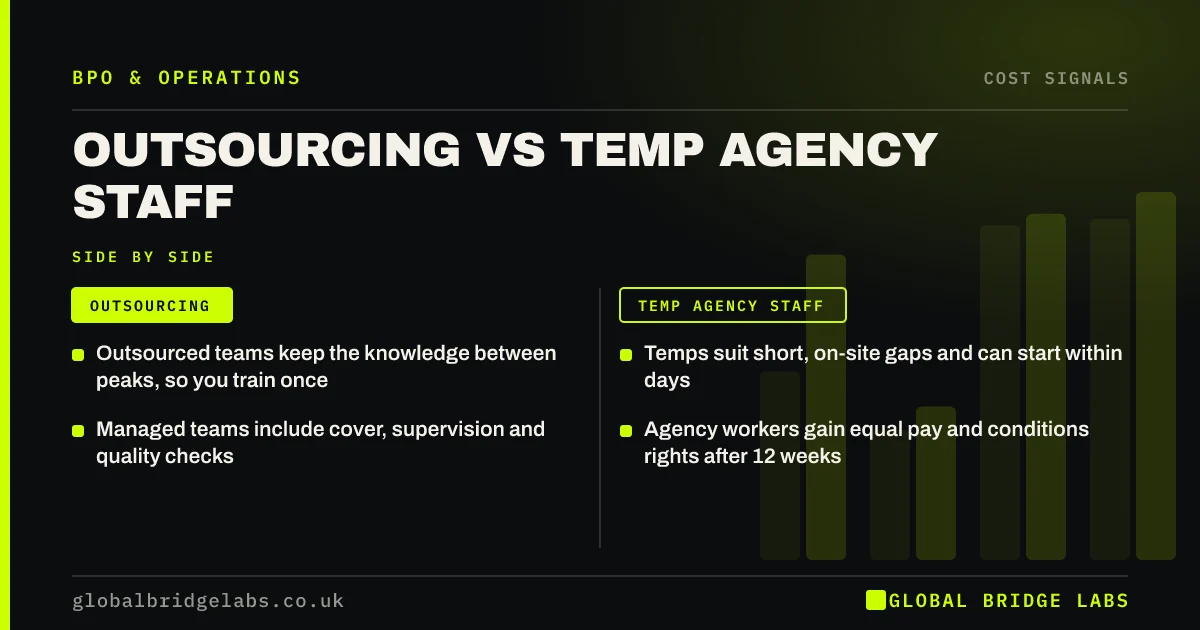
- Outsourced teams keep the knowledge between peaks, so you train once.
- Temps suit short, on-site gaps and can start within days.
- Managed teams include cover, supervision and quality checks.
- Agency workers gain equal pay and conditions rights after 12 weeks.
Choosing between temps and outsourcing? Message us on WhatsApp with the gap you need to fill.
Chat on WhatsApp →What is the difference between temp staff and outsourcing?
Temp staff are people supplied by an agency to work under your direction, usually in your premises and systems. Outsourcing hands a whole process to a provider that staffs, supervises and measures it. With temps you manage the person; with outsourcing you manage the result through a written process and agreed service levels.
How do temps and outsourcing compare?
The comparison below assumes office-based support or admin work. For warehouse or site work that needs physical presence, temps are usually the only practical option.
- Speed: temps can start within days; a managed seat in about two weeks.
- Training: every new temp needs training; an outsourced team retains it.
- Management: you supervise temps; the provider supervises its team.
- Cover: temps rarely come with cover; managed teams include it.
- Rights: agency workers gain equal treatment after 12 weeks.
- Location: temps work on site; outsourced teams work remotely.
How much do temps cost compared with outsourcing?
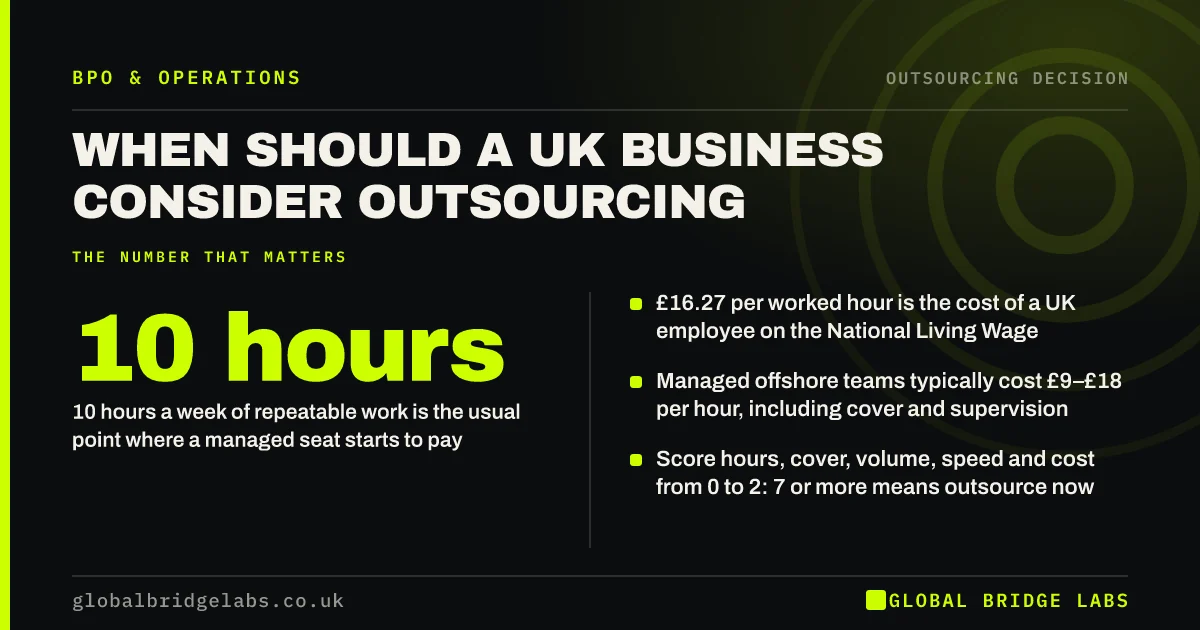
An agency charge rate includes the worker's pay, holiday pay, employer National Insurance and pension, and the agency's margin, so it sits well above the pay rate. At the National Living Wage of £12.71, the charge rate for an admin temp is typically well above £16 an hour. Managed offshore teams cost an indicative £9–£18 per hour, including supervision.
The hidden cost with temps is your time: induction, supervision and retraining each new person.
Want a like-for-like cost comparison? Ask us on WhatsApp.
Chat on WhatsApp →What rights do agency workers have?
From day one, agency workers have rights to use shared facilities, such as a canteen, and to be told about job vacancies. After 12 weeks in the same role with the same hirer, they qualify for the same basic pay and working conditions as someone employed directly. Planning around the 12-week point matters for longer assignments.
When are temps the better choice?
Temps are better for short, one-off gaps where someone must be on site, such as reception cover, a stock count or warehouse peaks. They are also useful when the work depends on your physical equipment or a site-only system. If the same gap appears every year or every month, outsourcing is usually better.
When is outsourcing the better choice?
Outsourcing is better for recurring, remote-friendly work: phones, inbox, booking, data entry, order processing and invoicing. The knowledge stays with the provider's team from one peak to the next, so you train once. It also works for extended hours, which temps rarely cover.
Can you combine temps and outsourcing?
Yes. A common mix is an outsourced team for the recurring remote work, with temps brought in for on-site peaks. For example, a retailer might outsource customer email all year and use temps in the warehouse at Christmas. Each option covers the part of the gap it is best at.
How do temps and outsourcing handle data protection?
Temps usually work inside your systems under your policies, so your existing data protection arrangements cover them, although you still need to control their access. An outsourced provider is a data processor under UK GDPR, which means a written processor contract is required, and an offshore team needs a valid transfer safeguard. Neither is a barrier, but the paperwork is different.
In both cases, give individual logins, grant only the access the work needs, and remove it the day the arrangement ends.
What does this look like in practice?
A pattern we see in UK e-commerce brands: each November they hire two temps for customer email, spend two weeks training them, and lose them in January. The next year starts from zero. An outsourced seat that knows the products and policies from last year can scale up in October without retraining.
Temps or outsourcing checklist
Use these questions to choose.
- Does the work need someone physically on site?
- Is the gap one-off or recurring?
- How long does it take to train someone?
- Will the assignment last more than 12 weeks?
- Does the work need cover beyond one person?
- Who will supervise and check quality?
Next step
Tell us about the gap you are trying to fill. We will say honestly whether temps or an outsourced team would serve you better.
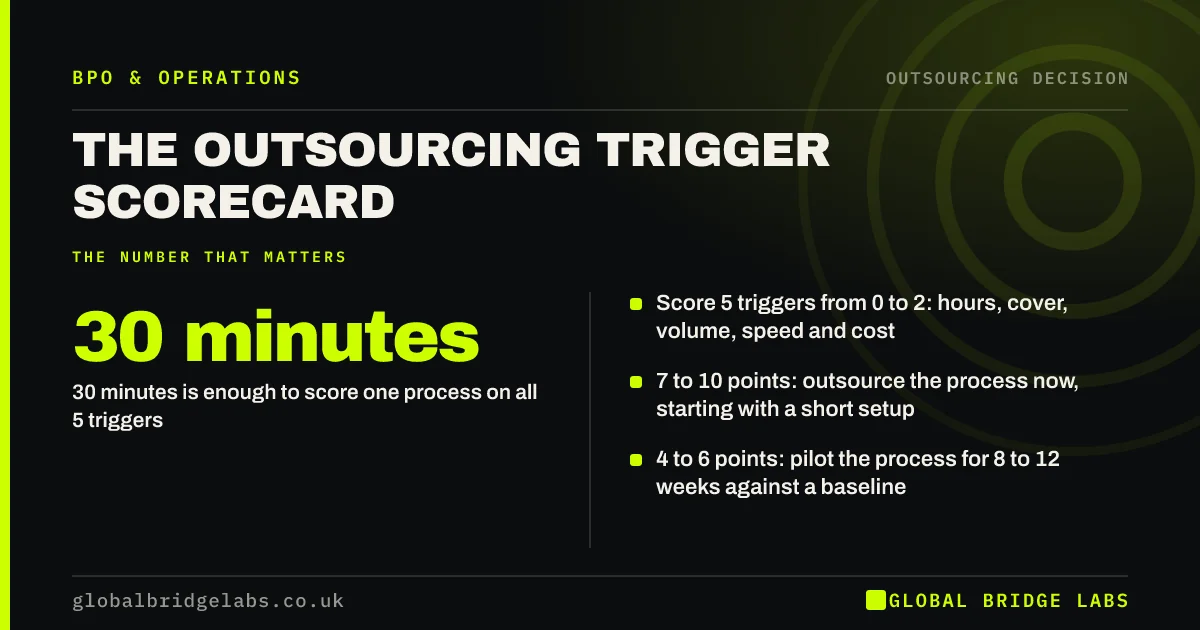
Message us on WhatsApp about your gap, or book a 30-minute consultation.
Chat on WhatsApp →Sources and further reading
- Agency workers: your rights · GOV.UK
- National Minimum Wage and National Living Wage rates · GOV.UK
- Rates and thresholds for employers 2026 to 2027 · HM Revenue & Customs
Frequently asked questions
Is it cheaper to use temps or outsource?
For short on-site gaps, temps are often simpler. For recurring remote work, outsourcing is usually cheaper once you count the agency margin, retraining each temp and your supervision time. Managed offshore teams typically cost £9–£18 per hour including supervision and cover.
What happens after 12 weeks with an agency worker?
After 12 weeks in the same role with the same hirer, an agency worker qualifies for the same basic pay and working conditions as a comparable direct employee. Some rights, such as access to shared facilities and job vacancies, apply from day one.
Can an outsourced team replace temporary staff?
For remote-friendly, repeatable work such as phones, email, booking and data entry, yes. The outsourced team keeps its knowledge between peaks, so you train once. For work that needs someone on site, temps remain the practical option.
Written by

Global Bridge Labs (GBL) is a UK–Sri Lanka partner for social media, websites and BPO. Everything here comes from client delivery, not theory.