On this page
- 01Key takeaways
- 02Why is support a challenge when expanding abroad?
- 03How can outsourcing cover new time zones?
- 04What about languages?
- 05What data protection rules apply?
- 06When should you outsource and when should you hire locally?
- 07How do you measure whether a new market is working?
- 08What are the risks?
- 09What does international support cover cost?
- 10What does this look like in practice?
- 11International support checklist
- 12Next step
- 13Sources and further reading
- 14Frequently asked questions
Key takeaways
Outsourcing for international expansion lets a UK business support customers in new time zones and markets without opening an office. Use it to test demand and cover hours your UK team cannot. Check data protection rules for each market, and hire locally once a market proves itself and needs relationships on the ground.
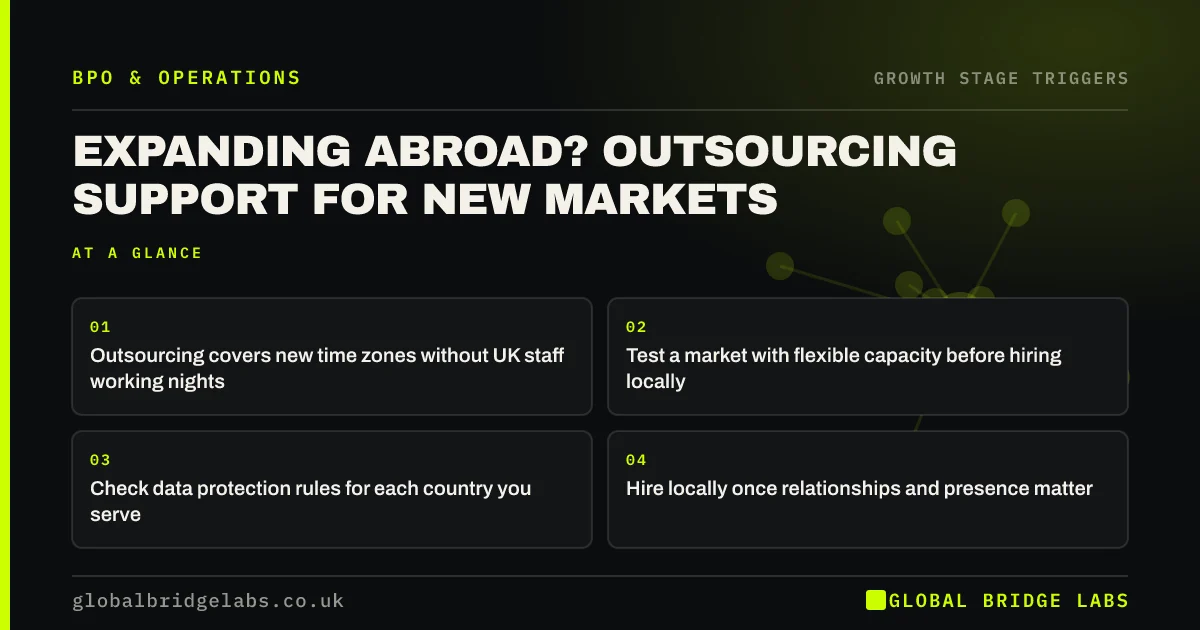
- Outsourcing covers new time zones without UK staff working nights.
- Test a market with flexible capacity before hiring locally.
- Check data protection rules for each country you serve.
- Hire locally once relationships and presence matter.
Expanding overseas? Message us on WhatsApp with the markets you are entering.
Chat on WhatsApp →Why is support a challenge when expanding abroad?
Because customers expect help during their working day, in their language, and your UK team works UK hours. A customer in Dubai or Sydney contacting you at their 9am may wait until your afternoon or the next day. Early in expansion, volume is too small to justify local staff, but too important to leave waiting.
How can outsourcing cover new time zones?
An outsourced team can work shifts that match your new customers' hours. Sri Lanka, for example, is 4.5 hours ahead of UK summer time and 5.5 hours ahead in winter, which overlaps the Middle East, South Asia and part of the Australian day, as well as the UK morning. That gives cover across regions from one team.
What about languages?
English-language markets are easiest to support from an outsourced English-speaking team. For other languages, check whether the provider has fluent speakers, or combine English support with translation tools for written contact. For sales and complex support in another language, native speakers are usually worth the extra cost.
Want to know what language cover is realistic? Ask us on WhatsApp.
Chat on WhatsApp →What data protection rules apply?
UK GDPR applies to your processing, and you need a processor contract with any provider and a valid safeguard for restricted transfers. New markets can add their own rules. If you sell to people in the EU without an EU establishment, EU GDPR may apply to you, and you may need to appoint an EU representative. Take advice for each market.
When should you outsource and when should you hire locally?
Outsource while you are testing a market, when volume is small, and when the work is support and admin that can be done remotely. Hire locally once a market proves itself and needs relationships, sales presence, local legal knowledge or in-person service. Many businesses keep outsourced support even after hiring a local sales lead.
How do you measure whether a new market is working?
Track enquiries, conversion, reply times and cost per customer for each market separately. Outsourced support makes this easier, because hours and contacts can be reported by market. After three to six months you will know whether the market justifies local hires, more support hours, or a rethink.
What are the risks?
The main risks are cultural mismatch, answers that ignore local rules such as consumer rights, and data protection gaps. Brief the team on each market's policies, returns rules and expectations, and review a sample of conversations weekly during launch.
What does international support cover cost?
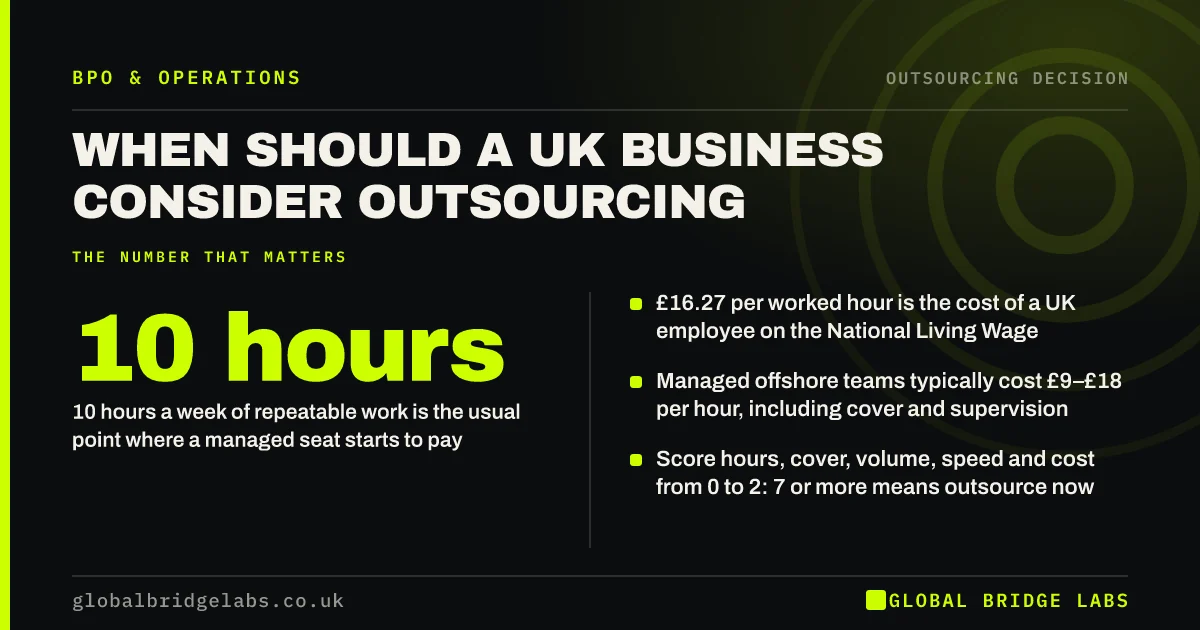
It costs the hours needed to cover your customers' working day, plus any language premium. As indicative market ranges, managed offshore teams cost £9–£18 per hour and onshore UK teams £20–£35. Because one offshore team can often cover several regions in its normal working day, cost per market is usually lower than setting up local support in each.
Start with the hours that matter most, such as your new market's morning, and extend once contact volumes are clear.
What does this look like in practice?
A pattern we see in UK e-commerce and software businesses entering the Gulf or Australia: the UK team answers overnight messages the next morning, and conversion in the new market lags. Adding outsourced support covering those customers' working day lifts response times and gives a clean read on whether the market is worth a local hire.
International support checklist
Use this before launching in a new market.
- Map customers' working hours against your UK team.
- Decide which hours and languages need cover.
- Check data protection rules for each market.
- Brief the team on local policies and consumer rules.
- Track enquiries, conversion and cost by market.
- Hire locally once the market proves itself.
Next step
Tell us which markets you are entering and when your customers need you. We will suggest how to cover them.
Message us on WhatsApp about expansion, or book a 30-minute consultation.
Chat on WhatsApp →Sources and further reading
- International transfers of personal data · Information Commissioner's Office
- Contracts and liabilities between controllers and processors · Information Commissioner's Office
- UK Customer Satisfaction Index · Institute of Customer Service
Frequently asked questions
How do I provide customer support in different time zones?
Use an outsourced team working shifts that match your customers' hours, combined with clear auto-replies for the quietest hours. A team in a time zone between your markets can often cover several regions from one base without anyone working nights.
Should I hire local staff when expanding abroad?
Once a market proves itself and needs relationships, sales presence or in-person service, yes. While testing a market, outsourced support is usually cheaper and more flexible. Many businesses keep outsourced support even after hiring a local sales lead.
Does GDPR apply when selling abroad?
UK GDPR applies to your processing. If you target people in the EU without an EU establishment, EU GDPR may also apply, and you may need an EU representative. Other countries have their own laws. Take advice for each market you enter.
Written by

Global Bridge Labs (GBL) is a UK–Sri Lanka partner for social media, websites and BPO. Everything here comes from client delivery, not theory.