On this page
- 01Key takeaways
- 02Can one social channel be enough?
- 03What does single-channel focus gain you?
- 04What is the risk?
- 05Should you still claim other handles?
- 06When is one channel not enough?
- 07What does this look like in practice?
- 08What does the single channel have to do well?
- 09Next step
- 10Sources and further reading
- 11Frequently asked questions
Key takeaways
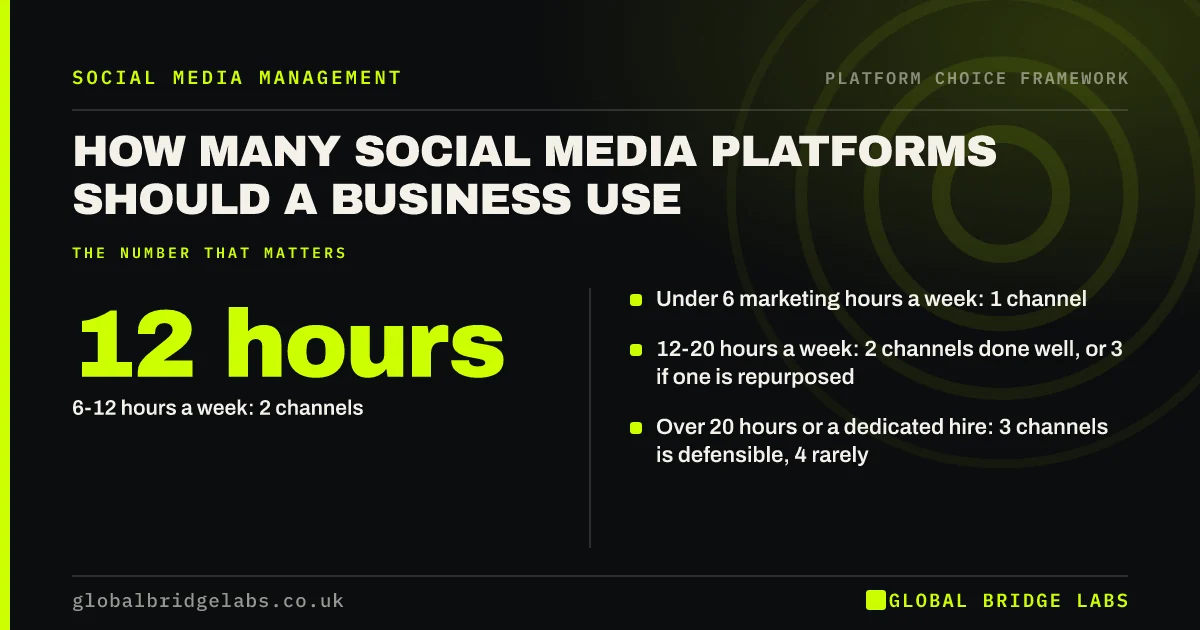
One channel done consistently for a year beats two done sporadically. For any UK business with under six marketing hours a week, single-channel focus is the correct strategy, provided you pair it with an owned channel you control.
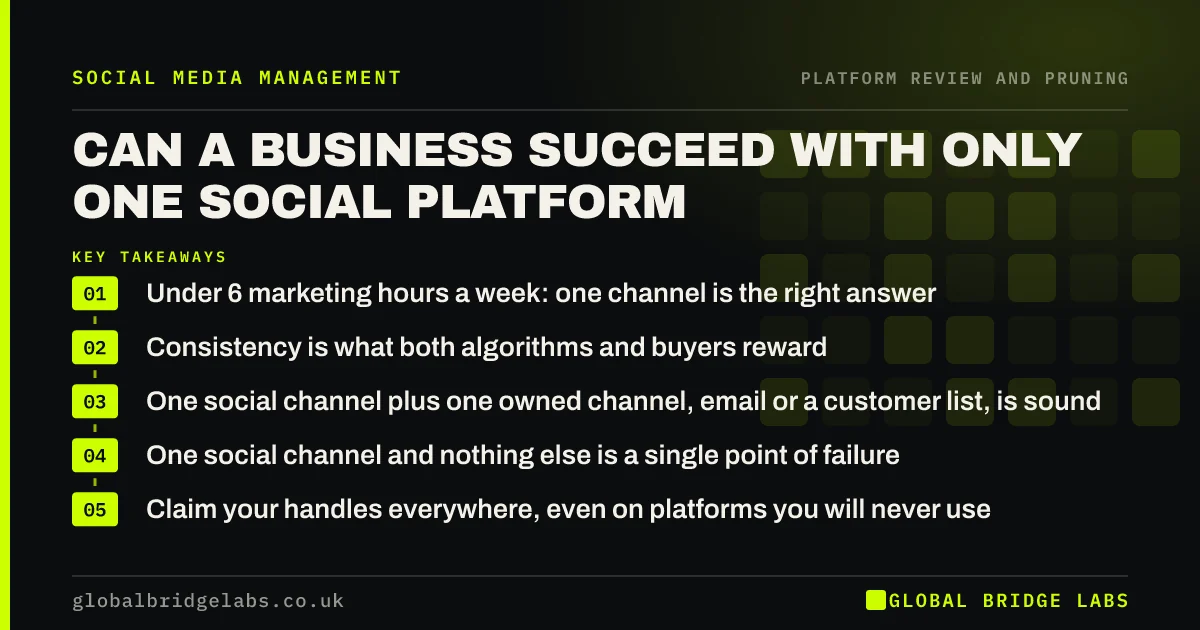
- Under 6 marketing hours a week: one channel is the right answer.
- Consistency is what both algorithms and buyers reward. Focus buys consistency.
- One social channel plus one owned channel, email or a customer list, is sound.
- One social channel and nothing else is a single point of failure.
- Claim your handles everywhere, even on platforms you will never use.
Considering focusing on one channel? We will confirm which one on WhatsApp.
Chat on WhatsApp →Can one social channel be enough?
Yes, and for a large share of UK small businesses it is better than the alternative. A single channel maintained at the required cadence, with replies inside four working hours, will outperform two channels maintained at 60% for the same total effort.
The reason is that both platform distribution and human trust reward consistency, and consistency is a function of capacity. Focus is the cheapest way to buy it.
What does single-channel focus gain you?
Five things, and the first two are worth more than any reach you give up.
- Reply speed, which is where most social enquiries are won or lost.
- Native format mastery, because you learn one platform properly instead of four badly.
- Consistency, which compounds over a year in a way bursts never do.
- Clear measurement, because there is only one channel to attribute anything to.
- A sustainable workload, which means the person doing it does not quietly stop.
What is the risk?
Dependency, and it is genuine. An algorithm change, a policy change or an account suspension can remove your entire audience with no notice and no appeal that arrives in a useful timeframe.
The mitigation is not a second social channel, which carries the same category of risk. It is an owned channel: an email list, a customer database, or a Google Business Profile. One social channel plus one owned channel is a sound position; one social channel alone is a single point of failure.
We will help you build the owned channel behind your social one. Ask on WhatsApp.
Chat on WhatsApp →Should you still claim other handles?
Yes, on every platform you might conceivably use, and it costs five minutes each. Handle-squatting is a real problem and recovering a handle someone else has taken is difficult and sometimes impossible.
Claim it, complete the bio with one line and a link, post nothing, and leave it. That is different from maintaining a channel: there is no expectation of activity on a profile that has clearly never been used, whereas a profile with 40 posts and an 18-month gap reads as abandonment.
When is one channel not enough?
When you serve two genuinely different audiences, such as trade and retail, or when recruitment is a continuous need alongside sales. Those are real second-channel cases because the content cannot be shared.
It is also not enough when you have the capacity for more and are choosing focus out of caution rather than constraint. If you have fifteen marketing hours a week and one channel, you are leaving reach on the table.
What does this look like in practice?
A UK two-person architectural practice ran three channels badly for two years, posting in bursts around project completions and going quiet for months in between.
Dropping to one channel with a fortnightly post and replies within a day produced more enquiries in the following year than the previous two combined. The output was lower and the presence was continuous, which is what a prospective client checking them in month seven actually needed.
What does the single channel have to do well?
Three things, and all three have to hold, because there is no second channel covering for it. It has to be findable, current and answered.
Findable means your business name, service area and what you do are all in the profile in the words people search. Current means the most recent post is recent enough that nobody wonders whether you are still trading. Answered means messages get a reply inside a working day, every week, including busy ones.
A single channel that does those three things consistently will outperform two channels doing them intermittently, which is the entire case for focus.
Check all three once a quarter. It takes ten minutes and it catches the slow drift that turns a working single channel into a dormant one, which is the only way single-channel focus actually fails.
Next step
If you have under six marketing hours a week, pick one channel this month and commit for a year. Then spend one of those hours building an email list, so the audience you build is not entirely rented.
Message us on WhatsApp and we will pick your single channel and set the cadence.
Chat on WhatsApp →Sources and further reading
- Meta Business Help Centre · Meta
- Electronic and telephone marketing under PECR · Information Commissioner's Office
Frequently asked questions
Can a business succeed with just one social media platform?
Yes, and for any UK business with under six marketing hours a week it is the right answer. One channel at the required cadence with fast replies beats two channels maintained at 60% for the same total effort.
What is the risk of using only one social channel?
Dependency: an algorithm change, policy change or suspension can remove your audience overnight. The mitigation is an owned channel such as an email list or customer database, not a second social platform carrying the same risk.
Should you claim handles on platforms you will not use?
Yes. It costs five minutes and recovering a handle someone else has taken is difficult. Complete the bio with one line and a link, post nothing, and leave it. An unused profile is fine; an abandoned one is not.
When does one social channel stop being enough?
When you serve two genuinely different audiences whose content cannot be shared, when recruitment is a continuous need alongside sales, or when you have the capacity for more and are limiting yourself out of caution rather than constraint.
Written by

Global Bridge Labs (GBL) is a UK–Sri Lanka partner for social media, websites and BPO. Everything here comes from client delivery, not theory.