On this page
- 01Key takeaways
- 02Why does social spend lean towards new customers?
- 03What should the existing-customer share pay for?
- 04When should you tilt towards existing customers?
- 05What are the risks of the wrong split?
- 06What does this look like in practice?
- 07Customer split checklist
- 08Next step
- 09Sources and further reading
- 10Frequently asked questions
Key takeaways
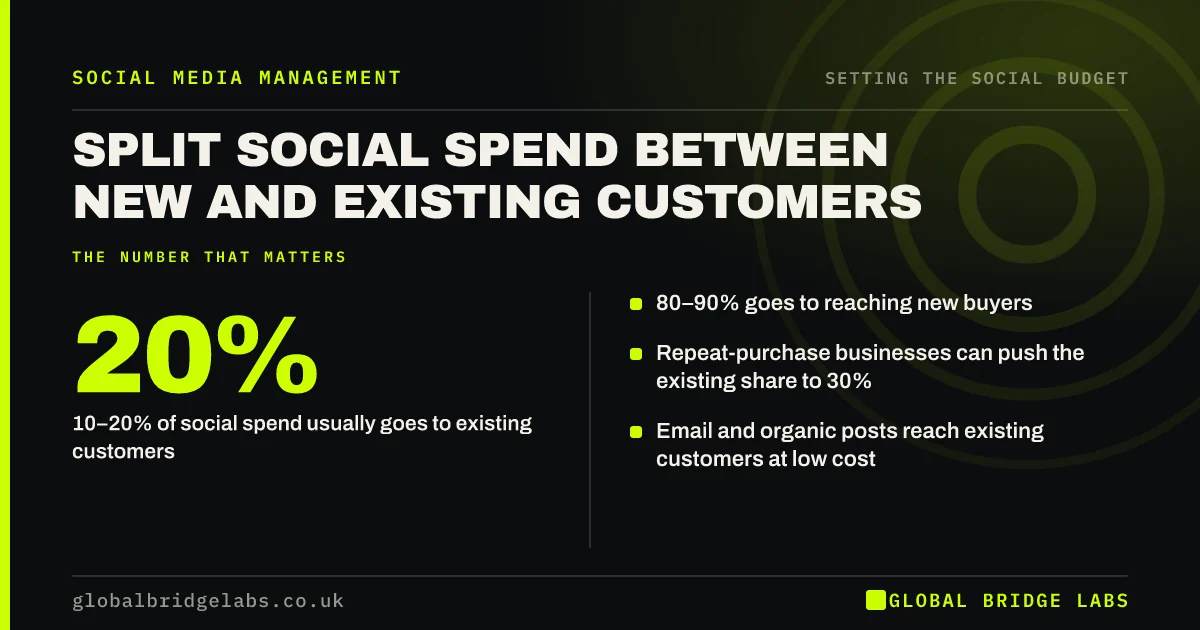
Splitting a marketing budget between new and existing customers on social media usually favours new buyers, because existing customers can be reached cheaply by email and organic posts. As a GBL rule of thumb, put 10–20% of social spend towards existing customers and the rest towards finding new ones.
- 10–20% of social spend usually goes to existing customers.
- 80–90% goes to reaching new buyers.
- Repeat-purchase businesses can push the existing share to 30%.
- Email and organic posts reach existing customers at low cost.
Want your split worked out? Message us on WhatsApp.
Chat on WhatsApp →Why does social spend lean towards new customers?
Existing customers already know you, follow you or are on your email list, so you can reach many of them without paying. Paid social is strongest at finding people who have never heard of you. Spending heavily to show ads to existing buyers often pays for sales that would have happened anyway.
What should the existing-customer share pay for?
Use it for things that create a second sale or a referral: ads to past buyers announcing a new service, reminders for seasonal repeat work, review requests and referral offers. Upload customer lists only with a lawful basis under UK GDPR, and keep the message different from cold ads.
- New service or product announcements to past buyers.
- Seasonal reminders for repeat work.
- Referral offers that reward introductions.
- Review requests after a completed job.
Send us your repeat-purchase rate on WhatsApp and we will discuss your requirements.
Chat on WhatsApp →When should you tilt towards existing customers?
Tilt towards them when repeat purchase is the business model, such as cafes, salons, subscriptions and consumables, or when new-customer costs rise sharply. Then 25–30% can be sensible. Tilt back when you need growth beyond your current base or are opening in a new area.
What are the risks of the wrong split?
All acquisition and no retention leaks customers you paid to win. All retention and no acquisition shrinks the business slowly as customers move or stop buying. Track how many sales each month come from new versus returning customers, and set the split from that number.
What does this look like in practice?
A pattern we see: retargeting audiences full of existing customers absorb a large share of ad spend and report excellent results, because those people were going to buy again. Excluding recent buyers from cold campaigns usually frees budget for genuinely new customers.
Customer split checklist
- Measure the share of sales from returning customers.
- Set the existing-customer share at 10–20% to start.
- Use email and organic posts first for existing buyers.
- Exclude recent customers from cold ad audiences.
- Check the lawful basis for any uploaded customer list.
Next step
Count last quarter's sales from new and returning customers. Compare that ratio with how your social spend was divided, and adjust the next month's plan.
Message us on WhatsApp with your ratio, or book a 30-minute consultation.
Chat on WhatsApp →Sources and further reading
- Direct marketing and privacy and electronic communications · Information Commissioner's Office
- Meta Business Help Centre · Meta
Frequently asked questions
Is it cheaper to keep a customer than find a new one?
Usually, because existing customers already trust you and can be reached through email and organic posts at little cost. That is a reason to look after them, not to put most paid social spend towards them. Paid reach is most valuable for finding people who do not know you yet.
Can I upload my customer list to Facebook?
Meta allows customer list audiences, but under UK GDPR you need a lawful basis and must tell customers in your privacy notice that their data may be used this way. Check the ICO's direct marketing guidance and your consent records before uploading.
Should I exclude existing customers from my ads?
Exclude recent buyers from cold campaigns aimed at new customers, so you do not pay to reach people who already bought. Keep a separate, smaller campaign for existing customers with a message that suits them, such as a new service or a referral reward.
Written by

Global Bridge Labs (GBL) is a UK–Sri Lanka partner for social media, websites and BPO. Everything here comes from client delivery, not theory.