On this page
- 01Short answer
- 02What does social media actually cost a small business?
- 03How much should you spend as a percentage of revenue?
- 04How should the budget be split?
- 05What is the minimum viable social media budget?
- 06Where do small businesses waste social media budget?
- 07When should you increase the budget?
- 08How do you budget across a year rather than a month?
- 09Next step
- 10Sources and further reading
- 11Frequently asked questions
Short answer
Most UK small businesses need £500-£2,500 a month for social media to produce readable results. Split it roughly 60% production, 15% tools, 25% paid reach. Below about £300 a month in total, you are buying activity rather than outcomes.
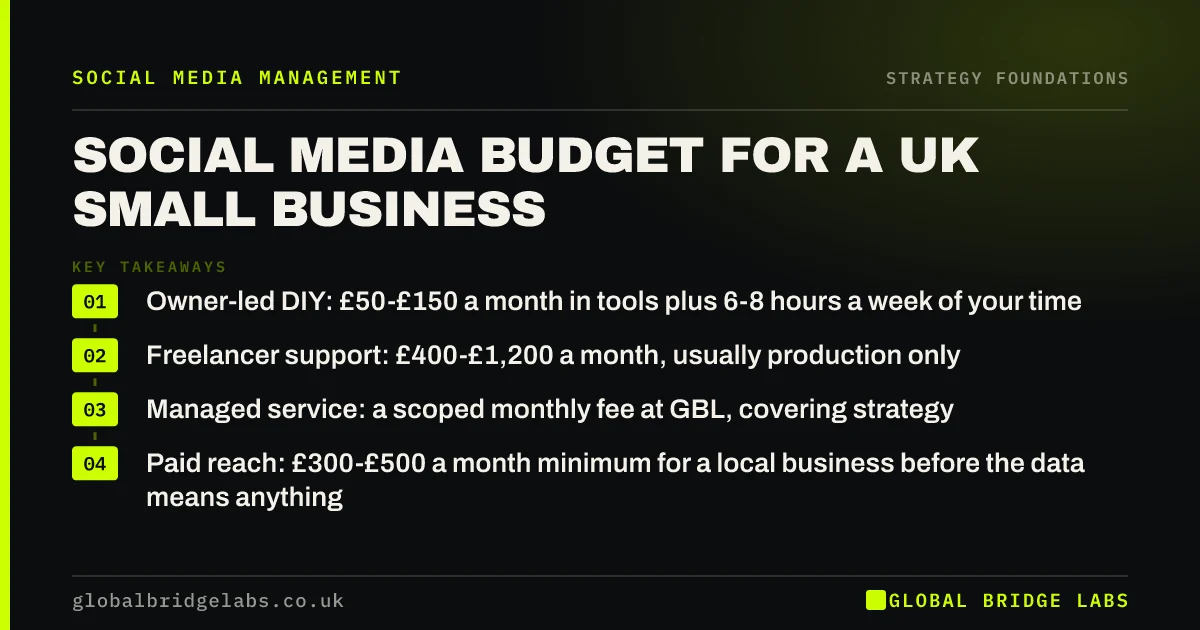
- Owner-led DIY: £50-£150 a month in tools plus 6-8 hours a week of your time.
- Freelancer support: £400-£1,200 a month, usually production only.
- Managed service: a scoped monthly fee at GBL, covering strategy, production, publishing and reporting.
- Paid reach: £300-£500 a month minimum for a local business before the data means anything.
- Rule of thumb: marketing at 5-10% of revenue, with social taking a share proportional to where your buyers actually are.
Want a costed plan against your revenue and goals? Message us on WhatsApp.
Chat on WhatsApp →What does social media actually cost a small business?
Three cost lines, and most budgets only count the third.
Production is people time, whether that is your hours, a freelancer's or an agency's. It is the largest line and the one most often valued at zero when an owner does it themselves. At a modest £40 an hour of owner time, six hours a week is around £960 a month of real cost before a penny is spent on anything else.
Tools are scheduling, design and analytics, typically £20-£80 a month for a small business. Paid reach is amplification, and it is the only line that scales linearly.
How much should you spend as a percentage of revenue?
A common planning range for UK SMEs is 5-10% of revenue on total marketing, with the lower end for established businesses with referral flow and the higher end for those trying to grow into a new area or service line.
Social media should take a share of that proportional to its role. If social is your primary acquisition channel, 30-50% of the marketing budget is reasonable. If it is credibility support for a referral-led business, 10-15% is enough, and the rest belongs with your website and search.
How should the budget be split?
Start at 60 / 15 / 25 and adjust once you have 90 days of data.
- 60% production: content creation, community management, reporting.
- 15% tools and assets: scheduling, design, stock where unavoidable, occasional photography.
- 25% paid reach: boosting proven organic posts and running one always-on campaign.
- Adjust up on paid when a post consistently outperforms organically. That is the cheapest reach you will ever buy.
What is the minimum viable social media budget?
For a local UK business, roughly £300-£500 a month of paid reach plus a committed 6 hours a week of production is the floor at which you can tell whether social works for you.
Below that, you will get results, but you will not be able to interpret them. Small budgets produce small sample sizes, and a fortnight of £50 spend cannot distinguish between a weak offer, a weak audience and normal variance. That ambiguity is what causes businesses to abandon a channel that would have worked.
Tell us your monthly figure on WhatsApp and we will tell you honestly whether it is enough for your sector.
Chat on WhatsApp →Where do small businesses waste social media budget?
Four places, consistently.
Boosting posts with no objective set, which buys impressions instead of actions. Paying for followers or engagement pods, which permanently damages your audience quality. Producing expensive video before knowing whether the message works, when a phone test would have answered it for nothing. And paying a retainer that covers publishing only, so nobody is accountable for whether it produced anything.
- Boosting without a conversion objective or a destination that converts.
- Buying followers, engagement or comments. Always visible, always counterproductive.
- High production values before message validation.
- Retainers with deliverables measured in posts rather than outcomes.
When should you increase the budget?
Increase when cost per enquiry is stable and below your threshold, and only then. If you are getting enquiries at £45 and you can service twice as many, more budget is straightforward arithmetic.
Do not increase budget to fix weak results. Scaling an unprofitable channel scales the loss. Fix the offer, the destination page or the response time first, then scale what works.
How do you budget across a year rather than a month?
Set an annual figure and weight it to your commercial calendar, rather than spending the same amount every month regardless of whether anyone is buying.
For most UK SMEs that means front-loading spend into the weeks before your buying season and protecting a baseline through the quiet months. A garden business spends heavily in February and March; a hospitality venue spends in September for Christmas; a B2B firm avoids August.
Hold back roughly 10% of the annual budget as a reserve. Something will work better than expected, and being able to fund it in the month it happens is worth considerably more than spreading the same money evenly across twelve months.
- Set the budget annually, spend it seasonally.
- Front-load into the weeks before your buying season.
- Protect a baseline through quiet months to avoid gaps.
- Hold 10% in reserve for what works unexpectedly.
Next step
We will build a costed plan for your business: what to spend, on which line, and what it should return before you commit further.
Message us on WhatsApp for a costed social media plan for your business.
Chat on WhatsApp →Sources and further reading
- Business population estimates for the UK and regions 2025 · Department for Business and Trade
- Employee earnings in the UK (Annual Survey of Hours and Earnings) · Office for National Statistics
Frequently asked questions
How much should a small business spend on social media per month?
£500-£2,500 a month covers most UK small businesses across production, tools and paid reach. The floor for interpretable results is roughly £300-£500 of paid spend plus six committed hours a week. Below that, results exist but cannot be distinguished from variance.
Is it cheaper to do social media in-house?
Only if you value your time at zero. Six hours a week of owner time at £40 an hour is around £960 a month, which is comparable to what a managed service costs. In-house makes sense when someone junior owns it full-time and has strategy support.
How much should I spend on paid social versus organic?
Around 25% of the social budget on paid reach to start. Spend it amplifying posts that have already earned engagement organically rather than on new creative, because organic performance is the cheapest possible test of whether a message works.
What social media tools does a small business actually need?
A scheduler, a design tool and the native platform analytics. That is typically £20-£80 a month. Paid analytics and listening tools only earn their cost once you are managing several brands or need historical competitive data, which small businesses rarely do.
Written by

Global Bridge Labs (GBL) is a UK–Sri Lanka partner for social media, websites and BPO. Everything here comes from client delivery, not theory.