On this page
Key takeaways
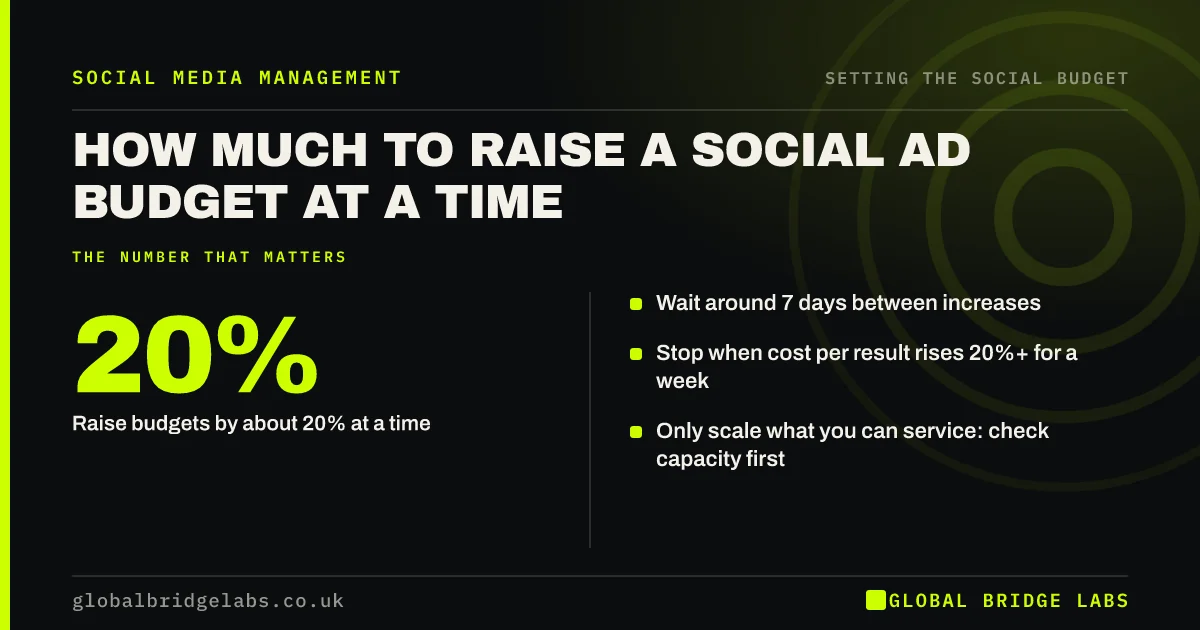
How much to increase an ad budget depends on stability. As a GBL rule of thumb, raise a working campaign by about 20% at a time and wait around seven days before the next step. Large jumps can push the platform back into learning and lift cost per result. Stop scaling when costs climb.
- Raise budgets by about 20% at a time.
- Wait around 7 days between increases.
- Stop when cost per result rises 20%+ for a week.
- Only scale what you can service: check capacity first.
Want a scaling plan for a working campaign? Message us on WhatsApp.
Chat on WhatsApp →Why not double the budget at once?
Meta treats a significant budget change as a reason to re-enter the learning phase, and results are less stable while it relearns. A sudden doubling also forces the system to find twice as many people at once, often less likely buyers. Steady steps keep costs predictable while reach grows.
What does a scaling schedule look like?
Illustrative schedule: a campaign at £20 a day producing enquiries below target rises to £24, then £29, then £35 and £42 over four weeks, if cost per enquiry holds. That is roughly doubling in a month with four checks along the way. Any week that breaks the target pauses the climb.
- Week 1: £20 a day.
- Week 2: £24 a day.
- Week 3: £29 a day.
- Week 4: £35 a day.
- Week 5: £42 a day, if results hold.
Send us your current daily budget on WhatsApp and we will discuss your requirements.
Chat on WhatsApp →What signals should stop you scaling?
Stop when cost per enquiry rises noticeably for a week, when frequency climbs because the audience is too small, or when you cannot reply to enquiries quickly. Scaling past your capacity wastes the extra leads. Each signal says the next pound will buy less than the last one did.
Is there a faster way to scale?
You can duplicate a working campaign at a higher budget and run both, then keep the better one. It is faster but riskier and costs more while both run. For most small businesses steady steps are safer, because a lost week of learning matters more on a small budget.
What does this look like in practice?
A pattern we see: a campaign works at £15 a day, the owner moves it to £60 overnight, cost per enquiry triples and the conclusion is that ads 'stopped working'. Returning to the old budget and stepping up gradually usually brings costs back to where they were.
Scaling checklist
- Confirm cost per enquiry is below target for two weeks.
- Check you can handle more enquiries.
- Raise the budget by about 20%.
- Wait a week and recheck cost and frequency.
- Repeat, or hold if the target breaks.
Next step
Pick your best campaign and write a four-week scaling schedule with a stop rule. Put the review dates in the calendar now.
Message us on WhatsApp with your schedule, or book a 30-minute consultation.
Chat on WhatsApp →Sources and further reading
- About budgets · Meta
- Meta Business Help Centre · Meta
Frequently asked questions
How often can I increase my Facebook ad budget?
Around once a week is a sensible pace for a small account, giving the platform time to settle and you enough data to judge. Changing budgets daily makes it hard to tell whether results moved because of the change or normal day-to-day variation.
Will increasing my budget reset the learning phase?
A significant change can. Meta lists budget changes among the edits that can send an ad set back into learning. Small, steady increases are less disruptive than large jumps, which is why many advertisers step budgets up gradually. Review it each quarter against your enquiries and sales, and adjust in small steps.
Should I increase budget on a campaign that is not working?
No. More budget scales whatever is already happening, including losses. Fix the offer, audience, creative or landing page first, then prove a cost per enquiry below target at the current budget for at least two weeks. Only then increase spend, in steps, while watching whether the cost holds.
Written by

Global Bridge Labs (GBL) is a UK–Sri Lanka partner for social media, websites and BPO. Everything here comes from client delivery, not theory.