On this page
- 01Key takeaways
- 02What is a customer referral scheme?
- 03How does social media help referrals?
- 04What reward should you offer?
- 05When should you ask for referrals?
- 06What UK rules apply to referral schemes?
- 07When does a referral scheme not work?
- 08What does this look like in practice?
- 09Referral scheme checklist
- 10Next step
- 11Sources and further reading
- 12Frequently asked questions
Key takeaways
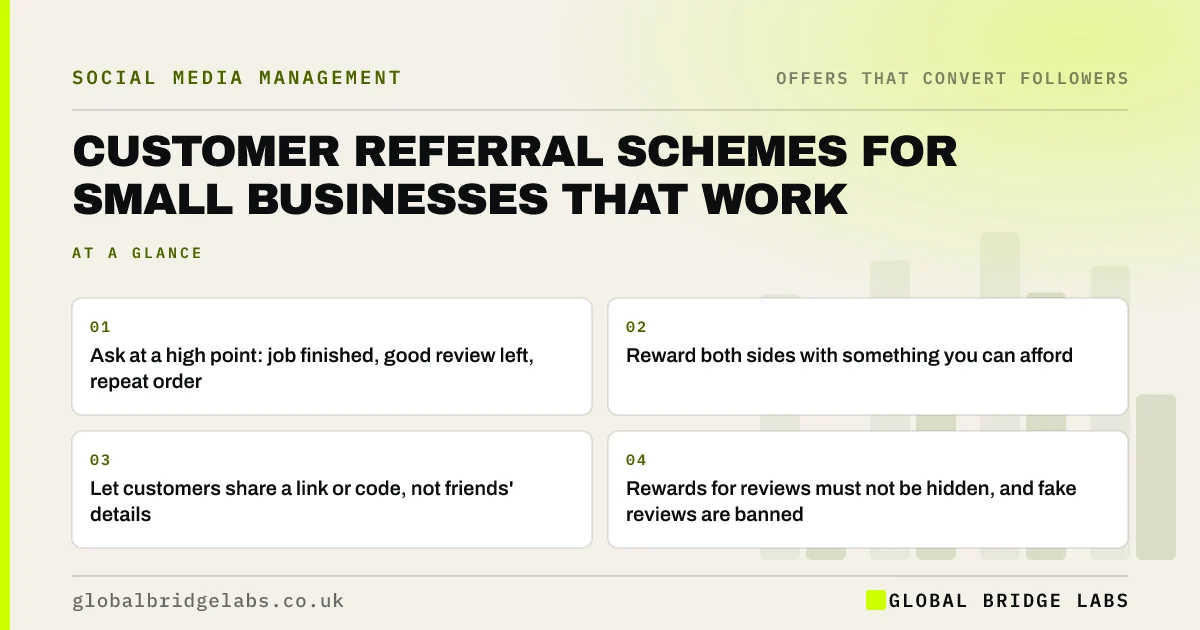
A customer referral scheme turns happy customers into a source of new ones by rewarding them for recommending you. For small businesses the best schemes are simple: one reward for the referrer, often one for the friend, asked for at a moment of satisfaction. Social media spreads it, but the ask works best in person or by message.
- Ask at a high point: job finished, good review left, repeat order.
- Reward both sides with something you can afford.
- Let customers share a link or code, not friends' details.
- Rewards for reviews must not be hidden, and fake reviews are banned.
Want a referral scheme set up? Message us on WhatsApp.
Chat on WhatsApp →What is a customer referral scheme?
A customer referral scheme is a structured programme in which a business rewards existing customers for introducing new customers, usually through a personal code or link that tracks who referred whom. It formalises word of mouth, which is often a small business's best source of customers.
How does social media help referrals?
Social media helps referrals in three ways. Customers can tag or share you where their friends will see it. Your posts give them something easy to forward. And your profile is where the friend checks you out before getting in touch, so it needs proof and a clear offer.
What reward should you offer?
Offer a reward worth the value of a new customer to you but cheap to provide: account credit, a free add-on service, a discount on the next order or a donation to a local cause. Two-sided rewards, where the friend also gets something, tend to make the ask easier. An illustrative example: £50 credit each side on a £1,500 job.
- Trades: credit against the next job, or a free service visit.
- Hospitality: a meal or drinks voucher for both.
- E-commerce: a discount code for both, with a minimum spend.
- B2B: a fee credit or a charity donation.
Want your reward costed? Message us on WhatsApp and we will discuss your requirements.
Chat on WhatsApp →When should you ask for referrals?
Ask when the customer is happiest: just after a job is finished well, after they leave a good review, or when they reorder. Ask personally, explain the reward in one sentence and send a link or code they can forward. A card with the job and a message the next day both work.
What UK rules apply to referral schemes?
If a referral scheme asks customers to post about you in return for a reward, those posts are advertising and should be labelled, under the CAP Code and ASA guidance. Paying for reviews without disclosure, or fake reviews, are banned under the Digital Markets, Competition and Consumers Act 2024. And under PECR, a "refer a friend" scheme where you email friends whose details customers give you is risky; let customers share the link themselves.
When does a referral scheme not work?
A referral scheme does not work when customers are not happy enough to recommend you, when the reward is too small to remember, or when the service is private and people prefer not to say they used it. In sensitive services, a discreet thank-you works better than a public scheme.
What does this look like in practice?
A pattern we see: many customers come by recommendation, but nobody asks for referrals and nothing is tracked. A simple two-sided reward, asked for at the end of each job and with a shareable code, usually turns that habit into a measurable channel.
Referral scheme checklist
- Choose a reward you can afford on every new customer.
- Make it two-sided if you can.
- Give each customer a code or link to share.
- Ask at the moment of satisfaction.
- Label any rewarded posts as adverts.
- Track referrals and pay rewards promptly.
Next step
Count how many of last year's customers came by recommendation. If it is more than a few, a referral scheme is worth setting up this month.
Message us on WhatsApp and we will help design your scheme, or book a 30-minute consultation.
Chat on WhatsApp →Sources and further reading
- Publishing consumer reviews and complying with consumer protection law · Competition and Markets Authority
- Digital Markets, Competition and Consumers Act 2024 · legislation.gov.uk
- Influencers' guide to making clear that ads are ads · ASA / CAP
- Electronic and telephone marketing under PECR · Information Commissioner's Office
Frequently asked questions
How do I set up a referral scheme for a small business?
Choose a reward for the referrer and ideally for the friend, give each customer a code or link to share, ask at a moment of satisfaction such as job completion, and track who referred whom. Keep it simple enough to explain in one sentence.
What is a good referral reward?
One worth less than the profit from a new customer but valued by your customers: account credit, a free add-on, a discount on the next purchase or a charity donation. Two-sided rewards, where both people benefit, tend to make asking and sharing easier.
Can I reward customers for reviews?
Rewarding reviews is risky. Incentivised reviews must not be concealed, and fake reviews are banned under the Digital Markets, Competition and Consumers Act 2024. Platforms such as Google prohibit incentivised reviews. Reward referrals of new customers instead, and ask for honest reviews without a reward.
Written by

Global Bridge Labs (GBL) is a UK–Sri Lanka partner for social media, websites and BPO. Everything here comes from client delivery, not theory.