On this page
- 01Key takeaways
- 02What counts as traditional advertising?
- 03What are the main advantages?
- 04What are the main disadvantages?
- 05What does it cost?
- 06How does it compare with social media?
- 07Who gains most from traditional advertising?
- 08When is it the wrong choice?
- 09What does this look like in practice?
- 10Decision checklist
- 11Next step
- 12Sources and further reading
- 13Frequently asked questions
Key takeaways
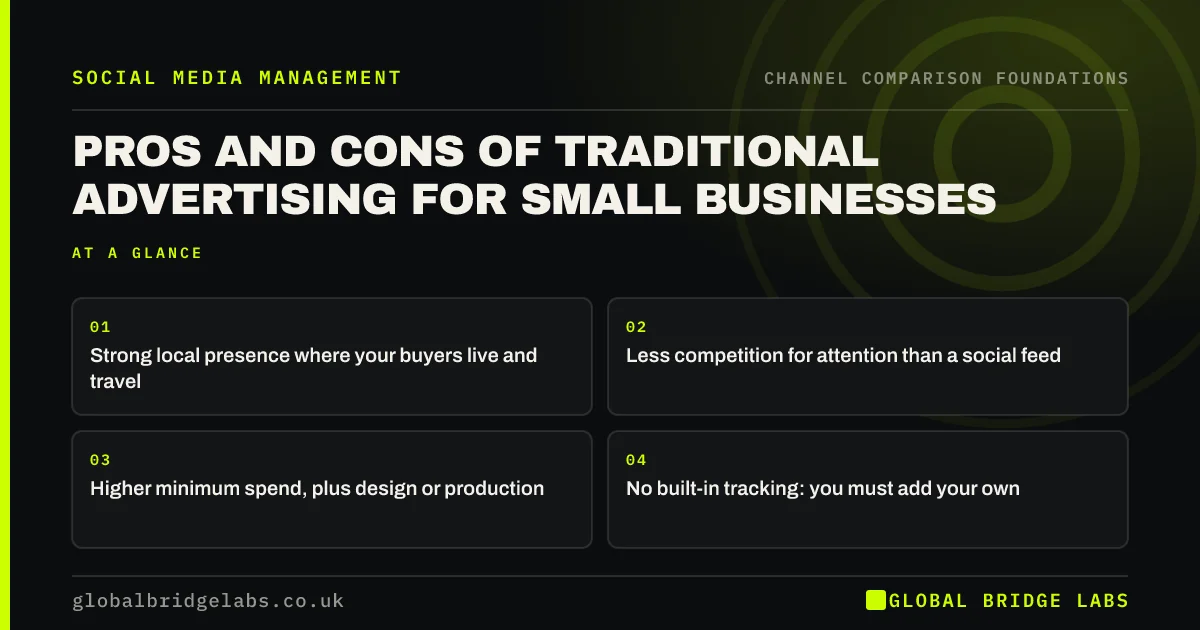
The pros and cons of traditional advertising are the mirror image of social media. It gives a small business physical presence and undivided attention in a defined place. In exchange it costs more to start, cannot be changed once it runs and reports very little about who responded.
- Strong local presence where your buyers live and travel.
- Less competition for attention than a social feed.
- Higher minimum spend, plus design or production.
- No built-in tracking: you must add your own.
Being asked to renew a booking? Message us on WhatsApp and we will help you weigh it up.
Chat on WhatsApp →What counts as traditional advertising?
Traditional advertising is paid promotion in print, on radio and television, through the letterbox, on outdoor sites and at events. For a small business it usually means a local paper or magazine, leaflets, local radio, a poster site or a sponsorship.
What are the main advantages?
The main advantages are presence, attention and reach beyond the internet. A leaflet is in the house. A radio advert is heard on the school run. Neither needs the buyer to be scrolling. For audiences who use social media little, these may be the only adverts they notice.
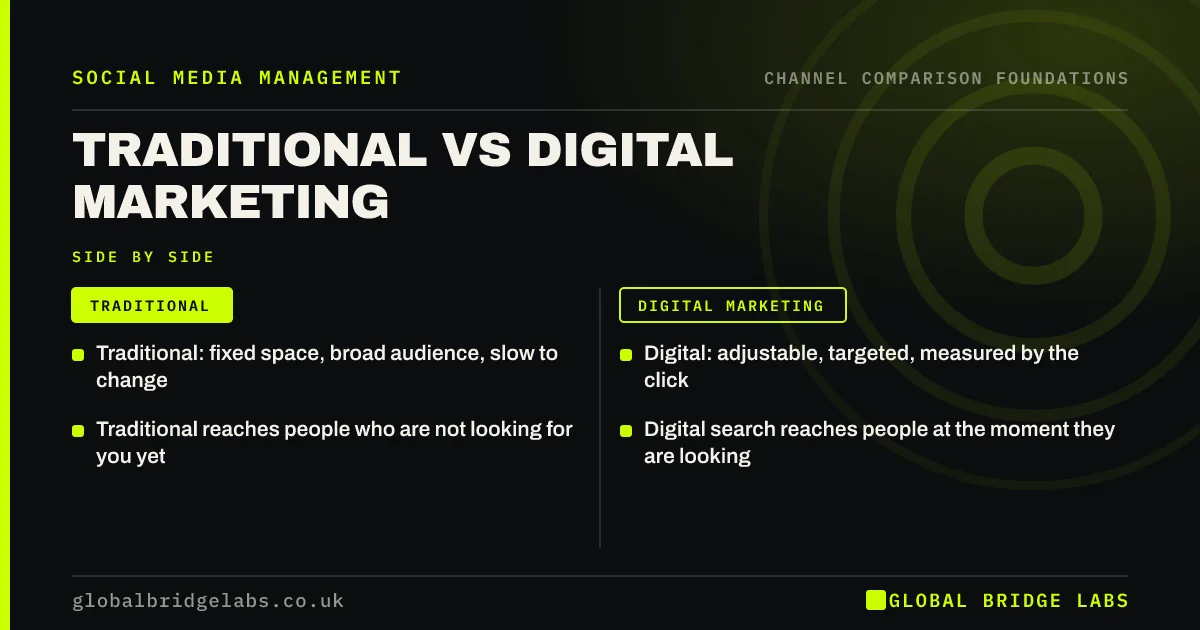
- Reaches people who are not searching or scrolling.
- Covers a defined local area thoroughly.
- Physical items can be kept and shared at home.
- A known title or station lends some credibility.
- No algorithm decides whether it is shown.
What are the main disadvantages?
The main disadvantages are cost, rigidity and blindness. You pay to reach everyone the medium covers, including people who will never buy. A mistake cannot be corrected after printing. And the media owner can tell you the audience size, but not how many enquiries your advert produced.
- Larger minimum spend and advance booking.
- Design, print or production cost on top.
- Cannot be edited once it has run.
- Pays for many people outside your market.
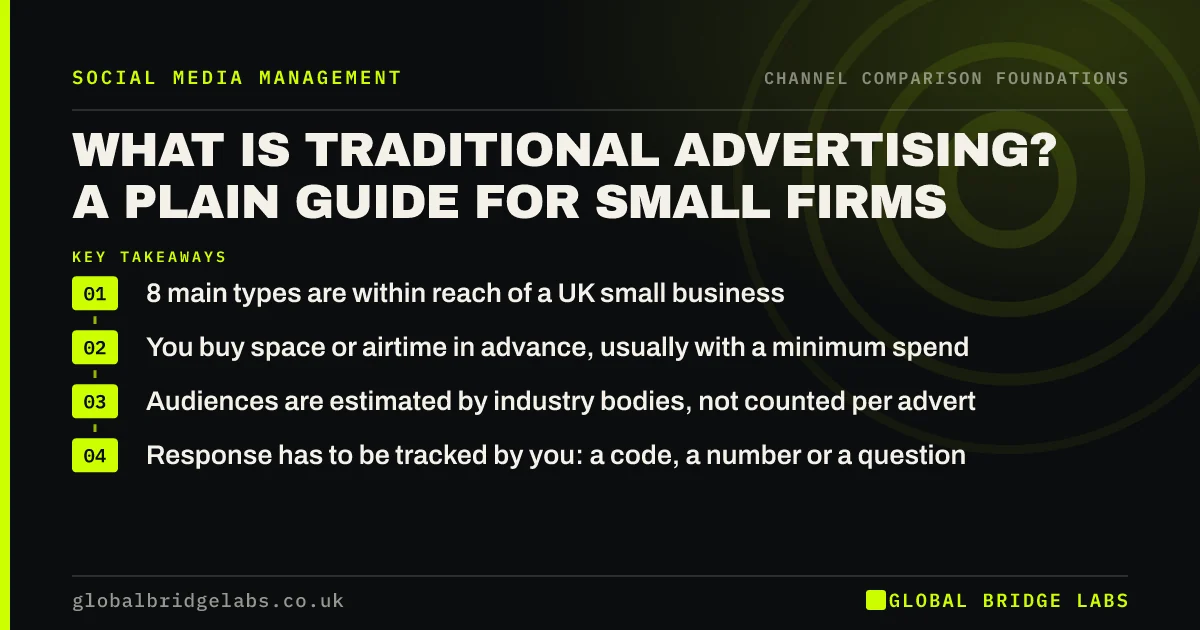
- Response must be tracked by you.
What does it cost?
As indicative UK ranges, a leaflet drop costs roughly 6p to 15p per household including print, a local newspaper advert £150 to £1,000 an insertion, a week of local radio £500 to £2,500 plus production and a two-week billboard outside London £300 to £1,200. Because repetition matters, budget for at least three appearances.
- How much does advertising cost a UK small business?
- How to negotiate advertising rates as a small business
Want a quote sense-checked against a social media test? Message us on WhatsApp and we will discuss your requirements.
Chat on WhatsApp →How does it compare with social media?
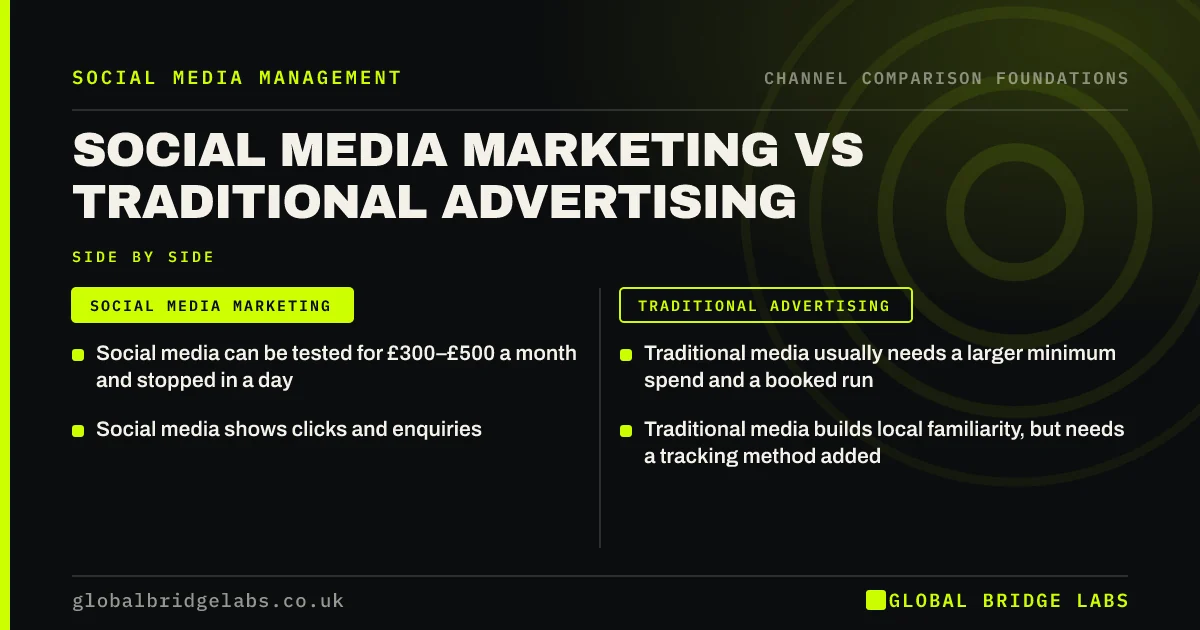
Compared with social media, traditional advertising is harder to target and track but easier to run: once it is booked, the work is done. Social media can be tested from £300–£500 a month and changed daily. Many firms find one covers the weakness of the other.
Who gains most from traditional advertising?
Businesses gain most when they serve households in a compact area, when buyers are older, or when a location needs to be known. Ofcom's Media Nations 2026 report found just under nine in ten adults listen to live radio weekly, and JICMAIL data shows door drops are kept for 5.6 days on average.
When is it the wrong choice?
It is the wrong choice when you can only afford one appearance, when your customers are scattered nationally, or when you are buying under pressure from a deadline offer. It is also wrong if you will not track it, because you will face the same decision next year with no more evidence.
What does this look like in practice?
A pattern we see with local service firms: a single half-page advert is bought once, produces two calls and is declared a failure. The same budget split across three smaller appearances in the same title, each with a code, often tells a different story, because readers needed to see the name more than once.
Decision checklist
- Do your buyers use this medium? Ask them.
- Does its area match the area you serve?
- Can you afford three or more appearances?
- Is there a code, number or web address on it?
- Have you compared it with a social media test?
Next step
Before your next booking, ask the media owner for audience figures for your postcodes and decide how you will track replies.
Message us on WhatsApp with the quote and we will help you judge it, or book a 30-minute consultation.
Chat on WhatsApp →Sources and further reading
- Media Nations 2026: TV, video, radio and audio in the UK · Ofcom
- Joint Industry Committee for Mail: audience measurement for mail and door drops · JICMAIL
- UK Code of Non-broadcast Advertising and Direct & Promotional Marketing (CAP Code) · ASA / CAP
- Radio Joint Audience Research: UK radio listening figures · RAJAR
Frequently asked questions
What are the advantages of traditional advertising?
Traditional advertising reaches people who are not online at that moment, covers a local area thoroughly and has a physical or audible presence that is hard to scroll past. A respected local title or station can also lend a small business some credibility.
What are the disadvantages of traditional advertising?
It usually costs more to start, has to be booked ahead, cannot be changed after it runs and reaches many people outside your market. It also has no built-in way of showing who responded, so tracking has to be added by the advertiser.
Is traditional advertising more trustworthy than online advertising?
Not automatically. Some people give more weight to a printed or broadcast advert because it took money and commitment to place. Trust still depends on the advert being honest and the business being easy to check, and the same advertising rules apply to every medium.
Is traditional advertising worth it for a small business?
It can be, when the audience and area match and the advert is repeated and tracked. It is rarely worth it as a single untracked appearance. Test it on a small scale and compare cost per enquiry with social media before committing to a long booking.
Written by

Global Bridge Labs (GBL) is a UK–Sri Lanka partner for social media, websites and BPO. Everything here comes from client delivery, not theory.