On this page
- 01Key takeaways
- 02Is any advertising really free?
- 03Which free listings should you claim?
- 04What can you do on social media for nothing?
- 05How do reviews and referrals count?
- 06What do you already own that can advertise?
- 07Which should you do first?
- 08How much time should you set aside?
- 09What are the limits of free advertising?
- 10When should you start paying?
- 11What does this look like in practice?
- 12Next step
- 13Sources and further reading
- 14Frequently asked questions
Key takeaways
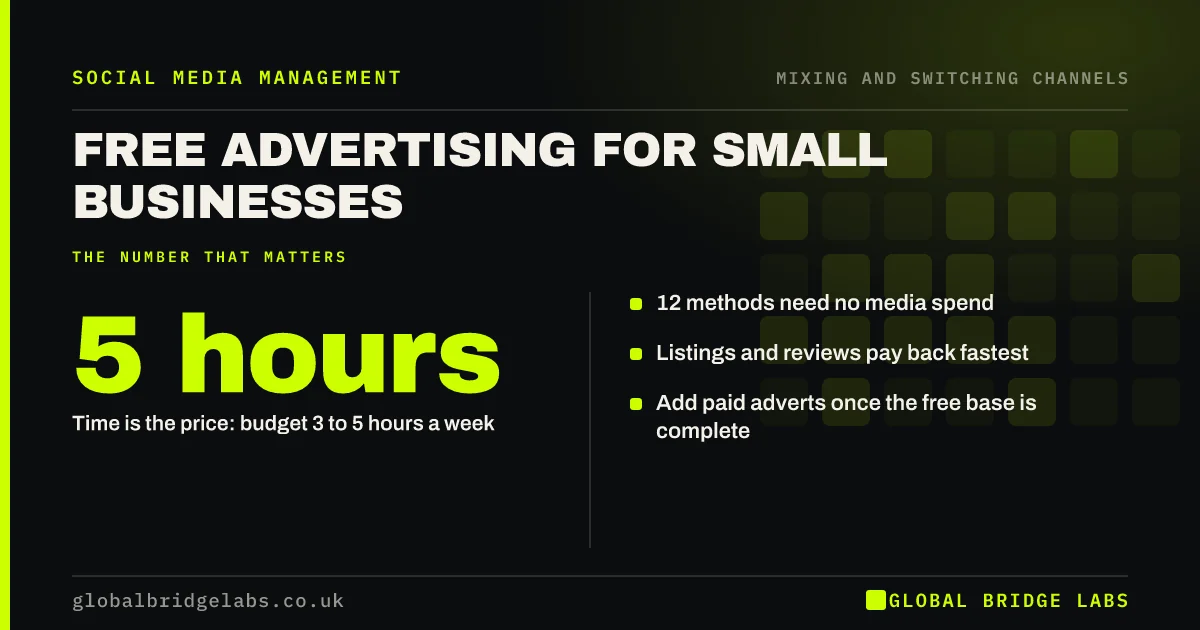
Free advertising for a small business means channels with no media cost: listings, social media, reviews, referrals and your own signs. They cost time, not money, and together they form the base that any paid advert later relies on.
- 12 methods need no media spend.
- Time is the price: budget 3 to 5 hours a week.
- Listings and reviews pay back fastest.
- Add paid adverts once the free base is complete.
Want to know which free methods fit your business? Message us on WhatsApp.
Chat on WhatsApp →Is any advertising really free?
No advertising is free of effort. 'Free' here means you pay no media owner. At the April 2026 National Living Wage an hour of staff time costs about £16.27 with employer costs, so four hours a week is roughly £3,400 a year. That is still a low price for a base that lasts.
Which free listings should you claim?
Claim the listings buyers and search engines check first.
- 1. Google Business Profile, fully completed.
- 2. Bing Places and Apple Business Connect.
- 3. Free entries in relevant trade and local directories.
What can you do on social media for nothing?
Unpaid social media is the largest free channel, and it rewards regularity.
- 4. Post finished work weekly, naming the area.
- 5. Answer questions helpfully in local community groups.
- 6. Share customer photos and reviews, with permission.
How do reviews and referrals count?
Reviews and referrals are advertising other people do for you.
- 7. Ask every satisfied customer for a review.
- 8. Ask for referrals and thank people who give them.
- 9. Swap recommendations with firms that serve the same customers.
What do you already own that can advertise?
Your own assets advertise every day once they carry your name clearly.
- 10. Email signature, invoices and quotes.
- 11. A job-site board, with the customer's permission.
- 12. A story offered to the local paper or community page.
Which should you do first?
Do the listing and the reviews first, because they help people who are already looking. Then set a weekly posting habit. Then work on referrals. Leave press stories and partnerships until the basics run without thought.
How much time should you set aside?
Set aside three to five hours a week and protect them. A workable split is one hour for listings and reviews, two for creating and posting content and one for replying and taking part in local groups. Put the hours in the diary as you would a job, because free methods fail mainly through neglect.
What are the limits of free advertising?
Free methods are slow and mostly reach people close to your existing customers. Unpaid posts are shown to a fraction of followers. If you need enquiries this month, or want to reach a new area, free methods alone will not do it.
When should you start paying?
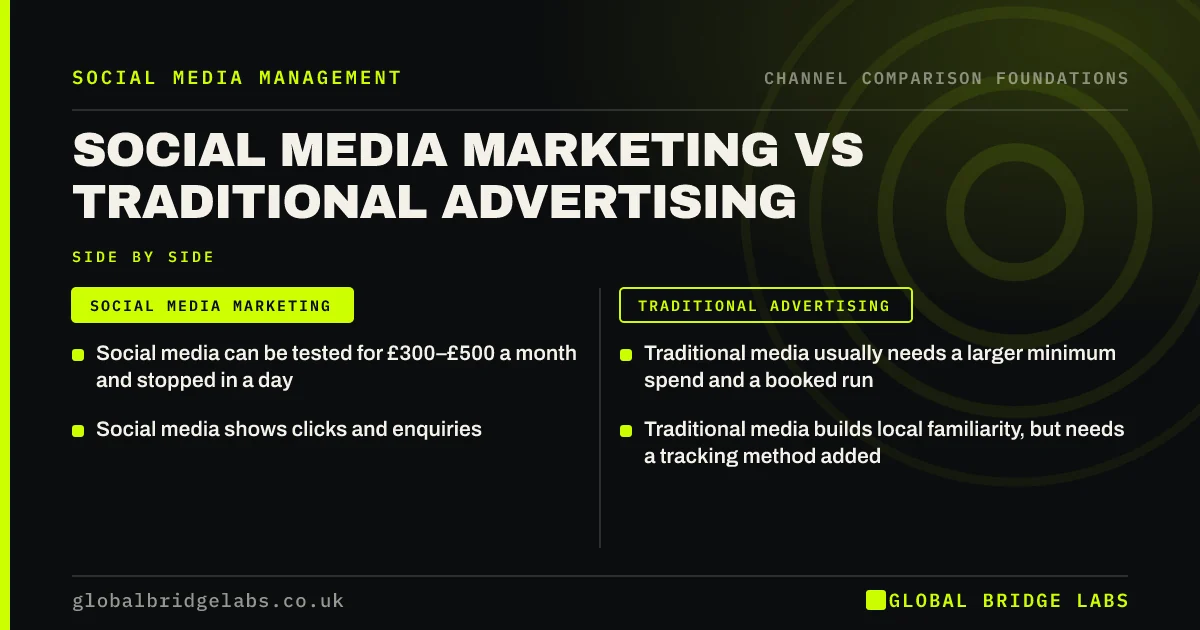
Start paying when the free base is complete and you want growth you can control. Paid social has a practical floor of £300–£500 a month. If time is the constraint, most UK SMEs using an agency pay £950–£2,500 a month for managed social media.
- The minimum budget to test an advertising channel properly
- How much does advertising cost a UK small business?
Ready to add a small paid test to your free base? Message us on WhatsApp and we will discuss your requirements.
Chat on WhatsApp →What does this look like in practice?
A pattern we see with firms on tight budgets: money is found for an advert while the free listing has no photos and four reviews. An afternoon spent completing the free methods usually does more than the advert would have.
Next step
Tick off the twelve methods and count how many you do every week. Start with the lowest-numbered one you have skipped.
Message us on WhatsApp with your count and we will suggest the next three, or book a 30-minute consultation.
Chat on WhatsApp →Sources and further reading
- Google Business Profile Help · Google
- National Minimum Wage and National Living Wage rates · GOV.UK
- Rates and thresholds for employers 2026 to 2027 · HM Revenue & Customs
- Bing Webmaster Guidelines · Microsoft Bing
Frequently asked questions
How can I advertise my business for free?
Complete a Google Business Profile, post regularly on one social platform, ask every customer for a review and a referral, take part helpfully in local online groups and make sure your vehicles, invoices and emails carry your details.
What is the best free advertising for a small business?
A complete Google Business Profile with regular genuine reviews is usually the most valuable, because it reaches people who are already searching for what you sell. Regular social media posts showing real work come second.
Does free advertising actually work?
Yes, slowly. Free methods build visibility and trust over months, mainly among people near your existing customers. They work best as the foundation for paid advertising, which then converts better because the business is easy to check.
When should I move from free to paid advertising?
When the free basics are complete, you record where enquiries come from and you want faster or more predictable growth. Start with a small tracked test, such as £300–£500 a month of paid social media.
Written by

Global Bridge Labs (GBL) is a UK–Sri Lanka partner for social media, websites and BPO. Everything here comes from client delivery, not theory.