On this page
Key takeaways
A marketing budget for a low-margin business should be set from gross profit, not turnover, because most of each sale goes back to suppliers. Advertise high-margin items and bundles, invest in repeat customers and organic reach, and keep paid tests small and tightly measured. Break-even ROAS is high, so weak ads lose money fast.
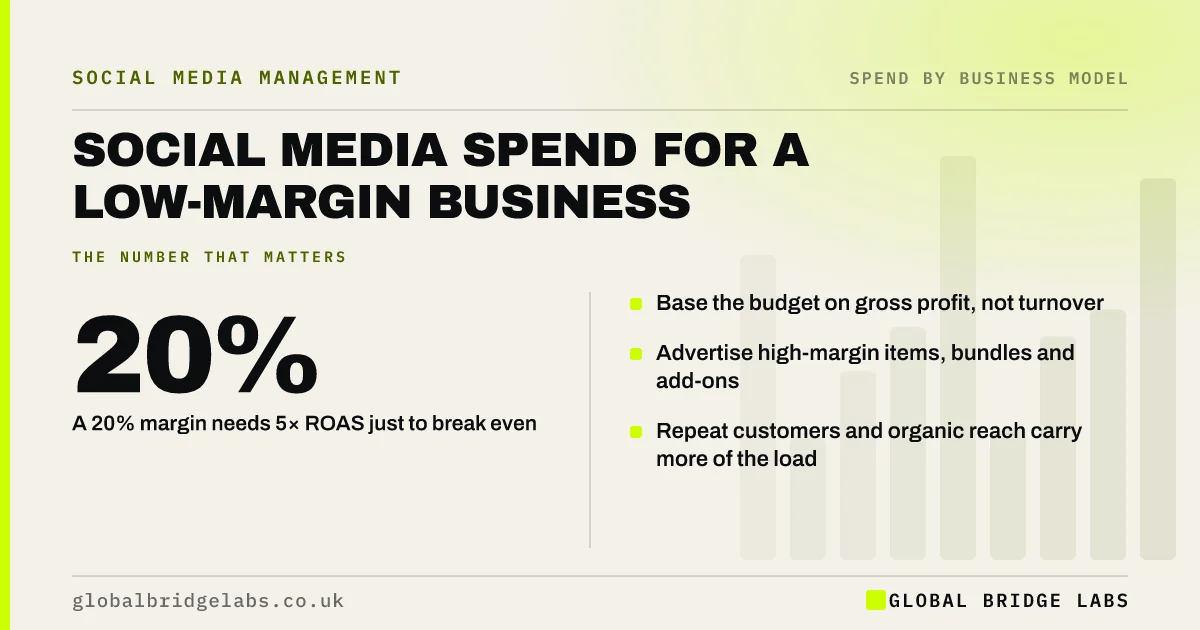
- Base the budget on gross profit, not turnover.
- Advertise high-margin items, bundles and add-ons.
- A 20% margin needs 5× ROAS just to break even.
- Repeat customers and organic reach carry more of the load.
Running on thin margins? Message us on WhatsApp.
Chat on WhatsApp →Why use gross profit instead of turnover?
A 5% of turnover marketing budget means very different things at 60% and 15% margins. At 15%, it would take a third of all gross profit. Setting the budget as a share of gross profit, often 10–20%, keeps marketing in proportion to what the business actually earns.
What should a low-margin business advertise?
Products or services with the best margins, bundles that raise order value, and add-ons that lift profit per sale. Avoid advertising loss leaders unless you know buyers come back for higher-margin purchases. Each ad should point to a sale that can pay for it.
Send us your margins by product on WhatsApp and we will discuss your requirements.
Chat on WhatsApp →Where else should the effort go?
Repeat customers and organic content. Email, loyalty rewards and regular posts reach existing buyers at little cost, and each repeat sale needs no new ad spend. Growing these lowers the share of revenue that must go on ads.
How should paid tests be run?
Small, short and tightly tracked, with break-even ROAS written down before launch. Stop quickly if results fall below break-even. Low margins leave little room for learning money, so test one product and one audience at a time.
What does this look like in practice?
A pattern we see: a low-margin retailer advertises its cheapest, most popular items and sells plenty at a loss. Switching ads to bundles and higher-margin lines usually sells fewer units but makes the advertising profitable.
Low-margin checklist
- Set the budget as a share of gross profit.
- Write down break-even ROAS by product.
- Advertise high-margin lines and bundles.
- Invest in repeat customers and organic posts.
- Keep tests small and stop quickly if unprofitable.
Next step
Rank your products by gross profit per sale. Move next month's ads to the top three and compare profit, not just sales.
Message us on WhatsApp with your ranking, or book a 30-minute consultation.
Chat on WhatsApp →Sources and further reading
- Learn about Meta pixel · Meta
- Inflation and price indices · Office for National Statistics
Frequently asked questions
Can a low-margin business afford social media ads?
Yes, if ads promote higher-margin items or bundles and results are tracked against break-even ROAS. With a 20% margin, ads must bring £5 of sales for every £1 just to break even, so weak campaigns lose money quickly. Organic content and repeat customers matter more.
How much should a low-margin business spend on marketing?
Set it as a share of gross profit rather than turnover, often 10–20% of gross profit depending on growth goals. That keeps marketing in proportion to what the business actually earns, rather than a turnover percentage that could swallow most of the profit.
Should I advertise my cheapest products?
Only if buyers reliably return for higher-margin purchases and you can track it. Otherwise, advertising the cheapest items often sells volume at a loss. Bundles, add-ons and higher-margin lines usually make advertising pay, because each sale leaves enough gross profit to cover what it cost to win.
Written by

Global Bridge Labs (GBL) is a UK–Sri Lanka partner for social media, websites and BPO. Everything here comes from client delivery, not theory.