On this page
- 01Key takeaways
- 02Which is better for B2B, LinkedIn or Facebook?
- 03Why does deal size predict the answer?
- 04What does each platform cost in effort?
- 05Why do LinkedIn company pages underperform?
- 06Where do Facebook groups beat LinkedIn for B2B?
- 07When should you run both?
- 08What does this look like in practice?
- 09How do you get into a sector Facebook group?
- 10Next step
- 11Sources and further reading
- 12Frequently asked questions
Key takeaways
LinkedIn wins where the buyer has a job title and a procurement process. Facebook wins where the buyer is an owner-manager spending their own money. Deal size is the fastest proxy: above roughly £10,000 a year, LinkedIn; below it, check Facebook seriously.
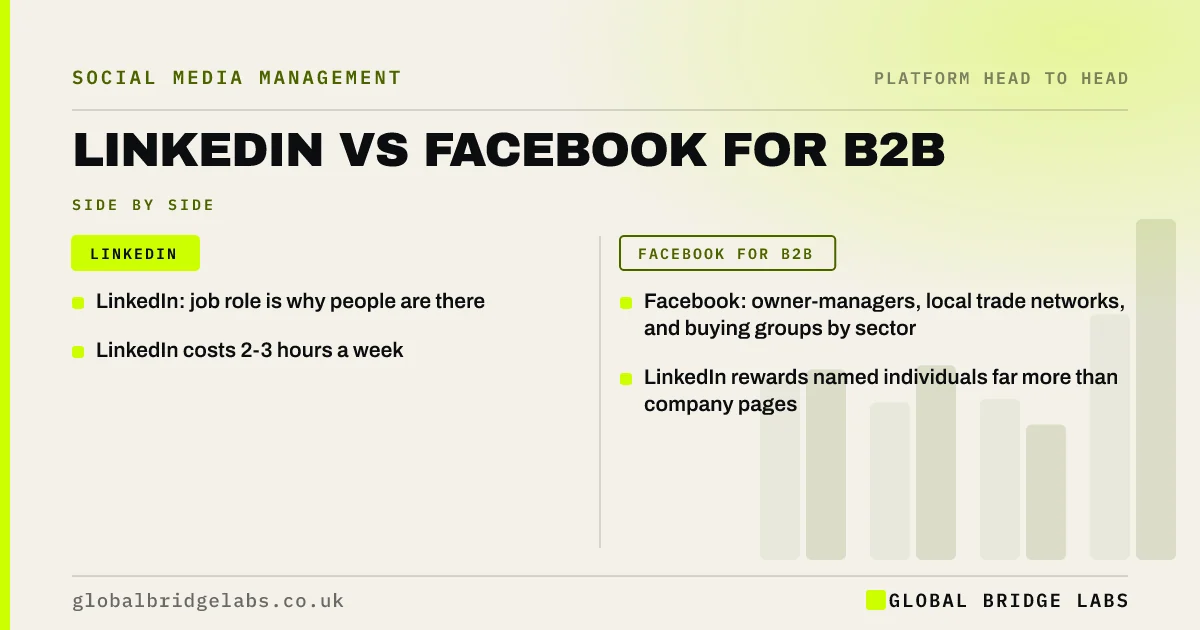
- LinkedIn: job role is why people are there. Unmatched for formal B2B buying.
- Facebook: owner-managers, local trade networks, and buying groups by sector.
- LinkedIn costs 2-3 hours a week. Facebook costs 2-4, mostly in groups.
- LinkedIn rewards named individuals far more than company pages.
- Deal size above £10,000 a year: LinkedIn. Below: test Facebook groups first.
Tell us your average deal size on WhatsApp and we will tell you which channel to back.
Chat on WhatsApp →Which is better for B2B, LinkedIn or Facebook?
LinkedIn for formal B2B, because it is the only major platform where your buyer's job title is the reason they are there. That single fact changes targeting, credibility and the odds that your content reaches the person who signs.
Facebook for owner-managed B2B, which is most UK B2B by volume. There are around 5.5 million private sector businesses in the UK and the overwhelming majority have no employees, so your buyer is frequently a person spending their own money rather than a procurement function.
Why does deal size predict the answer?
Because deal size determines whether a buying process exists. Above roughly £10,000 a year, a UK business usually involves more than one person, produces a written comparison and may run a procurement step, all of which favour a platform organised around job roles.
Below that, one person usually decides, often in the evening, often on their phone, and often after asking a peer group for a recommendation. That behaviour lives on Facebook and in sector-specific groups far more than on any professional network.
What does each platform cost in effort?
Both are cheap by social media standards, which is one reason B2B channel choice is less painful than consumer channel choice.
- LinkedIn: 2-3 hours a week. Low production cost, high thinking cost per post.
- Facebook groups: 2-4 hours a week, almost entirely conversation rather than production.
- LinkedIn needs named people posting. A company page alone performs poorly.
- Facebook groups need patience. Most produce nothing for the first two months.
- Neither needs video, which is why B2B channels are sustainable for small teams.
We will build a B2B posting rhythm your team can hold. Message us on WhatsApp.
Chat on WhatsApp →Why do LinkedIn company pages underperform?
Because people follow people. LinkedIn's distribution consistently favours personal profiles over company pages, and buyers treat the page as a verification step rather than a subscription.
For a small UK firm the workable setup is a complete, current company page for credibility plus consistent posting from two or three named people with real roles. Expect the page to be checked and the people to be followed. Investing the effort the other way round is the most common LinkedIn mistake we see.
Where do Facebook groups beat LinkedIn for B2B?
In sector communities where owner-managers ask peers for supplier recommendations. Trades, hospitality supply, logistics, childcare, fitness and independent retail all have active UK groups where real buying conversations happen daily.
The mechanic is the same as in local consumer groups: be useful, answer questions without pitching, and be the name that gets tagged. It is slow, it does not scale, and it produces better-qualified enquiries than most paid campaigns because the recommendation carries trust you did not have to buy.
When should you run both?
When you sell to two different buyer types, typically a corporate account and an owner-managed account, with materially different deal sizes. That is a genuine two-channel case rather than a two-channel habit.
Keep them separate in content as well as in platform. Corporate buyers want process, compliance and references. Owner-managers want price honesty, speed and evidence you will turn up. The same post rarely satisfies both, and trying makes you sound vague to each.
What does this look like in practice?
A UK commercial catering equipment supplier ran LinkedIn exclusively because the sector advice said B2B means LinkedIn. Its actual buyers were independent café and restaurant owners, who were on Facebook in three large trade groups and barely on LinkedIn at all.
Adding two hours a week of genuine participation in those groups produced more enquiries in a quarter than the previous year of LinkedIn posting. LinkedIn was kept for the small number of contract accounts, where it continued to be the right channel. Both were right, for different customers.
How do you get into a sector Facebook group?
By applying honestly and then being useful before you are visible. Most UK sector groups ask a joining question about what you do, and answering it as a supplier is fine. Answering it dishonestly is how businesses get removed later, publicly.
Then spend the first month answering questions with no link and no pitch. Group members can tell the difference between a supplier who contributes and one who is prospecting, and so can moderators. The businesses that do well in these groups are the ones who would still be answering questions if the commercial return disappeared.
Next step
Write down your average annual deal size and who signs it. If that person has a job title inside a larger organisation, back LinkedIn. If they own the business and spend their own money, spend two hours a week in the groups they are already in before you commit to anything else.
Message us on WhatsApp and we will identify the groups and people worth your B2B hours.
Chat on WhatsApp →Sources and further reading
- LinkedIn Pages best practices · LinkedIn
- Business population estimates for the UK and regions 2025 · Department for Business and Trade
Frequently asked questions
Is LinkedIn better than Facebook for B2B leads?
For formal B2B with a procurement process, yes, because job role is the reason people are on LinkedIn at all. For owner-managed businesses spending their own money, Facebook sector groups frequently produce better-qualified enquiries at lower effort, because the recommendation comes from a peer rather than from you.
Should B2B businesses use Facebook at all?
Yes when their buyers are owner-managers. Most UK businesses have no employees, so the buyer is often one person asking peers for a recommendation, and those conversations happen in Facebook sector groups rather than on professional networks.
Why does my LinkedIn company page get no reach?
Because LinkedIn distribution favours personal profiles, and buyers treat company pages as a verification step rather than something to subscribe to. Keep the page complete and current for that check, then invest the posting effort in two or three named people with real roles and real opinions.
How long before LinkedIn produces B2B enquiries?
Two to three quarters of consistent posting from named individuals. B2B buying cycles are long and much of the valuable behaviour is invisible, so judge progress on qualified conversations started rather than on likes or follower growth.
Written by

Global Bridge Labs (GBL) is a UK–Sri Lanka partner for social media, websites and BPO. Everything here comes from client delivery, not theory.