On this page
- 01Key takeaways
- 02What does QA testing involve?
- 03What does an in-house tester cost?
- 04What does outsourced QA cost?
- 05Which testing should stay in-house?
- 06When is an in-house tester worth it?
- 07How do you make outsourced testing work?
- 08Should testing be manual or automated?
- 09What does this look like in practice?
- 10QA checklist
- 11Next step
- 12Sources and further reading
- 13Frequently asked questions
Key takeaways
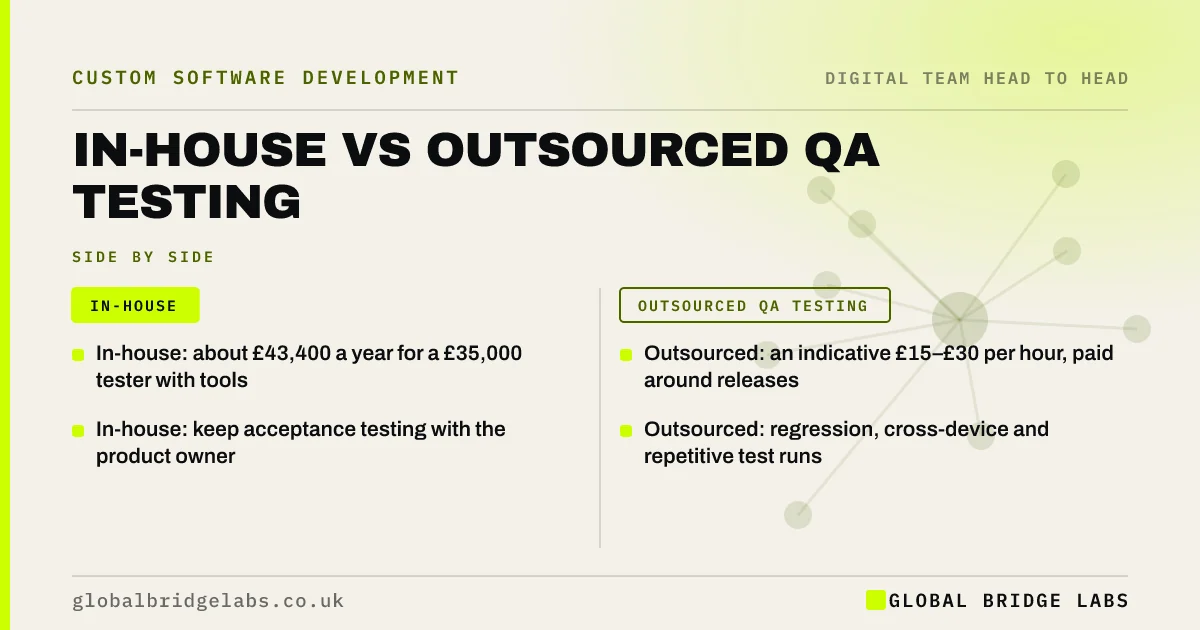
In-house vs outsourced QA testing depends on release rhythm. A QA tester on £35,000 costs about £43,400 a year with tools. Outsourced testing at an indicative £15–£30 per hour offshore lets you pay for test cycles around releases. Keep acceptance testing close to the product owner; outsource regression and cross-device checks.
- In-house: about £43,400 a year for a £35,000 tester with tools.
- Outsourced: an indicative £15–£30 per hour, paid around releases.
- In-house: keep acceptance testing with the product owner.
- Outsourced: regression, cross-device and repetitive test runs.
Want QA costed for your release schedule? Message us on WhatsApp.
Chat on WhatsApp →What does QA testing involve?
Quality assurance (QA) testing checks that software and websites work as intended before users see them. It includes testing new features against requirements, regression testing to catch things that broke elsewhere, cross-browser and device checks, and user acceptance testing by the business.
What does an in-house tester cost?
A QA tester on £35,000 costs about £40,363 a year in employment costs using 2026/27 rates. Test tools, devices and licences add about £3,000, for about £43,400 before recruitment. If releases are monthly, the tester may be idle between cycles or pulled into other work.
What does outsourced QA cost?
Managed offshore testing commonly costs an indicative £15–£30 per hour, depending on whether it is manual or automated. If a monthly release needs 60 hours of testing, that is about £10,800–£21,600 a year. You pay for test cycles, not for idle weeks.
Want your test cycles priced? Send us your release frequency on WhatsApp.
Chat on WhatsApp →Which testing should stay in-house?
User acceptance testing belongs with the product owner or the people who will use the software, because only they can confirm it solves the business problem. Security-sensitive testing on live data should also stay close, or be done on anonymised data.
- In-house: acceptance testing against the business need.
- Outsourced: regression suites run each release.
- Outsourced: browser, device and accessibility checks.
- Either: test automation, depending on skills.
When is an in-house tester worth it?
When releases are frequent, the product is complex, and testing needs deep knowledge of edge cases that take months to learn. A tester embedded with developers catches problems earlier, which is cheaper than finding them later.
How do you make outsourced testing work?
Write test cases for the main user journeys, give testers a staging environment with test data rather than live data, and agree a defect format with steps to reproduce. Review the test report before each release, not after users complain.
Should testing be manual or automated?
Both, for different jobs. Automated tests suit stable, repeated checks such as log-in, checkout and key calculations, run on every release. Manual testing suits new features, usability and anything that changes often. Start by automating the few journeys that would hurt most if they broke.
What does this look like in practice?
A pattern we see in UK SMEs with customer portals: developers test their own work, and bugs reach customers after each release. An outsourced regression run before release, with acceptance by the product owner, catches most of them without a full-time tester.
QA checklist
Use these steps to decide.
- Count releases per month and test hours per release.
- Cost an in-house tester including idle time.
- Price outsourced test cycles.
- Write test cases for key journeys.
- Set up staging with test data.
- Keep acceptance testing with the product owner.
Next step
Tell us your release rhythm and product. We will cost in-house and outsourced QA in a 30-minute call.
Message us on WhatsApp for a QA comparison, or book a 30-minute consultation.
Chat on WhatsApp →Sources and further reading
- Rates and thresholds for employers 2026 to 2027 · HM Revenue & Customs
- WCAG 2 overview · W3C Web Accessibility Initiative
- Contracts and liabilities between controllers and processors · Information Commissioner's Office
Frequently asked questions
Is outsourced software testing cheaper?
For monthly or less frequent releases, usually. A £35,000 tester costs about £43,400 a year with tools, while outsourced testing at an indicative £15–£30 per hour is paid per test cycle. Frequent releases on a complex product can justify an embedded in-house tester.
What testing should not be outsourced?
User acceptance testing, which confirms the software solves the business problem, should stay with the product owner or the people who will use it. Testing on live personal data should stay close to the business or use anonymised data in a staging environment.
Should outsourced testers use live data?
No. Give them a staging environment with test or anonymised data. If personal data must be used, the provider is a processor under UK GDPR, so a written contract, access controls and a transfer safeguard for offshore teams are required before any data is shared.
How much testing does each release need?
It depends on the size of the change and the risk. A small fix may need an hour of targeted checks plus a short regression run; a major release may need days. Keep a list of critical journeys that are always tested, whatever the size of the release.
Written by

Global Bridge Labs (GBL) is a UK–Sri Lanka partner for social media, websites and BPO. Everything here comes from client delivery, not theory.