On this page
- 01Key takeaways
- 02What does time on page mean in GA4?
- 03Is more time on the homepage good?
- 04How should you read engagement time?
- 05What is a good number?
- 06When is time the wrong metric?
- 07What does this look like in practice?
- 08Engagement time checklist
- 09Next step
- 10Sources and further reading
- 11Frequently asked questions
Key takeaways
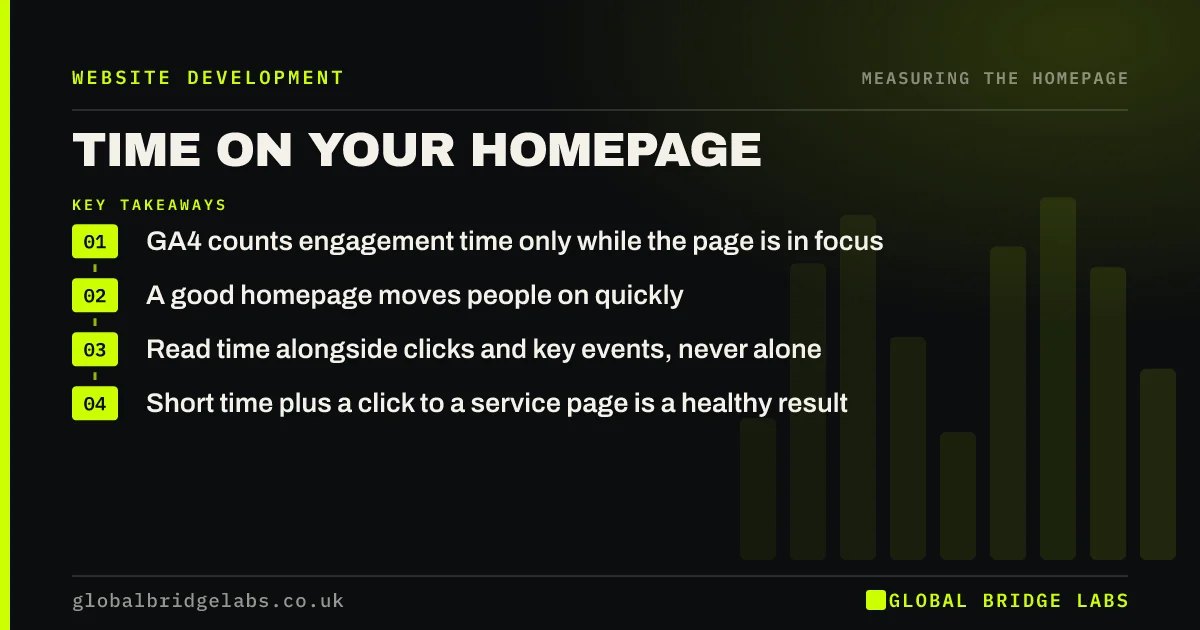
Average time on homepage visits, shown in GA4 as engagement time, measures how long the page was in focus. Longer is not automatically better: a good homepage often gets visitors to the next page quickly. Read engagement time alongside clicks to service pages and key events. Short time with clicks is healthy; short time with exits is not.
- GA4 counts engagement time only while the page is in focus.
- A good homepage moves people on quickly.
- Read time alongside clicks and key events, never alone.
- Short time plus a click to a service page is a healthy result.
Want to know what your homepage engagement time is telling you? Message us on WhatsApp.
Chat on WhatsApp →What does time on page mean in GA4?
GA4 measures engagement time: the time a page is in the foreground of the browser. Average engagement time is reported per session or per active user, depending on the report. It replaced the old 'time on page' from Universal Analytics, which measured differently, so do not compare the two.
Is more time on the homepage good?
Not necessarily. The homepage is a router; its job is often to get visitors to the right service page or action quickly. Long time on the homepage can mean people are reading with interest, or it can mean they are searching for something they cannot find.
How should you read engagement time?
Read it with what happened next.
- Short time, then a click to a service page or contact: healthy.
- Short time, then an exit: the first screen is not working.
- Long time, then a click: visitors are reading and deciding.
- Long time, then an exit: visitors may be hunting and giving up.
What is a good number?
There is no reliable universal benchmark, because it depends on page length, traffic mix and purpose. Nielsen Norman Group found that visitors often leave pages within 10–20 seconds, but those who stay past that point tend to stay longer. Track your own trend and compare traffic sources.
When is time the wrong metric?
Time is the wrong metric when you are judging a change, because it moves for many reasons. Key events and clicks to the next step are better measures of whether a homepage improvement worked. Use time as a clue, not a target.
What does this look like in practice?
A pattern we see: an owner celebrates a longer average time on the homepage after a redesign, while enquiries fall. Recordings show visitors scrolling up and down looking for the contact route, which the redesign had moved. Longer time was a symptom, not a success.
Engagement time checklist
- Find average engagement time in the landing page report.
- Split by channel and device.
- Read it with clicks and exits.
- Do not compare with Universal Analytics figures.
- Judge changes by key events, not time.
Next step
Pull your homepage engagement time and next-step clicks for the last three months. Look at which of the four combinations above you are in.
Message us on WhatsApp to interpret them, or book a 30-minute consultation.
Chat on WhatsApp →Sources and further reading
- Engagement rate and bounce rate · Google Analytics Help
- How long do users stay on web pages? · Nielsen Norman Group
Frequently asked questions
What is a good average time on a homepage?
There is no single good figure. A homepage that routes visitors quickly to service pages may have short engagement time and perform well. Read the time alongside clicks to the next page and key events, and compare against your own trend.
What is average engagement time in GA4?
It is the average time your site or page was in focus in the visitor's browser, reported per session or per active user. It only counts active time, so tabs left open in the background do not inflate it.
Is long time on page good for SEO?
Not directly in any way you can rely on. What matters is whether visitors find what they need. A homepage that quickly sends visitors to the right page is doing its job, even if each visit is short.
Written by

Global Bridge Labs (GBL) is a UK–Sri Lanka partner for social media, websites and BPO. Everything here comes from client delivery, not theory.