On this page
Key takeaways
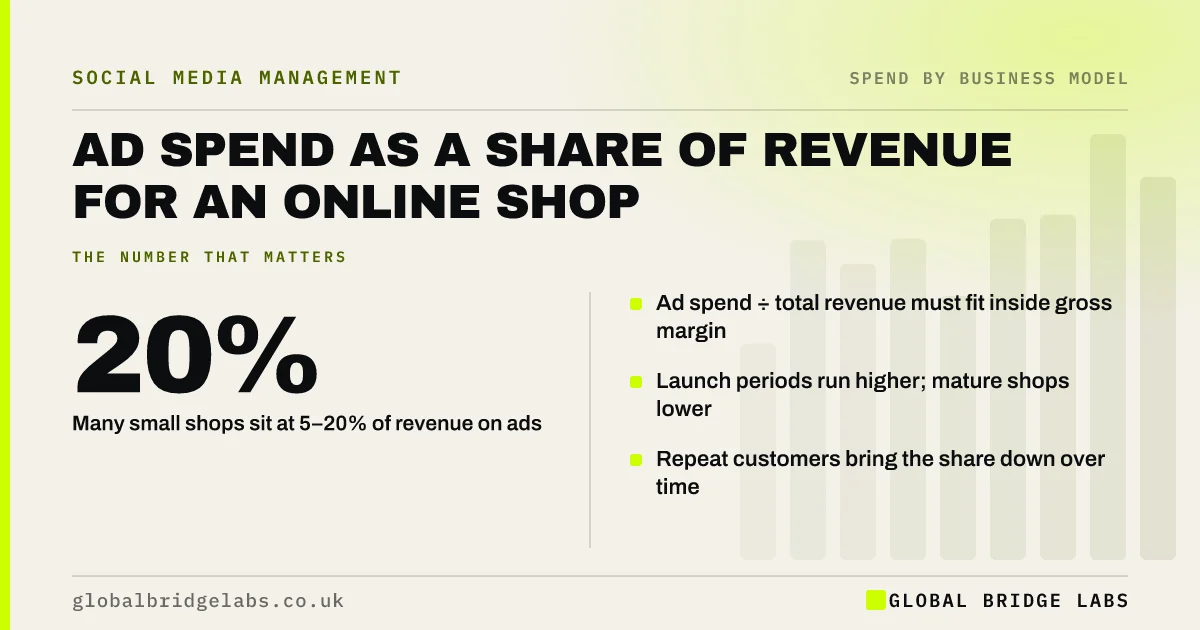
Ecommerce ad spend as a percentage of revenue should be set from gross margin. Total ad spend divided by total revenue must leave enough margin to cover overheads and profit. As a working range we see, many small online shops sit between 5% and 20%, higher while launching and lower once repeat customers grow.
- Ad spend ÷ total revenue must fit inside gross margin.
- Many small shops sit at 5–20% of revenue on ads.
- Launch periods run higher; mature shops lower.
- Repeat customers bring the share down over time.
Want your ad share checked against margin? Message us on WhatsApp.
Chat on WhatsApp →How do you set the right share?
Start with gross margin after product, delivery, packaging and payment fees. Subtract the share needed for overheads and profit. The rest is the most you can spend on ads. Illustrative example: 50% margin, 25% for overheads and 10% profit, leaves 15% of revenue for advertising.
How is this different from ROAS?
ROAS compares revenue a platform attributes to ads with spend on those ads. Ad spend as a share of total revenue includes sales from all sources, such as repeat customers and organic traffic. It is a whole-business check, similar to marketing efficiency ratio, and harder for platforms to inflate.
Send us your margin and monthly revenue on WhatsApp and we will discuss your requirements.
Chat on WhatsApp →Why does the share change over time?
A new shop has few repeat buyers, so nearly every sale needs ads, and the share is high. As customers return and organic traffic grows, revenue rises faster than ad spend. If the share stays high for years, repeat purchase or organic growth may need attention.
When should you accept a higher share?
During launch, a new product line or a deliberate push to win customers who will return. Set a time limit and track whether those customers buy again. A higher share is an investment only if repeat sales follow.
What does this look like in practice?
A pattern we see: a shop's platform ROAS looks healthy, but ad spend has crept above a quarter of total revenue, eating the margin. Setting a ceiling from gross margin and cutting the weakest campaigns usually restores profit within a quarter.
Ecommerce ad share checklist
- Calculate gross margin after all variable costs.
- Set the ad share ceiling from margin.
- Track ad spend ÷ total revenue monthly.
- Compare it with platform ROAS.
- Watch repeat purchase rate over time.
Next step
Divide last month's total ad spend by total revenue. Compare the result with the ceiling your margin allows.
Message us on WhatsApp with your figure, or book a 30-minute consultation.
Chat on WhatsApp →Sources and further reading
- Internet sales as a percentage of total retail sales · Office for National Statistics
- Learn about Meta pixel · Meta
Frequently asked questions
What percentage of revenue should an online shop spend on ads?
It depends on gross margin. Subtract overheads and target profit from your margin; the rest is your ceiling. Many small UK online shops sit between 5% and 20% of revenue on ads, higher while launching and lower as repeat customers and organic sales grow.
What is TACoS?
TACoS, total advertising cost of sale, is ad spend divided by total revenue, including sales not attributed to ads. It is common in marketplace selling and works as a whole-business check, because it shows whether advertising is helping overall sales grow, not just the sales platforms claim.
Why is my ad spend share rising?
Common causes are rising ad costs, falling conversion rates, fewer repeat customers or less organic traffic. Check each in turn. Raising prices or average order value can also bring the share down without cutting the ads that work. Review it each quarter against your enquiries and sales, and adjust in small steps.
Written by

Global Bridge Labs (GBL) is a UK–Sri Lanka partner for social media, websites and BPO. Everything here comes from client delivery, not theory.