On this page
- 01Key takeaways
- 02What happens when advertising stops?
- 03What should you cut first?
- 04What should you protect?
- 05Why is social media useful when money is tight?
- 06How much can be saved without harm?
- 07Can you cut cost without cutting activity?
- 08Is a downturn ever a reason to spend more?
- 09What is the risk of cutting too deep?
- 10What does this look like in practice?
- 11Next step
- 12Sources and further reading
- 13Frequently asked questions
Key takeaways
Cutting the advertising budget is sometimes necessary, and the order matters. Stop what you cannot measure and what reaches the wrong people first. Protect the channel with the best cost per customer and keep some visible presence, because a name that goes silent is expensive to rebuild.
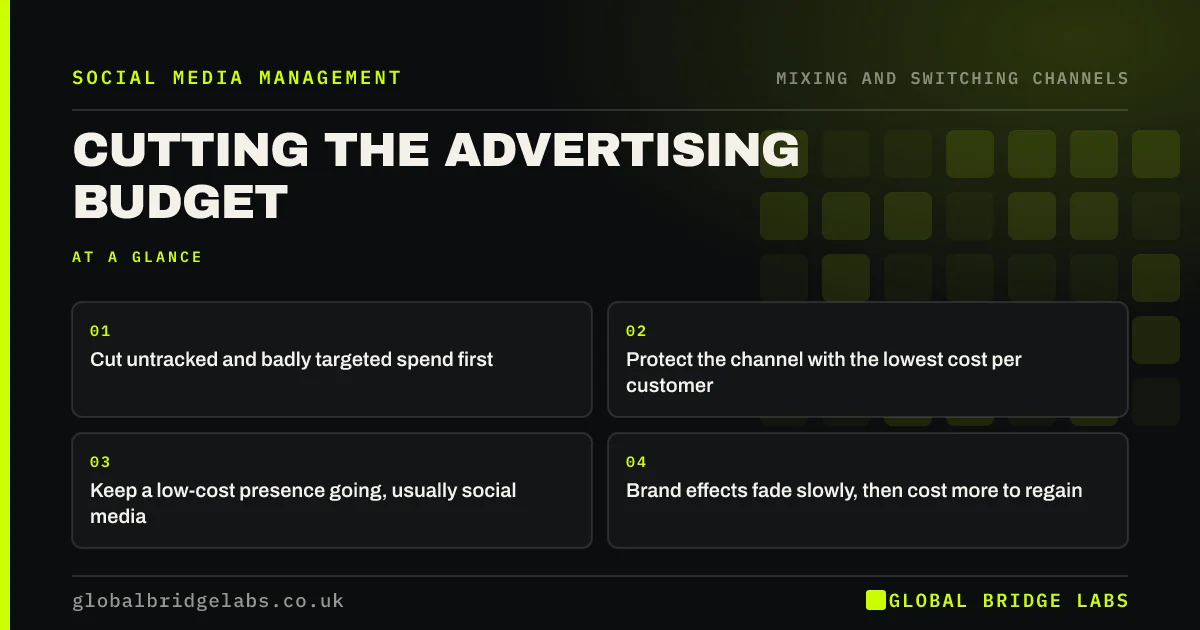
- Cut untracked and badly targeted spend first.
- Protect the channel with the lowest cost per customer.
- Keep a low-cost presence going, usually social media.
- Brand effects fade slowly, then cost more to regain.
Need to trim spend without losing enquiries? Message us on WhatsApp.
Chat on WhatsApp →What happens when advertising stops?
When advertising stops, response adverts stop working at once and brand effects fade more slowly. Research for the IPA by Binet and Field describes brand building as creating memory that supports sales for a long time. That memory decays without reinforcement, so the damage from going dark appears later than the saving.
What should you cut first?
Cut in this order, so that the least proven spend goes first.
- 1. Anything you cannot connect to a single enquiry.
- 2. Media covering areas you do not serve.
- 3. Automatic renewals nobody has reviewed.
- 4. Sponsorships with no audience among your buyers.
- 5. Extra channels that duplicate your lead channel.
What should you protect?
Protect the channel with the lowest tracked cost per customer, your free base of listings and reviews, and one steady form of presence. If you do not know which channel is cheapest per customer, finding out is worth more than any cut.
Why is social media useful when money is tight?
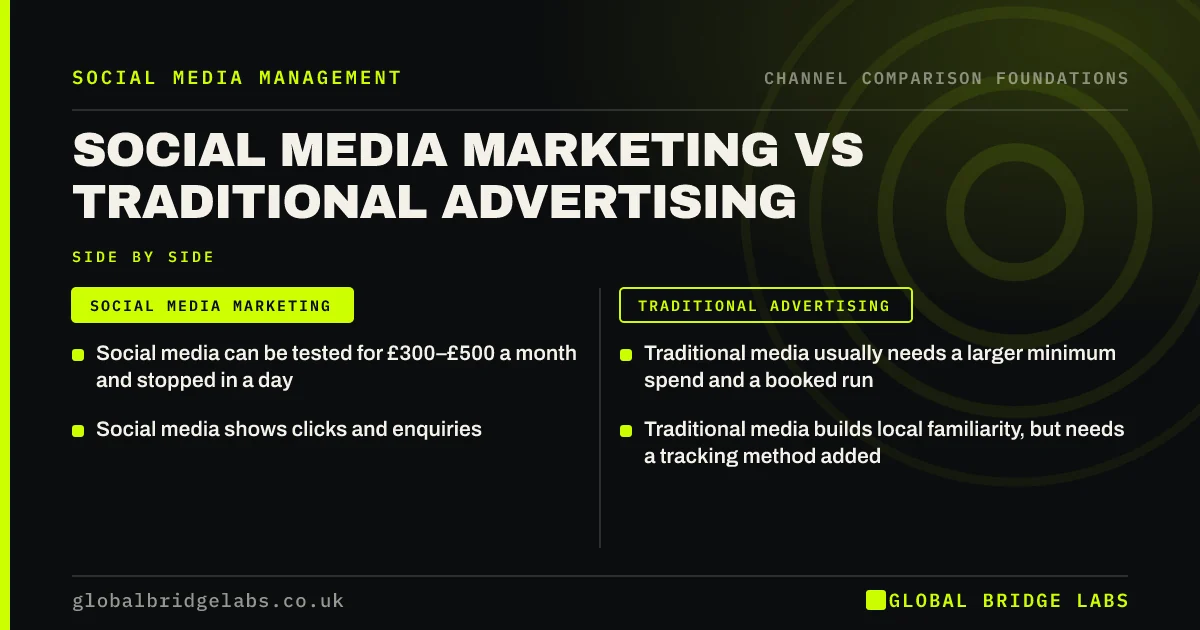
Social media is useful in a squeeze because it can be scaled down without disappearing. Advert spend can drop to the practical floor of £300–£500 a month or pause, while regular posts keep the profile alive. A print contract or a radio campaign is all or nothing.
How much can be saved without harm?
It depends on how much was unproven to begin with. In an illustrative budget of £1,500 a month, a firm might find £300 of untracked renewals and £200 of out-of-area press. Cutting those saves a third while leaving every channel that can show a result untouched.
- How to split a marketing budget between traditional and digital
- How to run a cost review in a small business
Want your budget reviewed line by line? Message us on WhatsApp and we will discuss your requirements.
Chat on WhatsApp →Can you cut cost without cutting activity?
Often. Renegotiate rates, since sellers discount in slow markets. Narrow the area to your best postcodes. Reuse content across channels. Move production to a lower-cost delivery team while keeping strategy in-house. Each lowers cost per customer without reducing how often you are seen.
Is a downturn ever a reason to spend more?
It can be. When competitors go quiet, media gets cheaper and attention is easier to win. A firm with cash and a proven channel can gain ground. A firm short of cash should not gamble on this. The evidence favours holding presence, not betting the business.
What is the risk of cutting too deep?
The risk is a slow leak. Enquiries hold for a few months on past reputation, the cut looks painless and then the pipeline thins. By the time it shows, the fix takes months. Set a floor: the minimum presence you will keep whatever happens.
What does this look like in practice?
A pattern we see in tight years: the measurable channel gets cut because its cost is visible, while untracked renewals survive because nobody looks at them. Reversing that order protects enquiries and usually saves more.
Next step
List every advertising cost and mark each 'proven', 'unproven' or 'unknown'. Cut from the unproven list first and add tracking to the unknowns.
Message us on WhatsApp with your list and we will help you rank it, or book a 30-minute consultation.
Chat on WhatsApp →Sources and further reading
- The Long and the Short of It: balancing short and long-term marketing strategies · IPA
- Advertising Association / WARC Expenditure Report · Advertising Association
- Meta Business Help Centre · Meta
Frequently asked questions
Should I cut my marketing budget in a recession?
Trim it carefully instead of stopping. Remove spend you cannot measure or that reaches the wrong audience, protect the channel with the best cost per customer and keep a visible presence. Going silent saves money now and costs enquiries later.
What happens if I stop advertising completely?
Response-driven enquiries fall quickly. Enquiries from reputation hold for a while and then decline as people forget the name and competitors remain visible. Rebuilding that familiarity later usually costs more than maintaining it. The saving shows in this month's accounts, and the cost shows several months later.
Which advertising should I cut first?
Cut anything you cannot link to an enquiry, media that covers areas you do not serve, automatic renewals and sponsorships with no audience among your buyers. Keep whatever can show a cost per customer you are happy with.
How can I reduce advertising costs without losing customers?
Narrow your area, negotiate rates, reuse content across channels and stop duplicated activity. Keep free listings and reviews current, and maintain a low-cost presence such as regular social media posts. Review each channel's cost per customer first, so that the cuts fall on the weakest spend and not on the most visible.
Written by

Global Bridge Labs (GBL) is a UK–Sri Lanka partner for social media, websites and BPO. Everything here comes from client delivery, not theory.