On this page
- 01Key takeaways
- 02What is customer-centric website design?
- 03How can you tell if a website is organised around the business?
- 04How do you make a website more customer-centric?
- 05Does customer-centric design help search visibility?
- 06When can customer-centric design go too far?
- 07What does this look like in practice?
- 08Customer-centric website checklist
- 09Next step
- 10Sources and further reading
- 11Frequently asked questions
Key takeaways
Customer-centric website design organises pages, menus and words around what buyers are trying to do, rather than how the business is structured. It shows up in practical ways: menus named in customers' language, service pages that start with the problem, answers to the questions buyers really ask, and next steps that fit their stage. It is a method, not a style.
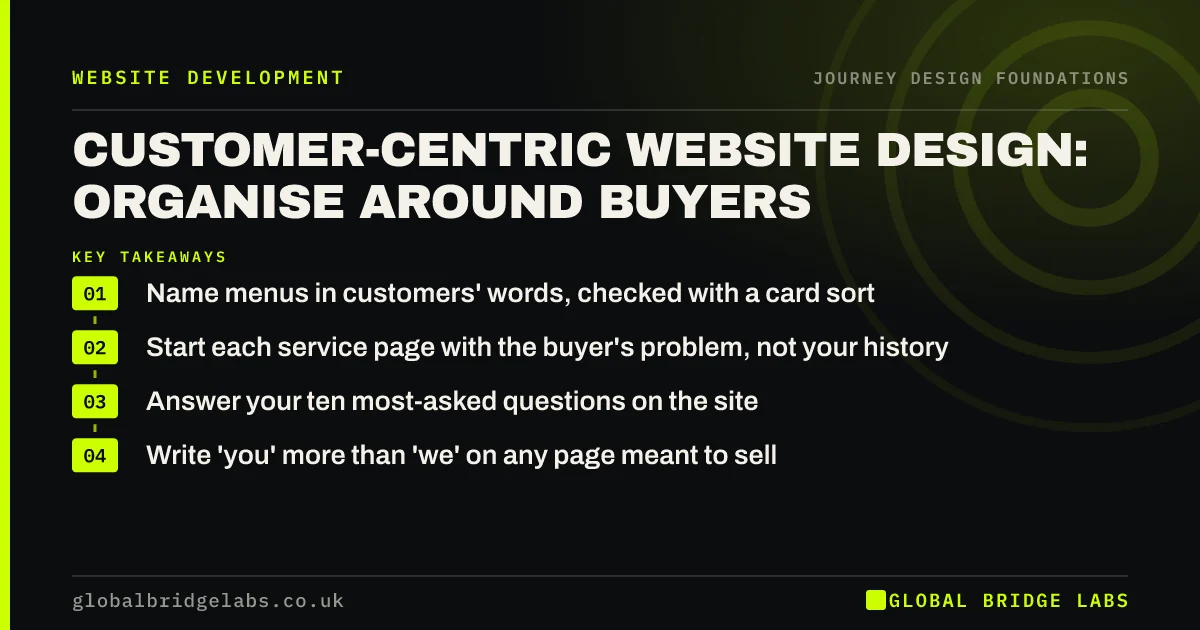
- Name menus in customers' words, checked with a card sort.
- Start each service page with the buyer's problem, not your history.
- Answer your ten most-asked questions on the site.
- Write 'you' more than 'we' on any page meant to sell.
Want to know how customer-centric your site reads? Send us the URL on WhatsApp.
Chat on WhatsApp →What is customer-centric website design?
Customer-centric website design is an approach that organises a website's structure, content and calls to action around the goals and questions of its buyers, based on research with real customers. It contrasts with organisation-centric design, where the site mirrors the company's departments, product names and internal language.
The difference shows in small choices. An organisation-centric menu says 'Solutions, Sectors, Insights'. A customer-centric one says 'Kitchen fitting, Bathroom fitting, Prices, Our work'. Both can look polished. Only one lets a buyer see in a second whether you do what they need.
How can you tell if a website is organised around the business?
You can tell a website is organised around the business when it describes itself before it describes the buyer's problem, uses internal names for services, groups pages by department, and hides practical answers such as price, area covered and timescales. Visitors have to translate their need into your structure, and many give up.
- The homepage opens with company history or a slogan, not what you do.
- Menu labels are internal terms buyers would not search for.
- Service pages list capabilities without naming the problem solved.
- Price, area and timescale answers live only in the sales call.
- Every page ends with the same generic 'Contact us'.
How do you make a website more customer-centric?
Make a website more customer-centric by researching first, then restructuring. Ask recent customers how they describe their problem, collect the questions your team answers every week, and check which pages visitors land on. Then rename menus in buyers' words, rewrite service pages to open with the problem, add missing answers and give each page a next step that fits its stage.
- Interview five recent customers per main buyer type.
- List the words they use for their problem and your service.
- Run a card sort to test how they group your services.
- Rewrite service pages: problem, outcome, process, proof, price guidance, next step.
- Add answers to the ten most common questions.
Does customer-centric design help search visibility?
Usually, yes. Buyers search in their own words, so pages written in those words match more searches. Google's guidance on helpful, people-first content describes content created mainly to help people rather than to rank. A customer-centric page that answers a real question fully is the kind of page that guidance describes, and it is also easier for AI search tools to quote.
When can customer-centric design go too far?
It goes too far when it ignores the business. A site can answer every question and still fail if it never asks for the enquiry, if it serves buyers you do not want, or if it promises things operations cannot deliver. Customer-centric does not mean customer-led on price or scope. It means clear about what you offer, to whom, and how to start.
It also goes too far when research becomes a reason to delay. Five interviews and your inbox are enough for most small businesses to start.
What does this look like in practice?
A pattern we see in B2B service firms: the menu lists 'Solutions' with product names the company invented, and buyers search for plain terms like 'pallet delivery' or 'payroll outsourcing'. Search traffic lands on blog posts, and the service pages get few visits because nobody can tell from the menu what they contain.
Renaming the menu and service pages in the words customers use, with the internal name in brackets where it matters, makes the existing pages findable. Across our client work we have seen a 2.4x enquiry rate from conversion changes of this kind. Global Bridge Labs (GBL) borrows customers' words before writing our own.
Customer-centric website checklist
- Homepage says what you do, for whom and where in one line.
- Menu labels match the words customers use.
- Each service page opens with the problem it solves.
- Price guidance, area and timescales are on the site.
- Proof comes from customers like the visitor.
- Each page ends with a next step that fits its stage.
Next step
If your site was written from the inside out, a short review will show where buyers have to translate. We will mark the pages that need the customer's words.
Message us on WhatsApp for a customer-centric review of your website, or book a 30-minute consultation.
Chat on WhatsApp →Sources and further reading
- Creating helpful, reliable, people-first content · Google Search Central
- Card sorting: uncover users' mental models · Nielsen Norman Group
- User research · GOV.UK Service Manual
Frequently asked questions
What does customer-centric website design mean?
It means organising the website's structure, content and calls to action around buyers' goals and questions, based on research with real customers, rather than around the company's departments, product names or internal language. Menus, headings and next steps all use the buyer's words.
How do I make my website more customer focused?
Talk to five recent customers per buyer type, collect your most-asked questions and check which pages visitors land on. Then rename menus in customers' words, open each service page with the problem it solves, add missing answers such as price guidance and give every page a fitting next step.
Is customer-centric design the same as user-centred design?
They are closely related. User-centred design is a design discipline focused on people using a product. Customer-centric design applies the same idea to the whole buying relationship, including what happens before and after the website. For a small business website, the practical steps are the same.
Written by

Global Bridge Labs (GBL) is a UK–Sri Lanka partner for social media, websites and BPO. Everything here comes from client delivery, not theory.