On this page
- 01Key takeaways
- 02What is staff augmentation?
- 03How is it different from outsourcing?
- 04Which is cheaper?
- 05When does staff augmentation fit?
- 06When does managed outsourcing fit?
- 07What about UK employment status rules?
- 08What does each model need from you on day one?
- 09What does this look like in practice?
- 10Model choice checklist
- 11Next step
- 12Sources and further reading
- 13Frequently asked questions
Key takeaways
Staff augmentation vs outsourcing comes down to who manages the work. With staff augmentation, a provider supplies people who work under your direction, and you own the process and results. With outsourcing, the provider owns delivery against agreed service levels. Augmentation is cheaper per person but needs your management time.
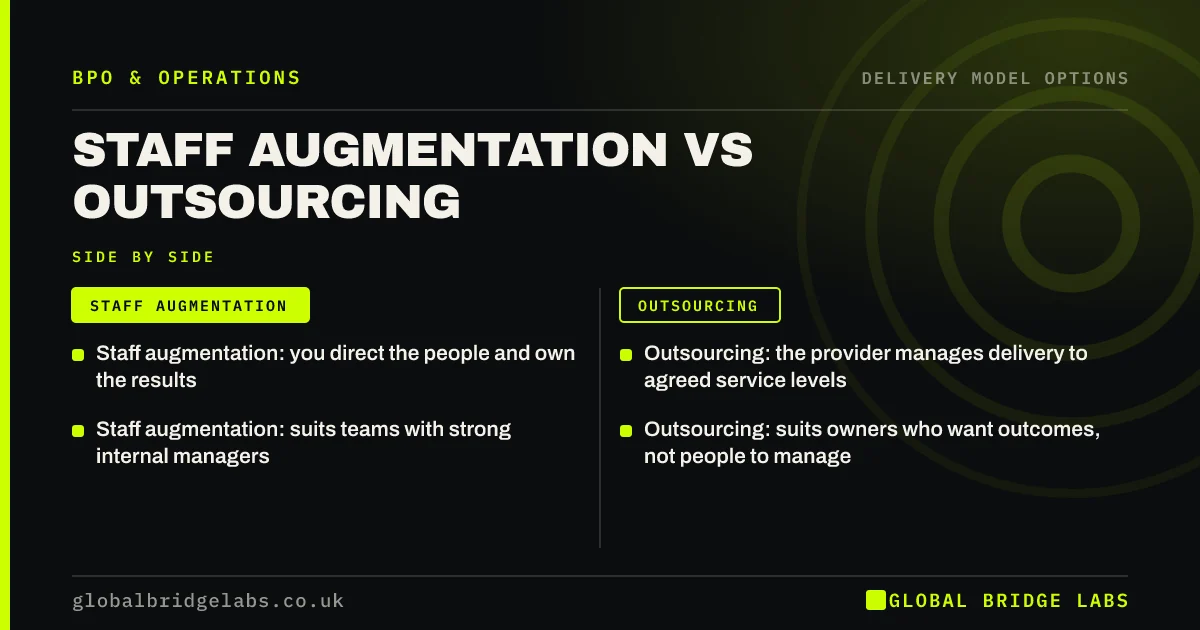
- Staff augmentation: you direct the people and own the results.
- Outsourcing: the provider manages delivery to agreed service levels.
- Staff augmentation: suits teams with strong internal managers.
- Outsourcing: suits owners who want outcomes, not people to manage.
Not sure which model fits your team? Message us on WhatsApp and we will talk it through.
Chat on WhatsApp →What is staff augmentation?
Staff augmentation is a model in which an external provider supplies skilled people who join your team and work under your direction, usually on a monthly fee per person. The provider handles employment, payroll and equipment; you set the priorities, manage the day-to-day work and carry responsibility for the output.
How is it different from outsourcing?
In outsourcing, you buy a result: a process run to an agreed standard, with the provider supervising, checking quality and covering absence. In staff augmentation, you buy capacity: people you manage. The difference shows up in who writes the process, who checks the work and who is accountable when targets are missed.
- Management: you (augmentation) or the provider (outsourcing).
- Pricing: per person per month (augmentation) or per hour, task or outcome (outsourcing).
- Quality: your checks (augmentation) or provider QA and SLAs (outsourcing).
- Cover: often extra (augmentation) or included (managed outsourcing).
Which is cheaper?
Staff augmentation usually has a lower rate, because the provider is not supplying supervision or quality control. But your manager's time fills that gap. If a £45,000 manager spends 5 hours a week directing two augmented staff, that is about £7,000 a year of management time, which can cancel the rate difference.
Want both models priced with management time included? Send us the roles on WhatsApp.
Chat on WhatsApp →When does staff augmentation fit?
When you have a strong internal manager, an established process and a need for specific skills, such as developers joining an existing product team. It also suits work that changes too often to hand over as a defined service.
When does managed outsourcing fit?
When the work is a repeatable process, such as customer support, admin or data entry, and you want it delivered to a standard without supervising it yourself. Managed outsourcing suits owners and small teams who lack spare management capacity.
What about UK employment status rules?
If augmented staff are UK-based individuals working through their own companies, the off-payroll working rules (IR35) may apply, and responsibility for deciding status depends on your company's size. Offshore staff employed by an overseas provider are employed under that country's law. Take advice if you are unsure.
What does each model need from you on day one?
Staff augmentation needs a manager ready to onboard and direct people from the first day: tasks, priorities, feedback and access. Managed outsourcing needs a documented process, service levels and access, after which the provider onboards its own team. If nobody has time to manage extra people, augmentation will struggle.
- Augmentation: a named manager, a task backlog, daily direction.
- Outsourcing: a written process, service levels, a monthly review.
- Both: system access, data protection terms and a start date.
What does this look like in practice?
A pattern we see in UK software SMEs: two augmented developers join the in-house team for a product build, directed by the in-house lead. Separately, customer support is fully outsourced, because nobody wants to manage it day to day. The same business uses both models, each where it fits.
Model choice checklist
Answer these before choosing.
- Do you have a manager with time to direct extra people?
- Is the work a defined process or changing daily?
- Do you want to buy capacity or a result?
- Who will check quality and cover absence?
- Have you costed your management time?
Next step
Tell us the work and who would manage it. We will compare staff augmentation and managed outsourcing in a 30-minute call.
Message us on WhatsApp to compare models, or book a 30-minute consultation.
Chat on WhatsApp →Sources and further reading
- Understanding off-payroll working (IR35) · HM Revenue & Customs
- Employment status · GOV.UK
- The Sourcing and Consultancy Playbooks · Cabinet Office
Frequently asked questions
What is the difference between staff augmentation and outsourcing?
In staff augmentation, a provider supplies people who work under your direction and you own the results. In outsourcing, the provider manages delivery, quality and cover against agreed service levels, and you manage the outcome through a written process and a monthly scorecard.
Is staff augmentation cheaper than outsourcing?
The rate is usually lower, because the provider is not supplying supervision or quality control. But you supply the management, quality checks and often cover. Once your manager's time is costed at its real value, the difference can be small or even reversed.
When should I use staff augmentation?
When you have a strong internal manager, an established process and a need for specific skills, such as developers joining an existing product team, or when the work changes too often to hand over as a defined service with fixed service levels.
Can I switch from staff augmentation to managed outsourcing?
Yes, once the work is stable enough to document. Write down the process the augmented staff follow, agree service levels, and ask the provider to take over supervision and quality checks. Your management time then falls to reviews and escalations.
Written by

Global Bridge Labs (GBL) is a UK–Sri Lanka partner for social media, websites and BPO. Everything here comes from client delivery, not theory.