On this page
- 01Key takeaways
- 02What is a primary and a secondary channel?
- 03How should you split the hours?
- 04What should a secondary channel actually contain?
- 05How do you choose which channel is primary?
- 06When should a secondary channel be promoted?
- 07What does this look like in practice?
- 08What happens when both channels are busy?
- 09Next step
- 10Sources and further reading
- 11Frequently asked questions
Key takeaways
Split effort roughly 70/30 between a primary and a secondary channel and give each a different job. The primary channel is where you expect enquiries. The secondary is where people verify you before they buy. Treating both as primary is how a two-channel plan becomes two mediocre channels.
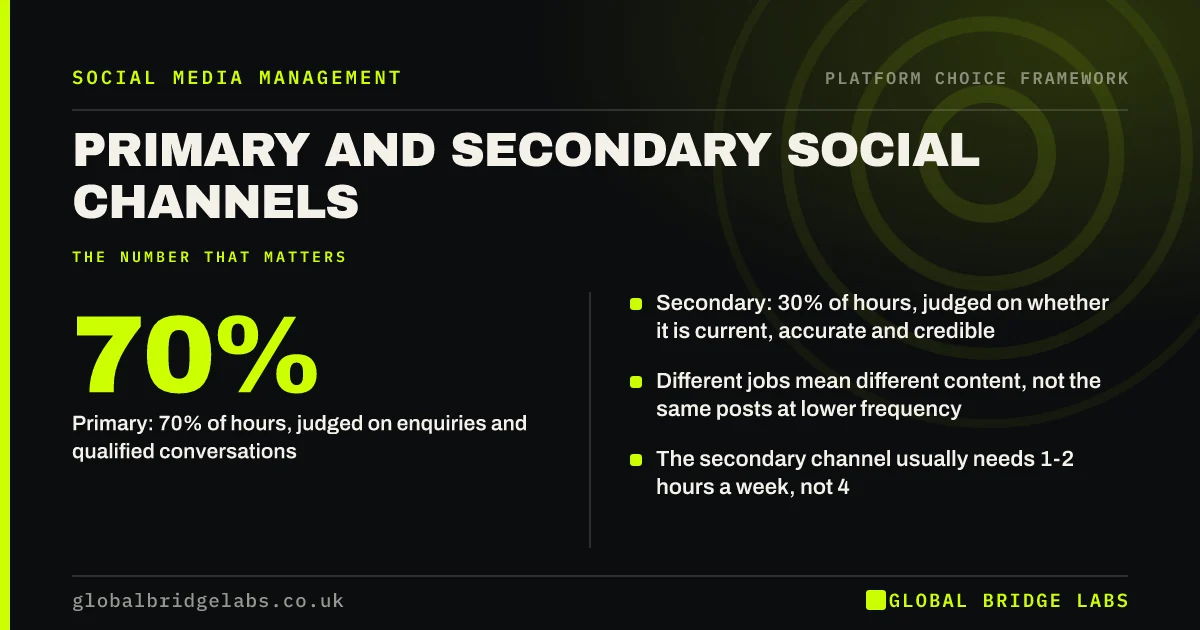
- Primary: 70% of hours, judged on enquiries and qualified conversations.
- Secondary: 30% of hours, judged on whether it is current, accurate and credible.
- Different jobs mean different content, not the same posts at lower frequency.
- The secondary channel usually needs 1-2 hours a week, not 4.
- Review the split every 6 months. Secondary channels sometimes earn promotion.
Want your two channels given clear jobs? Tell us which you run on WhatsApp.
Chat on WhatsApp →What is a primary and a secondary channel?
The primary channel is the one you expect to produce enquiries and the one that gets first call on your hours, your best content and your fastest replies. The secondary channel exists to be found and to reassure, which is a genuinely different job with genuinely different content.
Naming which is which is the step almost every small business skips. Without it, two channels quietly compete for the same hours and both end up at about 60% of what they needed.
How should you split the hours?
Roughly 70/30, with the primary channel receiving the larger share and all of the community management priority. In practice, for a business with eight marketing hours a week.
- Primary: about 5.5 hours. Production, publishing, and replies inside 4 working hours.
- Secondary: about 2.5 hours. Enough to stay current and answer messages within a day.
- Replies on the primary channel are never deferred to make room for secondary posting.
- When time is short, the secondary channel loses the week. Decide that in advance.
- If the secondary consistently outperforms, swap them rather than adding hours.
What should a secondary channel actually contain?
Proof and currency, not a diluted version of your primary feed. A prospect who arrives on your secondary channel has already heard your name and is checking whether you are real, active and any good.
That means recent work, clear information about what you do and where, a way to contact you, and evidence of other customers. Nine good posts that answer those questions beat ninety posts that do not. The frequency can be low as long as the most recent post is recent.
We will rebuild your secondary channel as a credibility asset. Message us on WhatsApp.
Chat on WhatsApp →How do you choose which channel is primary?
By where enquiries are most likely to start, which is usually the channel with the highest buying intent rather than the highest reach. A channel can reach five times as many people and still be the secondary choice if those people arrive with no supplier problem in mind.
The practical test: if you had to delete one channel tomorrow and keep the other for three years, which one would cost you more revenue? That question resolves the argument faster than any comparison of follower counts.
When should a secondary channel be promoted?
When it produces more qualified enquiries than the primary for two consecutive quarters on a third of the effort. That is a strong enough signal to act on, and it happens more often than people expect, usually because the original primary was chosen on reach rather than intent.
Promote by swapping the effort split rather than by raising both. The plan that fails is the one where the promising secondary gets more hours and the primary keeps its own, because those hours have to come from somewhere and they usually come from replies.
What does this look like in practice?
A UK commercial landscaping firm ran a photo-led channel as primary because the work photographs well, and a professional network as secondary because it felt obligatory. Enquiries from the photo channel were frequent, domestic and small. Enquiries from the professional network were rare, commercial and roughly twenty times the value.
Swapping the split put the professional network at 70% of effort with the site photographs feeding it as proof. Total enquiry count fell noticeably and revenue from social rose, because the channel finally matched the customer the business actually wanted.
What happens when both channels are busy?
The primary wins, every time, and the rule is written down before the busy week arrives. Most drift between channels happens in a fortnight when everything is urgent and nobody has decided in advance what gets dropped.
In practice that means three things stay untouched on the primary channel whatever else happens: the reply window, the posting cadence, and the weekly fifteen minutes of reviewing what got messages. Everything else, on both channels, is negotiable. Writing this down converts a stressful judgement call into an already-made decision.
Next step
Name your primary channel out loud this week, write the effort split down where the team can see it, and decide in advance which channel loses the week when things get busy. That single decision prevents most of the drift that turns two channels into two half-channels.
Message us on WhatsApp and we will set the primary, the secondary and the split with you.
Chat on WhatsApp →Sources and further reading
- LinkedIn Pages best practices · LinkedIn
- Meta Business Help Centre · Meta
Frequently asked questions
What is a primary social media channel?
The channel you expect enquiries from, which gets the majority of your hours, your best content and your fastest replies. Naming it explicitly stops two channels competing for the same time and both ending up at roughly 60% of what they needed.
How should effort be split between two social channels?
Roughly 70/30 in favour of the primary, with all community management priority on the primary. Decide in advance that the secondary channel loses the week when time is short, so the decision is not made under pressure.
What should a secondary social channel post?
Proof and currency: recent work, clear information about what you do and where, contact details and customer evidence. Someone arriving there already knows your name and is checking you are real and active, so recency matters more than frequency.
When should you swap your primary and secondary channels?
When the secondary produces more qualified enquiries for two consecutive quarters on a third of the effort. Swap the split rather than raising both, because extra hours for the secondary usually come out of reply time on the primary.
Written by
Global Bridge Labs (GBL) is a UK–Sri Lanka partner for social media, websites and BPO. Everything here comes from client delivery, not theory.