On this page
- 01Key takeaways
- 02Which messaging channel should a UK business use?
- 03What makes WhatsApp work for small businesses?
- 04When does Messenger make sense?
- 05What response time should you hold?
- 06What are the data protection considerations?
- 07What does this look like in practice?
- 08How do you stop messaging eating your day?
- 09Next step
- 10Sources and further reading
- 11Frequently asked questions
Key takeaways
In the UK, WhatsApp is the messaging channel customers will actually use. Messenger only makes sense when Facebook is already your primary channel and the conversation starts there. Running both badly is worse than running one well, because the failure mode is an unanswered message.
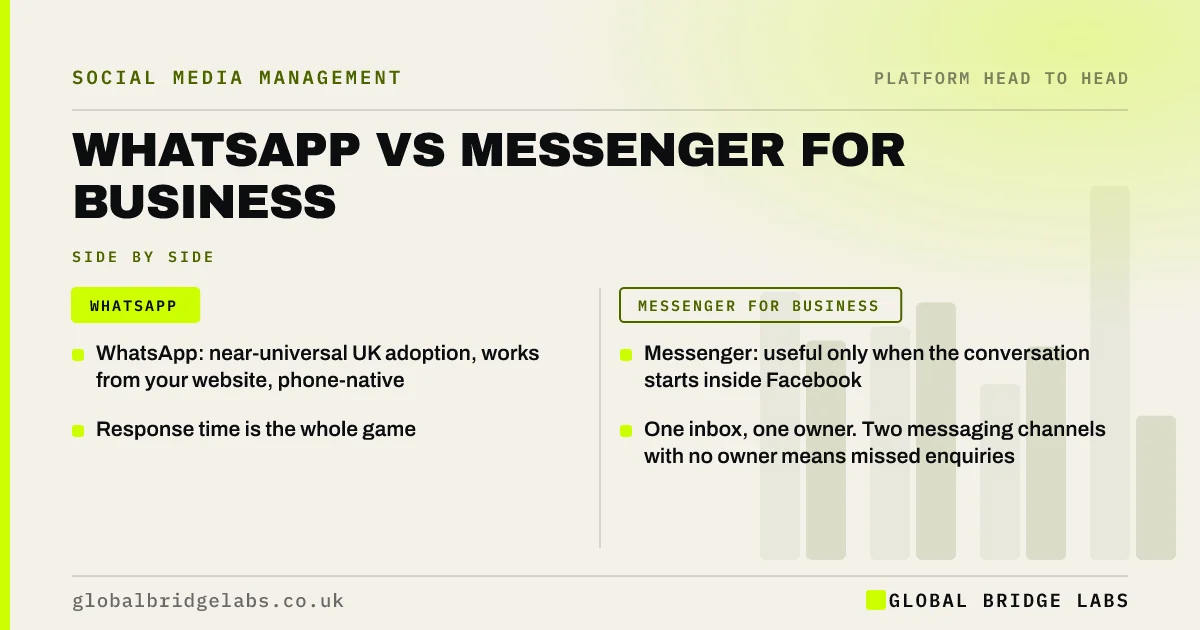
- WhatsApp: near-universal UK adoption, works from your website, phone-native.
- Messenger: useful only when the conversation starts inside Facebook.
- Response time is the whole game. 4 working hours is the standard to hold.
- One inbox, one owner. Two messaging channels with no owner means missed enquiries.
- Both need a stated hours policy so nobody expects a reply at 11pm.
Want a messaging setup that does not leak enquiries? Message us on WhatsApp.
Chat on WhatsApp →Which messaging channel should a UK business use?
WhatsApp, in almost every case, because UK adoption is broad across every age band and people already use it daily for personal messaging. Asking a customer to message you on WhatsApp asks them to do something they already do.
Messenger has a narrower role: it catches the conversation that starts on a Facebook page or in a Facebook ad, where it is the path of least resistance. It is a good catcher and a poor primary channel.
What makes WhatsApp work for small businesses?
Four practical properties, none of which are about marketing features.
- Click-to-chat links work from your website, email signature, profile and printed material.
- It is phone-native, so replies happen from a van, a site or a shop floor.
- Customers can send photographs, which shortens quoting for trades and services.
- Threads persist, so the history of a job is in one place.
- It feels like a conversation rather than a form, which lowers the barrier to enquiring.
When does Messenger make sense?
When Facebook is genuinely your primary channel and a meaningful share of enquiries already start there. In that case, Messenger is the channel the customer is already in and pushing them to WhatsApp adds a step that loses some of them.
The trap is running both without an owner. A Messenger inbox nobody checks is a source of missed enquiries and a public response-time badge that tells everyone you are slow, which is worse than not offering the channel at all.
We handle UK-hours message response for small teams. Ask how on WhatsApp.
Chat on WhatsApp →What response time should you hold?
Four working hours as a standard, one hour as a target during opening hours. Messaging enquiries decay faster than email because the person is usually in the middle of solving a problem and will message the next business on their list.
Set expectations explicitly rather than trying to be always on. A profile line saying replies within 4 working hours, Monday to Friday 9 to 5 does more for satisfaction than an aspiration to answer instantly that fails every weekend. The Institute of Customer Service's UK research consistently links satisfaction to expectations being met rather than to raw speed.
What are the data protection considerations?
Messaging a customer who has contacted you about a job is service communication and sits comfortably within normal expectations. Using a collected mobile number to send marketing messages is direct marketing and falls under PECR, which means you need consent.
Keep the two separate in practice: a service thread about a job is not an invitation to send offers. The ICO's direct marketing guidance is the reference point, and the practical rule is that if a message is trying to sell something to someone who did not ask, you need permission first.
What does this look like in practice?
A UK domestic appliance repair firm offered three contact routes: a form, Messenger and a phone number. The form produced slow, incomplete enquiries, Messenger went unchecked for days, and the phone rang while engineers were under sinks.
Consolidating on one WhatsApp number with a click-to-chat button on every page, a stated four-hour response promise and one named person responsible cut the quoting cycle noticeably, because customers sent photographs of the appliance and the model plate with the first message.
How do you stop messaging eating your day?
Two fixed windows rather than constant checking. Twenty minutes mid-morning and twenty minutes late afternoon clears almost every small business inbox and still meets a four-hour response standard.
Use saved replies for the five questions you answer most, which for most UK service businesses are price, availability, area covered, how long it takes and how to book. That turns a five-minute reply into a thirty-second one without making it feel automated, because you still edit the specifics before sending.
Publish the windows on your profile so nobody expects a reply at eleven at night. Stated hours protect your evening and, more usefully, they stop a two-hour wait feeling like being ignored.
Next step
Pick one messaging channel, put a click-to-chat link everywhere a customer might want to ask something, name one person responsible for it, and publish your response hours. The channel matters far less than whether somebody answers.
Message us on WhatsApp and we will set up your click-to-chat links and response policy.
Chat on WhatsApp →Sources and further reading
- How to use click to chat · WhatsApp Help Center
- Direct marketing and privacy and electronic communications · Information Commissioner's Office
Frequently asked questions
Should a UK business use WhatsApp or Messenger?
WhatsApp in almost every case, because UK adoption is broad across all age bands and people already use it daily. Messenger is worth having only when Facebook is your primary channel and enquiries already start inside it.
How fast should you reply to a WhatsApp business message?
Within four working hours as a standard and one hour during opening hours as a target. Messaging enquiries decay faster than email because the person is mid-problem and will message the next business on their list.
Can I send marketing messages on WhatsApp?
Only with consent. Replying about a job someone asked about is service communication and sits within normal expectations. Using a number collected during that job to send offers is direct marketing under PECR, and the ICO's guidance requires permission before you send anything of that kind.
Is it bad to offer several messaging channels?
Yes, when nobody owns them. An unchecked inbox produces missed enquiries and a public slow-response badge that every prospective customer can see, which is worse than not offering the channel at all. One channel with a named owner beats three with none.
Written by
Global Bridge Labs (GBL) is a UK–Sri Lanka partner for social media, websites and BPO. Everything here comes from client delivery, not theory.