On this page
Key takeaways
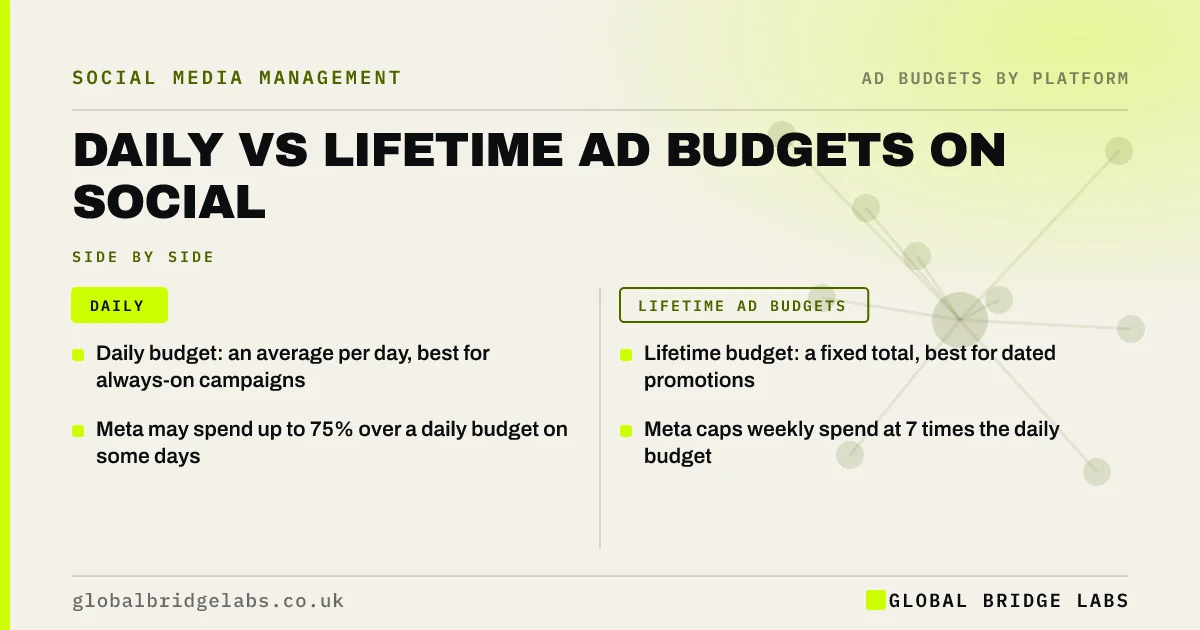
Daily vs lifetime budget is a choice about control over time. A daily budget sets an average per day and suits always-on campaigns. A lifetime budget sets a total for a fixed period and suits events and promotions with an end date. On Meta, daily spend can run over on some days but evens out across the week.
- Daily budget: an average per day, best for always-on campaigns.
- Lifetime budget: a fixed total, best for dated promotions.
- Meta may spend up to 75% over a daily budget on some days.
- Meta caps weekly spend at 7 times the daily budget.
Not sure which budget type to use? Message us on WhatsApp.
Chat on WhatsApp →How does a daily budget spend?
Meta treats a daily budget as an average. On days with better opportunities it can spend up to 75% more, and on quieter days less, but it will not spend more than seven times the daily budget in a calendar week. Google Ads works similarly, with its own monthly limit.
How does a lifetime budget spend?
You set a total and start and end dates, and the platform spreads spend across the period, putting more into days it expects to perform. Lifetime budgets let you schedule ads to run only at certain hours on some platforms, which suits businesses with set opening times.
Which should you choose?
Use a daily budget for ongoing campaigns you will adjust over time, such as your main service. Use a lifetime budget for events, sales, launches and anything with a fixed end. Illustrative example: £280 lifetime over 14 days for an open day, or £20 a day ongoing for bookings.
- Always-on lead or sales campaign: daily.
- Event, open day or limited offer: lifetime.
- Fixed opening hours with scheduling: lifetime.
Send us your campaign plan on WhatsApp and we will discuss your requirements.
Chat on WhatsApp →What are the common mistakes?
Panicking when one day overspends a daily budget, setting lifetime budgets with no end review, and switching between types mid-campaign, which can reset learning. Check spend weekly, not daily, and keep the budget type until the campaign ends.
What does this look like in practice?
A pattern we see: an owner sees a daily budget of £10 spend £17 on Saturday and pauses the campaign. Explaining the weekly average usually ends the worry, and leaving the campaign running gives it time to settle.
Budget type checklist
- Use daily budgets for always-on campaigns.
- Use lifetime budgets for dated events and offers.
- Expect daily spend to vary around the average.
- Check spend weekly against the weekly cap.
- Avoid switching budget type mid-campaign.
Next step
List your active campaigns and mark each as ongoing or dated. Any dated campaign on a daily budget is a candidate to switch at its next restart.
Message us on WhatsApp with your list, or book a 30-minute consultation.
Chat on WhatsApp →Sources and further reading
- About budgets · Meta
- Set and change an average daily budget for your campaign · Google Ads Help
Frequently asked questions
Why did Facebook spend more than my daily budget?
Meta treats the daily budget as an average. It can spend up to 75% more on days with better opportunities and less on others, but will not exceed seven times the daily budget in a calendar week. Check weekly totals rather than single days.
Is a lifetime budget better than a daily budget?
Neither is better overall. Lifetime budgets suit campaigns with fixed dates and allow ad scheduling on some platforms. Daily budgets suit ongoing campaigns you will raise or lower over time. Choose by whether the campaign has an end date. Many accounts use both for different campaigns.
Can I change from daily to lifetime budget?
Often not on an existing ad set, and doing so may require a new ad set that starts learning again. Decide the budget type before launch. If you must change, plan for a short period of less stable results. Plan the change for a quiet period.
Written by

Global Bridge Labs (GBL) is a UK–Sri Lanka partner for social media, websites and BPO. Everything here comes from client delivery, not theory.