On this page
Key takeaways
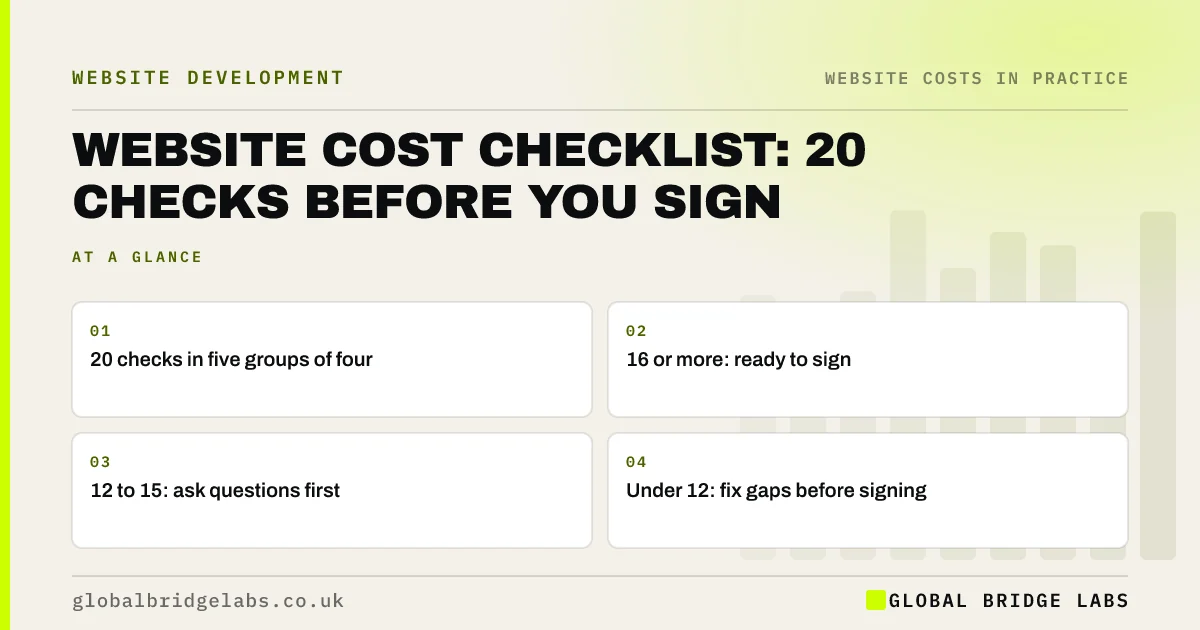
This website cost checklist has 20 yes or no checks in five groups of four, following the GBL five-line website budget: build, content, platform, care and growth. Score one point for each yes. 16 or more means the quote is ready to sign; 12 to 15 means ask questions first; under 12 means the budget or quote has gaps.
- 20 checks in five groups of four.
- 16 or more: ready to sign.
- 12 to 15: ask questions first.
- Under 12: fix gaps before signing.
Want the checklist as a scoring sheet? Message us on WhatsApp.
Chat on WhatsApp →How does the website cost checklist work?
The website cost checklist works by asking 20 yes or no questions about a quote and your budget, grouped into the five lines of the GBL five-line website budget. Each yes scores a point. The score shows whether the quote is complete enough to sign or still hides costs and risks.
Build and content checks
The first eight checks cover what is being built and who provides the words and images.
- Is the scope written, with pages and features listed?
- Are costs itemised by phase?
- Are exclusions listed?
- Is there a fix period after launch?
- Is it clear who writes the copy?
- Is photography or imagery covered?
- Is content loading included or priced?
- Are revision rounds stated?
Want your quote scored against these checks? Message us on WhatsApp and we will discuss your requirements.
Chat on WhatsApp →Platform and care checks
The next eight checks cover running costs and ownership.
- Is the domain registered in your name?
- Is copyright assigned to you on payment?
- Are hosting costs stated?
- Are plugin and app licences listed?
- Is a care plan priced?
- Are updates and backups covered?
- Is there an exit and handover clause?
- Are payment stages tied to deliverables?
Growth checks
The final four checks cover whether the site can be measured and improved.
- Is enquiry tracking set up as key events?
- Is basic SEO set-up included?
- Are redirects from any old site included?
- Is budget kept back for launch marketing?
When is a lower score acceptable?
A lower score can be acceptable for a small fixed package where some items are deliberately excluded and you will supply them. Mark those as covered by you rather than leaving them blank.
What does this look like in practice?
At Global Bridge Labs (GBL), a UK groundworks firm scored its preferred quote at 11. The gaps were ownership, licences, tracking, redirects and launch marketing. After the supplier added four items in writing and the firm budgeted the fifth, the score reached 17 and they signed.
Scoring checklist
- Answer all 20 checks for each quote.
- Score one point per yes.
- Mark items you will supply yourself.
- Ask suppliers to fill gaps in writing.
- Re-score after answers.
- Sign at 16 or more.
Next step
Score your current quote now. Every no is a question for your supplier before you pay a deposit.
Message us on WhatsApp for the 20-check website cost scoring sheet, or book a 30-minute consultation.
Chat on WhatsApp →Sources and further reading
- Consumer Rights Act 2015 · legislation.gov.uk
- How copyright protects your work · GOV.UK
- About key events · Google Analytics Help
Frequently asked questions
What should I check before signing a website quote?
Check the written scope, itemised costs, exclusions, content responsibilities, revision rounds, fix period, domain ownership, copyright assignment, hosting and licence costs, care, exit terms, payment stages, tracking, SEO set-up, redirects and launch marketing budget. Each missing item is a cost or risk to clarify first.
How do I score a website quote?
Answer 20 yes or no questions covering build, content, platform, care and growth, scoring one point per yes. A score of 16 or more suggests the quote is complete; 12 to 15 means ask questions; under 12 means significant gaps. Mark items you will supply yourself as covered.
What is the most commonly missed item in website quotes?
Ownership terms are among the most commonly missed: who owns the domain, design, code and content. Copywriting, plugin licences, redirects and enquiry tracking are also often left out. Asking about each in writing before signing avoids surprise costs and difficult supplier changes later.
Written by

Global Bridge Labs (GBL) is a UK–Sri Lanka partner for social media, websites and BPO. Everything here comes from client delivery, not theory.