On this page
- 01Key takeaways
- 02How are website projects usually paid for?
- 03How big should a website deposit be?
- 04What should each stage be tied to?
- 05What protects you at the final payment?
- 06What if you pay late or the supplier delivers late?
- 07What does this look like in practice?
- 08Payment stages checklist
- 09Next step
- 10Sources and further reading
- 11Frequently asked questions
Key takeaways
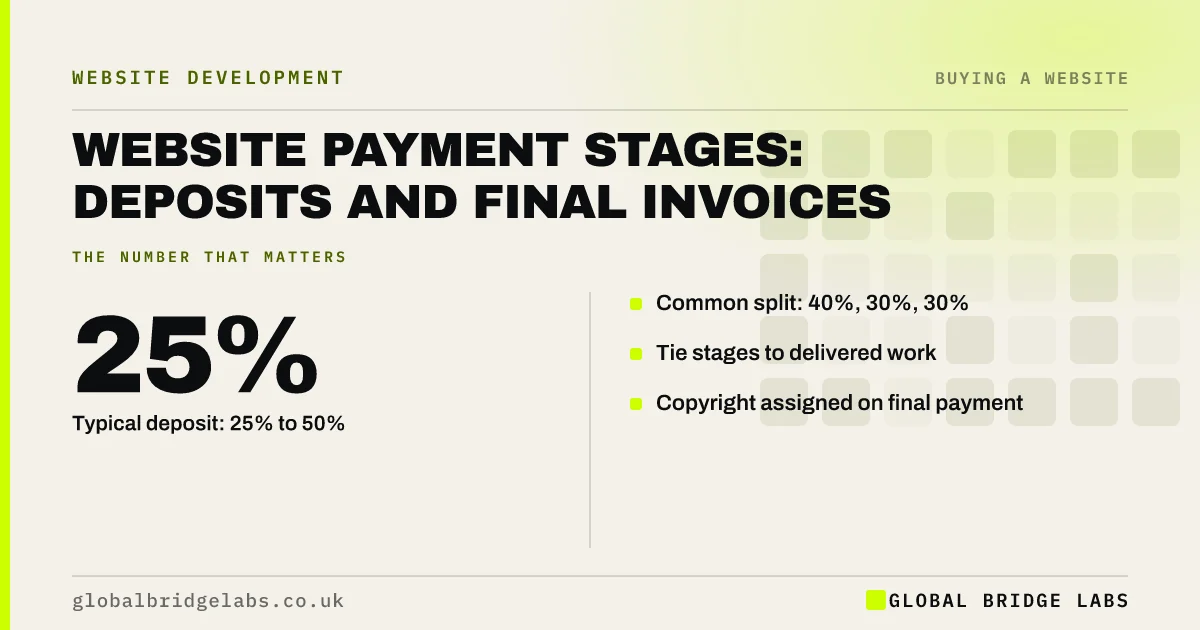
Most UK website projects take a deposit of 25% to 50%, then stage payments at design sign-off and launch. A common pattern is 40% upfront, 30% on design approval and 30% at launch. Tie payments to delivered work, never pay 100% upfront for a build, and link copyright assignment to the final payment.
- Typical deposit: 25% to 50%.
- Common split: 40%, 30%, 30%.
- Tie stages to delivered work.
- Copyright assigned on final payment.
Want a payment schedule checked? Message us on WhatsApp.
Chat on WhatsApp →How are website projects usually paid for?
Website projects are usually paid in stages: a deposit to start, a payment when design is approved, and a final payment at launch. Larger projects add milestones for build or content. Stages protect both sides: the supplier is paid for work done, and you only pay for delivered progress.
How big should a website deposit be?
A website deposit is typically 25% to 50% of the build price. It secures the supplier's time and covers early work. Deposits above 50% put more risk on you; very small deposits may suggest a supplier with little commitment to scheduling your project.
- 25% to 50% is common.
- Above 50%: ask why.
- Never 100% upfront for a build.
Want a fair payment schedule for your project? Message us on WhatsApp and we will discuss your requirements.
Chat on WhatsApp →What should each stage be tied to?
Each stage should be tied to something you can see and approve: signed-off designs, a working staging site, a completed launch. Avoid stages tied only to dates, which can leave you paying for delays you did not cause.
What protects you at the final payment?
At the final payment, you should receive copyright assignment, all logins, site files and confirmation the domain and hosting are in your name. Copyright stays with the creator unless assigned, so link assignment to this payment in the contract.
What if you pay late or the supplier delivers late?
Late payment of business invoices can attract statutory interest under UK late payment rules, so pay on agreed terms. If the supplier delivers late, a contract clause should say what happens. Both sides benefit from written terms on delays.
What does this look like in practice?
At Global Bridge Labs (GBL), a UK garden design business had paid 80% upfront to a previous supplier who then went quiet. For the rebuild, they used a 40%, 30%, 30% schedule tied to design sign-off and launch, with copyright assigned on final payment. The project ran to plan.
Payment stages checklist
- Keep the deposit at 25% to 50%.
- Tie stages to approved deliverables.
- Avoid paying in full upfront.
- Link copyright assignment to final payment.
- Get logins and files at launch.
- Agree terms for delays on both sides.
Next step
Ask your supplier to rewrite the payment schedule so each stage names the deliverable you approve before paying.
Message us on WhatsApp for a website payment schedule template, or book a 30-minute consultation.
Chat on WhatsApp →Sources and further reading
- Late commercial payments: charging interest and debt recovery · GOV.UK
- Consumer Rights Act 2015 · legislation.gov.uk
- How copyright protects your work · GOV.UK
Frequently asked questions
How much deposit should a web designer ask for?
Most UK web designers ask for a deposit of 25% to 50% of the build price before starting. This secures their time and covers early work. Be cautious about deposits above 50%, and never pay the full amount upfront for a custom build.
When should I pay the final website invoice?
Pay the final invoice when the site is launched and working as agreed, within the payment terms in your contract. At that point you should receive copyright assignment, logins, files and confirmation the domain and hosting are in your name. Raise any defects before paying.
Is it normal to pay for a website upfront?
Paying in full upfront is normal only for small fixed-price packages or subscriptions. For custom builds, staged payments tied to approved deliverables are standard and fairer. If a supplier insists on full payment upfront for a bespoke project, ask why and consider the risk carefully.
Written by

Global Bridge Labs (GBL) is a UK–Sri Lanka partner for social media, websites and BPO. Everything here comes from client delivery, not theory.