On this page
- 01Key takeaways
- 02How much should you keep back for marketing after launch?
- 03Where should launch marketing money go?
- 04How should the budget be split over six months?
- 05Why is launch marketing often forgotten?
- 06When can you spend less on launch marketing?
- 07What does this look like in practice?
- 08Launch budget checklist
- 09Next step
- 10Sources and further reading
- 11Frequently asked questions
Key takeaways
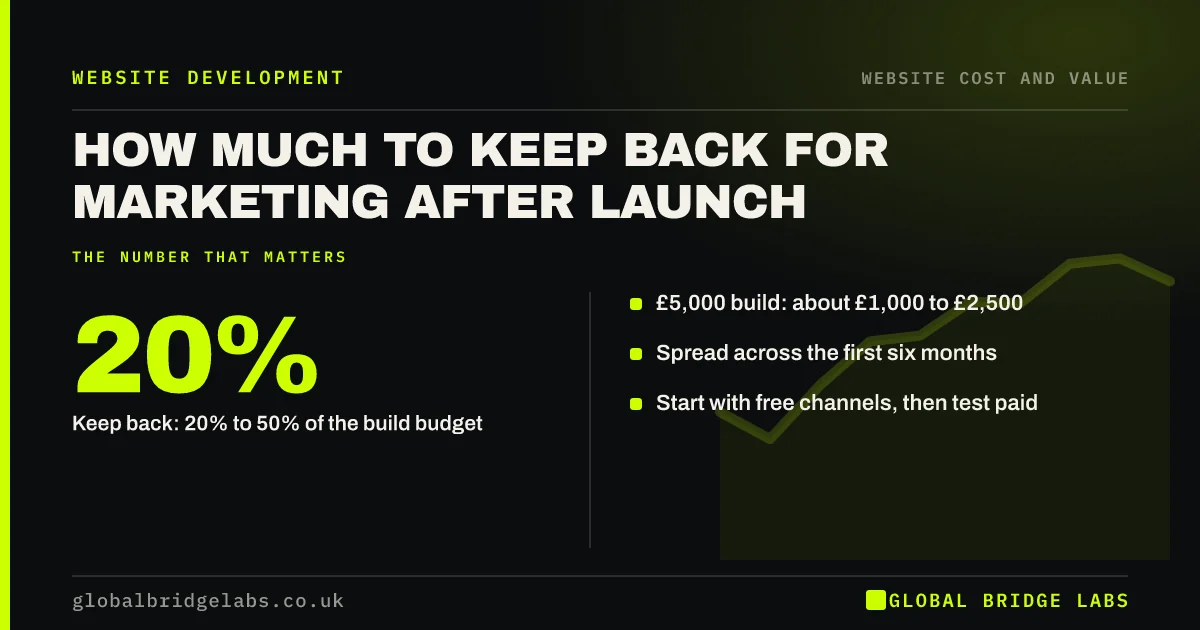
Keep back 20% to 50% of your website build budget for marketing in the first six months, because a new site gets few visitors on its own. For a £5,000 build, that means £1,000 to £2,500 for local search, content, email, social media or a small ad test. A site with no visitors cannot pay for itself, however good it is.
- Keep back: 20% to 50% of the build budget.
- £5,000 build: about £1,000 to £2,500.
- Spread across the first six months.
- Start with free channels, then test paid.
Want a launch marketing plan for your site? Message us on WhatsApp.
Chat on WhatsApp →How much should you keep back for marketing after launch?
Keep back about 20% to 50% of the build budget for marketing in the first six months. The higher end suits competitive markets or businesses relying on the site for most new work. A new site starts with little search visibility, so early visitors usually need to be brought in deliberately.
Where should launch marketing money go?
Start with low-cost channels that compound, then test paid ones. Free steps such as a Google Business Profile and telling existing customers often bring the first enquiries.
- Google Business Profile updated with the new site.
- Email to existing customers and contacts.
- Social media posts announcing the site.
- Content for key service pages.
- A small, tracked ad test.
Want your launch budget split across channels? Message us on WhatsApp and we will discuss your requirements.
Chat on WhatsApp →How should the budget be split over six months?
A simple split is a third in months one and two for launch activity and a first ad test, a third in months three and four for content and improvements based on data, and a third in months five and six for whatever is working. Track enquiries as key events to decide.
Why is launch marketing often forgotten?
Launch marketing is often forgotten because the build takes all the budget and attention, and owners expect search engines to send visitors immediately. In practice, new pages take time to rank, and marketing bridges that gap.
When can you spend less on launch marketing?
Spend less when the site replaces an established one with good search visibility and redirects in place, or when most work comes from referrals who will visit anyway. The site then inherits existing traffic.
What does this look like in practice?
At Global Bridge Labs (GBL), a UK pet groomer spent the whole budget on a new site and then saw few enquiries. A second groomer we worked with kept £1,200 back: they updated their Google profile, emailed past customers and ran a £300 local ad test. Their new site brought bookings from week one.
Launch budget checklist
- Keep 20% to 50% of build budget back.
- Update your Google Business Profile.
- Email existing customers.
- Plan content for key pages.
- Run a small, tracked ad test.
- Review results monthly.
Next step
Before signing a build quote, set aside your launch marketing budget. If the build leaves nothing for marketing, reduce the build scope.
Message us on WhatsApp for a launch marketing plan, or book a 30-minute consultation.
Chat on WhatsApp →Sources and further reading
- SEO Starter Guide · Google Search Central
- Google Business Profile Help · Google
- About key events · Google Analytics Help
Frequently asked questions
How much should I spend promoting a new website?
A sensible guide is 20% to 50% of the build budget over the first six months, spent on local search, email to existing customers, social media, content and a small ad test. Track enquiries so you can move money towards what works.
Will a new website get traffic on its own?
Some, but usually not much at first. New pages take time to appear and rank in search results, especially in competitive markets. Updating your Google Business Profile, telling existing customers and running small tests bring visitors while search visibility builds.
What is the cheapest way to promote a new business website?
Update your Google Business Profile with the new site, email existing customers and contacts, add the link to social profiles and email signatures, and ask happy customers for reviews. These cost little or nothing and often bring the first enquiries.
Written by

Global Bridge Labs (GBL) is a UK–Sri Lanka partner for social media, websites and BPO. Everything here comes from client delivery, not theory.