On this page
- 01Key takeaways
- 02How does website cost change with business size?
- 03What does a 10-person firm usually need?
- 04What does a 50-person business usually need?
- 05Why does size matter less than role?
- 06When do larger firms overspend?
- 07What does this look like in practice?
- 08Business size checklist
- 09Next step
- 10Sources and further reading
- 11Frequently asked questions
Key takeaways
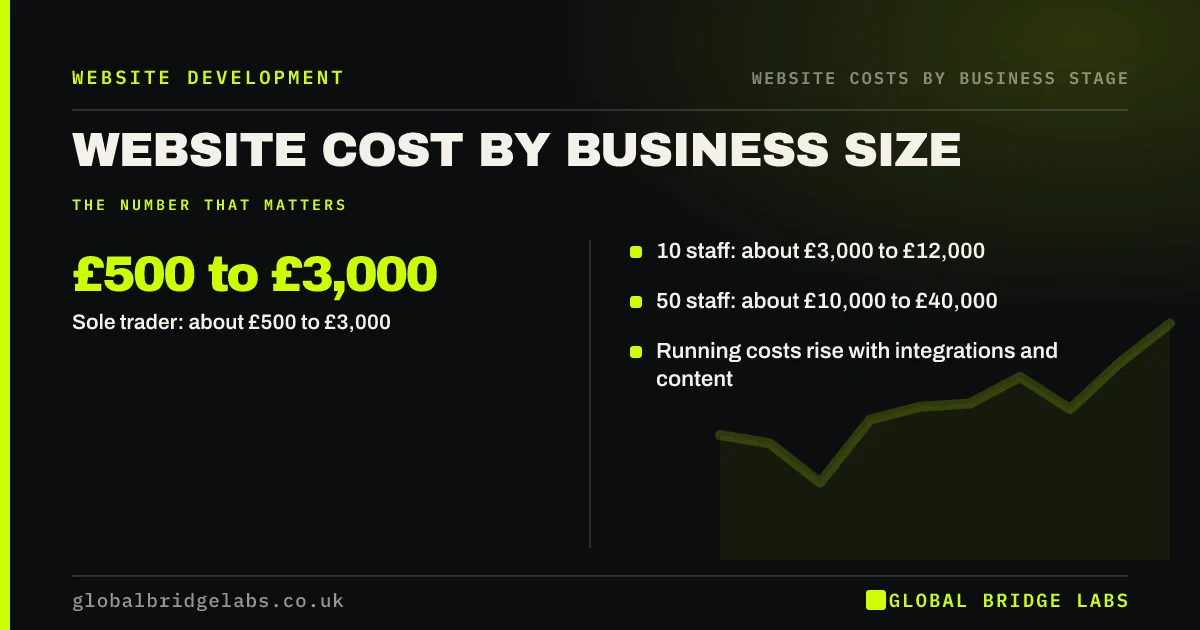
Website budgets typically grow with business size: about £500 to £3,000 for a sole trader, £3,000 to £12,000 for a 10-person firm, and £10,000 to £40,000 for a 50-person business. Size matters less than how much of your new business comes through the site, but larger firms usually need more services, proof, integrations and governance.
- Sole trader: about £500 to £3,000.
- 10 staff: about £3,000 to £12,000.
- 50 staff: about £10,000 to £40,000.
- Running costs rise with integrations and content.
Want a website budget for your business size? Message us on WhatsApp.
Chat on WhatsApp →How does website cost change with business size?
Website cost rises with size because larger businesses offer more services, serve more audiences and connect more systems. Typical UK budgets are about £500 to £3,000 for sole traders, £3,000 to £12,000 for 10-person firms and £10,000 to £40,000 for 50-person businesses.
What does a 10-person firm usually need?
A 10-person firm usually needs a site of 10 to 25 pages: service pages, team, case studies or reviews, enquiry tracking and perhaps booking or a CRM link. Running costs are typically £75 to £300 a month including care and some growth work.
- 10 to 25 pages.
- Team and proof pages.
- Enquiry tracking and CRM link.
Want your site scoped for your team size? Message us on WhatsApp and we will discuss your requirements.
Chat on WhatsApp →What does a 50-person business usually need?
A 50-person business usually needs more services and sectors, recruitment pages, integrations, content governance and stronger security. Several staff edit content, so permissions and processes matter. Running costs often reach £300 to £1,500 a month.
Why does size matter less than role?
Size matters less than the website's role in winning work. A 5-person e-commerce firm may need a bigger site than a 50-person contractor working through tenders. Base the budget on the share of new business that comes through the site.
When do larger firms overspend?
Larger firms overspend when committees add features nobody uses, or when every department wants its own section. A clear owner and goals keep scope proportionate.
What does this look like in practice?
At Global Bridge Labs (GBL), a UK engineering consultancy with 45 staff budgeted £35,000 for a site because a competitor had. Mapping where clients came from showed most work arrived through frameworks and referrals. A focused £14,000 site covered their needs, with savings spent on bid support.
Business size checklist
- Count services and audiences.
- List systems to connect.
- Decide who edits content.
- Estimate the site's share of new business.
- Set a clear owner.
- Budget running costs to match.
Next step
Estimate the share of last year's new business that began on your website. Use that, alongside size, to set your budget.
Message us on WhatsApp for a website budget by business size, or book a 30-minute consultation.
Chat on WhatsApp →Sources and further reading
- Business population estimates for the UK and regions 2025 · Department for Business and Trade
- SEO Starter Guide · Google Search Central
- About key events · Google Analytics Help
Frequently asked questions
How much should a 10 person business spend on a website?
A 10-person business typically spends £3,000 to £12,000 on a website, plus £75 to £300 a month to run it. The figure depends on how many services you offer, whether you need booking or CRM links and how much new business comes through the site.
How much does a website cost for a medium-sized business?
A medium-sized business with around 50 or more staff typically spends £10,000 to £40,000 on a website, with running costs of £300 to £1,500 a month. Costs reflect more services, integrations, recruitment pages, content governance and security needs.
Do bigger businesses always need bigger websites?
No. Website needs depend on how the business wins work. A small online retailer may need a larger site than a big contractor winning through tenders and referrals. Size the site to its role in sales and the questions buyers ask, not headcount alone.
Written by

Global Bridge Labs (GBL) is a UK–Sri Lanka partner for social media, websites and BPO. Everything here comes from client delivery, not theory.