On this page
- 01Key takeaways
- 02What share of turnover should go on a website?
- 03How do you work out the figure?
- 04What do worked examples look like?
- 05Why is a percentage only a starting point?
- 06When should you spend above the range?
- 07What does this look like in practice?
- 08Budget sizing checklist
- 09Next step
- 10Sources and further reading
- 11Frequently asked questions
Key takeaways
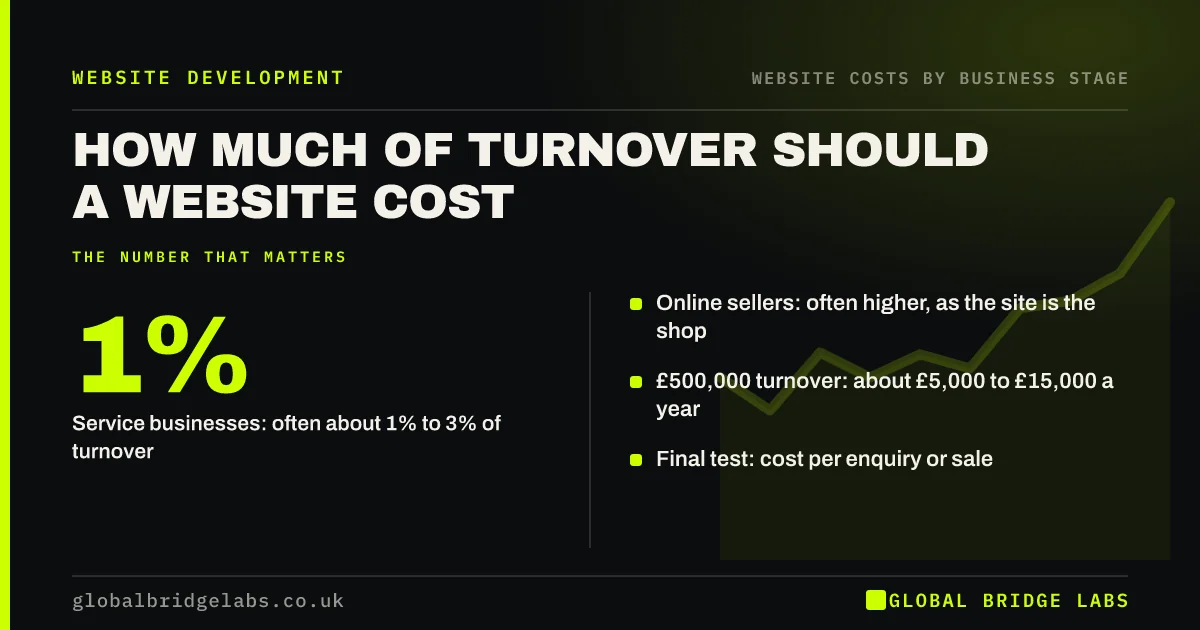
There is no fixed rule, but many UK service businesses spend about 1% to 3% of annual turnover on their website over its life, and online sellers more. A business turning over £500,000 might spend £5,000 to £15,000 a year on build, care and growth combined. Base the final figure on what the site produces, not on a percentage alone.
- Service businesses: often about 1% to 3% of turnover.
- Online sellers: often higher, as the site is the shop.
- £500,000 turnover: about £5,000 to £15,000 a year.
- Final test: cost per enquiry or sale.
Want your website budget sized to your turnover? Message us on WhatsApp.
Chat on WhatsApp →What share of turnover should go on a website?
Many UK service businesses spend roughly 1% to 3% of annual turnover on their website when build, care and growth are spread across its life. Online sellers, where the site is the shop, often spend more. These are rules of thumb, not standards, and should be checked against results.
How do you work out the figure?
Work out the figure by spreading the build over three to five years, adding yearly running and growth costs, and dividing by turnover. Compare that with what share of new business arrives through the website. If the site brings half your new clients, a higher share is reasonable.
- Build divided by years of use.
- Plus yearly hosting, care and growth.
- Divided by annual turnover.
- Compared with the site's share of new business.
Want this worked out with your numbers? Message us on WhatsApp and we will discuss your requirements.
Chat on WhatsApp →What do worked examples look like?
A trades firm turning over £300,000 with a £4,500 site over three years and £1,800 a year running costs spends £3,300 a year, about 1.1% of turnover. An online shop turning over £300,000 spending £15,000 a year on its site is at 5%, reasonable when the site produces most sales.
Why is a percentage only a starting point?
A percentage ignores what the site produces. Two firms at the same turnover can need very different sites. Use the percentage to sense-check, then judge by cost per enquiry or sale, tracked through analytics key events.
When should you spend above the range?
Spend above the range when the website is your main source of new customers, when entering a new market, or when the current site is clearly losing work. Spend below it when work comes mostly from referrals.
What does this look like in practice?
At Global Bridge Labs (GBL), a UK surveying firm turning over £1.2 million spent £1,500 a year on its website, about 0.1% of turnover, yet a third of new clients found them online. Raising spend to about 1% funded better service pages and tracking, and online enquiries grew steadily.
Budget sizing checklist
- Spread build over its years of use.
- Add yearly running and growth costs.
- Divide by turnover.
- Estimate the site's share of new business.
- Compare cost per enquiry or sale.
- Review yearly.
Next step
Find out what share of last year's new clients first found you online. Use that, not a rule of thumb, to set your website budget.
Message us on WhatsApp for a website budget calculator, or book a 30-minute consultation.
Chat on WhatsApp →Sources and further reading
- Business population estimates for the UK and regions 2025 · Department for Business and Trade
- About key events · Google Analytics Help
- Internet sales as a percentage of total retail sales · Office for National Statistics
Frequently asked questions
What percentage of revenue should a small business spend on its website?
Many UK service businesses spend about 1% to 3% of turnover on their website when build, care and growth are spread across its life. Online sellers often spend more because the site is their shop. Treat this as a sense check and judge by results such as cost per enquiry.
How much should a £1 million business spend on its website?
As a rough guide, a service business turning over £1 million might spend £10,000 to £30,000 a year on its website, including build spread over several years, care and growth. The right figure depends on how much new business comes through the site and what each customer is worth.
Is website spending part of the marketing budget?
Usually, yes. Most businesses treat the website as a core marketing channel, so build, care and growth sit within the marketing budget. Some split the build into capital spending. Either way, plan website costs alongside other channels so you can compare cost per enquiry fairly.
Written by

Global Bridge Labs (GBL) is a UK–Sri Lanka partner for social media, websites and BPO. Everything here comes from client delivery, not theory.