On this page
- 01Key takeaways
- 02Which contract clauses protect your budget?
- 03How should scope and changes be written?
- 04What do acceptance and fix period clauses do?
- 05What ownership and data terms should be included?
- 06When is a light contract enough?
- 07What does this look like in practice?
- 08Contract clause checklist
- 09Next step
- 10Sources and further reading
- 11Frequently asked questions
Key takeaways
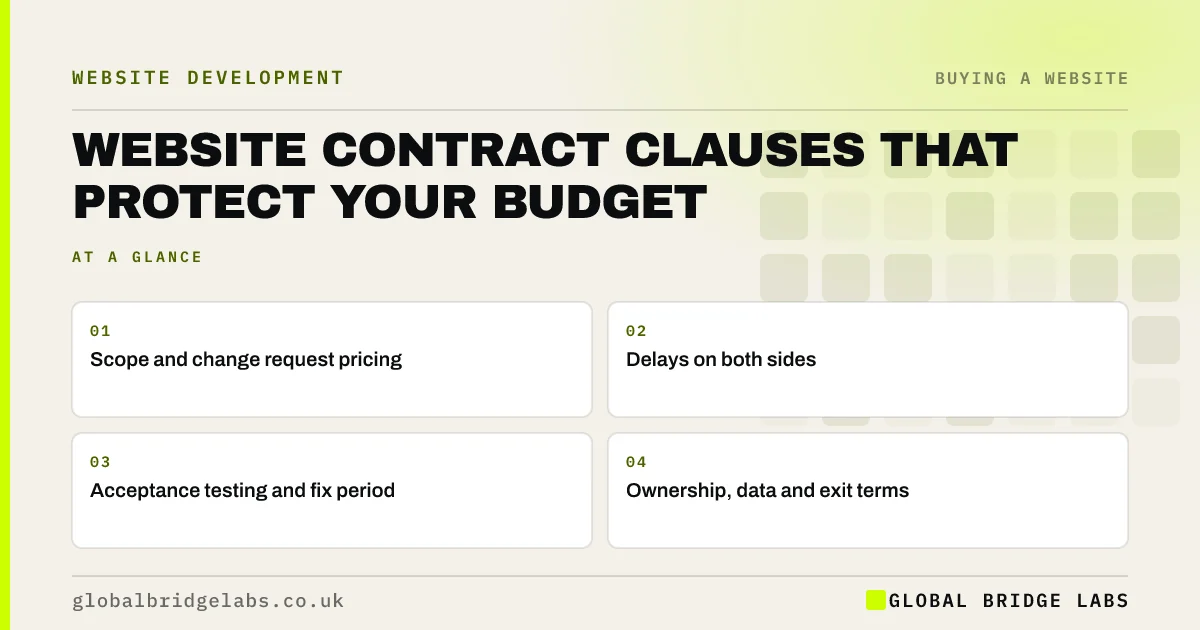
The website contract clauses that protect your budget cover scope, change requests, delays, acceptance testing, ownership, the fix period and exit. Together they decide who pays when things change or go wrong. Ask for them in writing before paying a deposit; a short, clear contract is better than none.
- Scope and change request pricing.
- Delays on both sides.
- Acceptance testing and fix period.
- Ownership, data and exit terms.
Want a website contract checked? Message us on WhatsApp.
Chat on WhatsApp →Which contract clauses protect your budget?
The clauses that protect your budget are a written scope, a change request process with rates, terms for delays on either side, acceptance criteria, a fix period for defects, ownership assignment, data protection terms and an exit clause. Each sets who pays when plans change.
How should scope and changes be written?
Scope should list pages, features, integrations and content responsibilities. Changes should follow a written process: request, quote, approve, then work. Without this, small requests add up to large invoices or friction.
- Pages, features and integrations listed.
- Content responsibilities stated.
- Change requests quoted before work.
Want scope and change terms drafted for your project? Message us on WhatsApp and we will discuss your requirements.
Chat on WhatsApp →What do acceptance and fix period clauses do?
Acceptance clauses define how you test and approve the site, against agreed criteria such as working forms, mobile layouts and speed. A fix period, often 30 to 90 days, covers defects found after launch at no extra cost. Without these, every fix becomes billable.
What ownership and data terms should be included?
Include assignment of copyright in design, code and content to you on payment, confirmation the domain and hosting are yours, and a data processing agreement if the supplier handles personal data. The ICO expects written terms between controllers and processors.
When is a light contract enough?
A light contract can be enough for small fixed packages, as long as it covers scope, ownership, payment and exit. A detailed contract matters more for larger, longer or integration-heavy projects.
What does this look like in practice?
At Global Bridge Labs (GBL), a UK pet supplies shop disputed a £1,800 invoice for "changes" after launch. The contract had no fix period or change process. For their next project, a 60-day fix period and a written change process meant two post-launch issues were fixed at no extra cost.
Contract clause checklist
- Written scope and content responsibilities.
- Change request process with rates.
- Delay terms for both sides.
- Acceptance criteria and fix period.
- Copyright assignment and data terms.
- Exit and handover clause.
Next step
Ask your supplier for their contract before paying a deposit, and check it against this list. Request any missing clause in writing.
Message us on WhatsApp for a website contract checklist, or book a 30-minute consultation.
Chat on WhatsApp →Sources and further reading
- Consumer Rights Act 2015 · legislation.gov.uk
- How copyright protects your work · GOV.UK
- Contracts and liabilities between controllers and processors · Information Commissioner's Office
Frequently asked questions
What should be in a website design contract?
A website design contract should cover scope, content responsibilities, change requests, timeline and delays, payment stages, acceptance testing, a fix period, ownership and copyright assignment, data protection terms and exit or handover arrangements. These clauses decide who pays when plans change or problems appear.
What is a fix period in a website contract?
A fix period is a set time after launch, often 30 to 90 days, during which the supplier fixes defects in agreed work at no extra charge. It covers bugs, not new features. Without one, every problem found after launch may be billed as extra work.
Do I need a contract for a small website?
Yes, even a short one. For small fixed packages, a simple written agreement covering scope, price, payment, ownership and what happens if either side wants to stop is enough. It avoids misunderstandings and protects your domain and content if you change supplier later.
Written by

Global Bridge Labs (GBL) is a UK–Sri Lanka partner for social media, websites and BPO. Everything here comes from client delivery, not theory.