On this page
Key takeaways
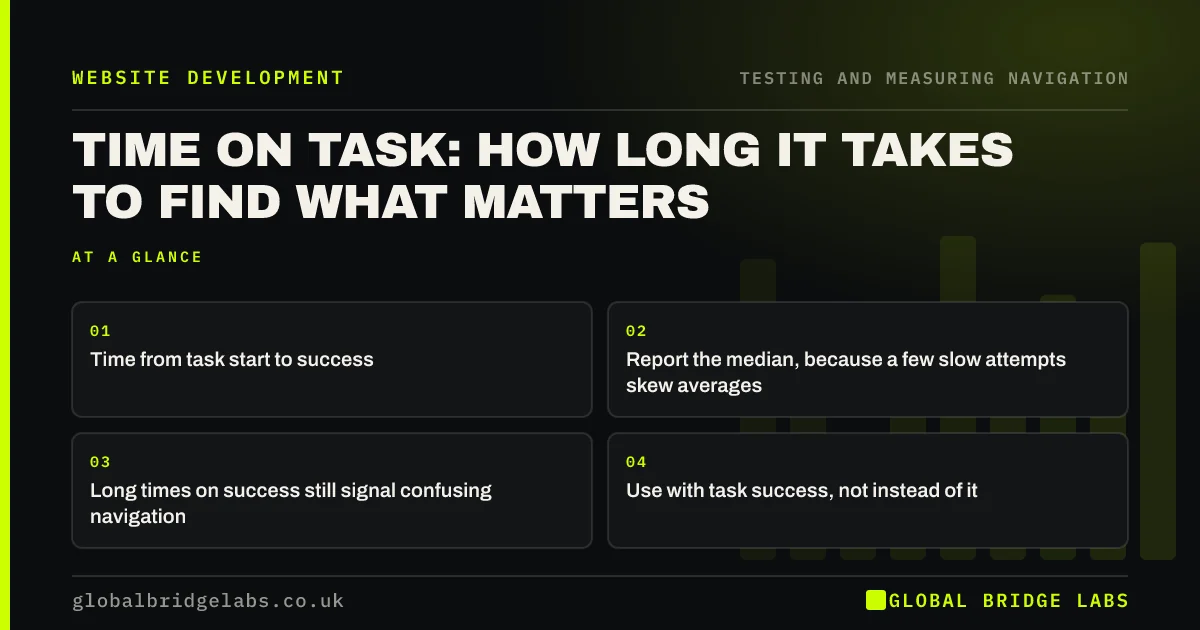
Time on task is how long a participant takes to complete a task, such as finding a price. It shows effort even when people succeed: a task that takes two minutes signals confusing navigation. Measure it in usability tests from the moment the task starts to success, report the median rather than the average, and compare like with like.
- Time from task start to success.
- Report the median, because a few slow attempts skew averages.
- Long times on success still signal confusing navigation.
- Use with task success, not instead of it.
Want to know how long your key tasks take? Message us on WhatsApp.
Chat on WhatsApp →What is time on task?
Time on task is a usability measure of the elapsed time between a participant starting a task and completing it. In navigation testing, it shows how quickly visitors can find information. It is different from 'time on page' in analytics, which measures attention on live traffic without a known goal.
Why does time matter if people succeed?
Success hides effort. A participant who finds the price after two minutes of searching succeeded in the test, but a real visitor might have left after 30 seconds. Long times show where navigation makes visitors work hard, even when it eventually works.
How do you measure it?
Start the clock when the participant begins the task and stop it at success. Most testing tools do this automatically. Record failed attempts separately, rather than mixing their times in. With small samples, report the median, because one participant who gets distracted can distort an average.
- Start when the task begins.
- Stop at the defined end point.
- Record only successful attempts in the time.
- Report the median for small samples.
- Compare the same tasks across rounds.
Want a timed navigation test run? Message us on WhatsApp and we will discuss your requirements.
Chat on WhatsApp →What is a good time?
There is no universal benchmark; it depends on the task. As a working rule, core tasks such as finding a phone number, a service or a price should take seconds, not minutes, for first-time visitors. Compare your times with your own earlier tests and, where possible, with a competitor's site on the same task.
Can analytics measure time on task?
Not directly, because analytics does not know what visitors were trying to do. You can approximate it for a known journey, such as the time from landing to reaching the contact page, using GA4 explorations, but treat that as a rough signal.
What does this look like in practice?
A pattern we see: five of five participants find a firm's fees page, but the median time is well over a minute, because fees sit three levels down under 'About'. Moving the link to the main menu typically brings the time down to a few seconds without changing the page.
Time on task checklist
- Time core tasks in every test.
- Record success and time separately.
- Report the median.
- Compare the same tasks over time.
- Investigate tasks that take minutes.
Next step
Time yourself finding your own price list from a blog post. Then ask a customer to try.
Message us on WhatsApp for a usability test, or book a 30-minute consultation.
Chat on WhatsApp →Sources and further reading
- Why you only need to test with 5 users · Nielsen Norman Group
- Engagement rate and bounce rate · Google Analytics Help
- User research · GOV.UK Service Manual
Frequently asked questions
What is time on task in usability testing?
It is the time a participant takes to complete a defined task, from starting it to reaching the goal. It complements task success by showing how much effort the task took, which success rates alone do not reveal.
Should I use the average or median time on task?
With small samples, the median is usually better, because one slow or distracted participant can pull the average up sharply. Report failures separately rather than including their times.
Is time on task the same as time on page?
No. Time on task is measured in a test with a known goal. Time on page, or engagement time in GA4, measures attention on live traffic where goals vary. A long time on page can mean interest or confusion; you cannot tell which.
Written by

Global Bridge Labs (GBL) is a UK–Sri Lanka partner for social media, websites and BPO. Everything here comes from client delivery, not theory.