On this page
- 01Key takeaways
- 02What is the platform fit scorecard?
- 03How is buyer fit scored?
- 04How is capacity fit scored?
- 05How is evidence fit scored?
- 06What do the score bands mean?
- 07Where does the scorecard mislead?
- 08What does this look like in practice?
- 09How do you stop the scores being fudged?
- 10Next step
- 11Sources and further reading
- 12Frequently asked questions
Key takeaways
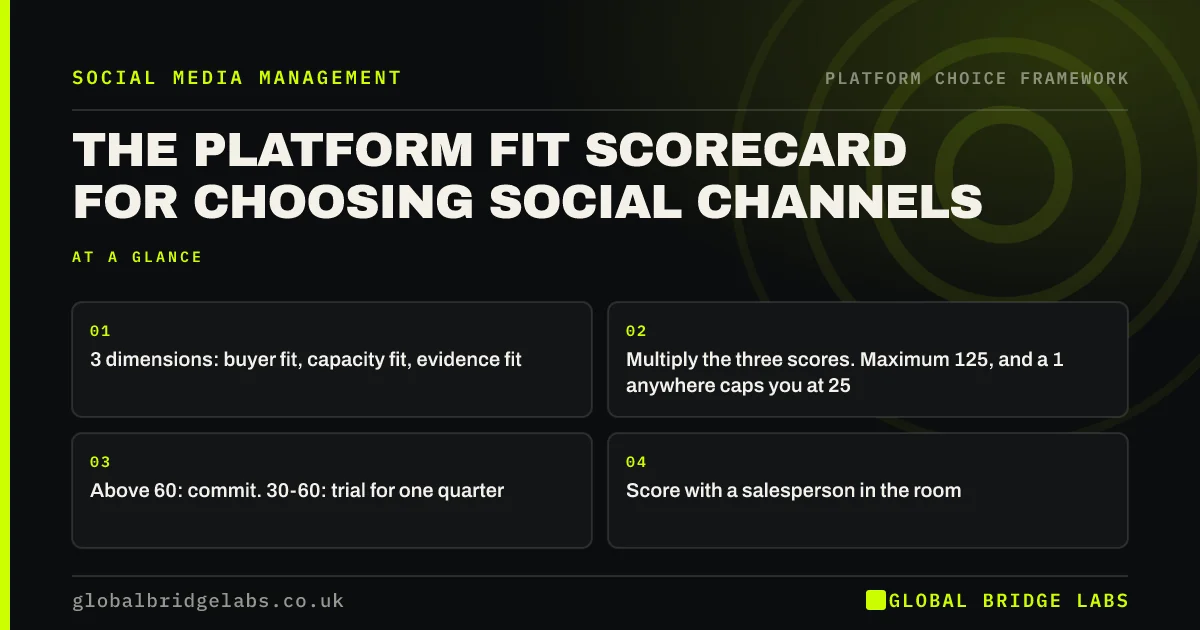
The GBL Platform Fit Scorecard scores every candidate channel on three dimensions: buyer fit, capacity fit and evidence fit. Each is scored 1 to 5 and the three are multiplied rather than added, so a single low score kills a channel instead of being averaged away.
- 3 dimensions: buyer fit, capacity fit, evidence fit. Score each 1-5.
- Multiply the three scores. Maximum 125, and a 1 anywhere caps you at 25.
- Above 60: commit. 30-60: trial for one quarter. Below 30: claim the handle and stop.
- Score with a salesperson in the room. They know where enquiries come from.
- Re-score annually and after any change to what you sell.
Want the scorecard as a one-pager to run yourself? Ask for it on WhatsApp.
Chat on WhatsApp →What is the platform fit scorecard?
The GBL Platform Fit Scorecard is a one-page tool that scores a social media channel on buyer fit, capacity fit and evidence fit, then multiplies the three to produce a single number between 1 and 125.
Multiplication is the design decision that makes it work. Adding scores lets a channel with excellent production economics and no buyers score respectably. Multiplying means a 1 on any dimension caps the total at 25, which is the honest outcome, because a channel your buyers do not use cannot be rescued by being easy to post to.
How is buyer fit scored?
On evidence about your buyers, not the national population. Use the scale below and require a reason for anything above 3.
- 5: most customers named it unprompted when asked where they check suppliers.
- 4: several named it, and your enquiry data shows referrals from it.
- 3: plausible by demographics, no direct evidence either way.
- 2: demographics suggest a minority of your buyers are there.
- 1: no evidence any customer uses it in a buying context.
How is capacity fit scored?
Against your worst month, not your best, and against the person who will actually do the work rather than the person proposing it.
A 5 means you already produce the native format as a by-product of the work: a builder photographing finished jobs, a chef plating food. A 3 means you could produce it with effort. A 1 means it needs a skill or a kit you do not have, such as edited video for a business with nobody who edits. Most failed channels scored a generous 4 here when the truthful answer was 2.
We will score your capacity honestly, including what we would take on. Message us on WhatsApp.
Chat on WhatsApp →How is evidence fit scored?
On whether you will be able to tell, within one quarter, if the channel is working. This is the dimension businesses skip and then regret, because a channel you cannot measure is a channel you can never justify cutting.
A 5 means enquiries from the channel are clearly attributable: click-to-chat links, UTM-tagged traffic, a question on your enquiry form, or direct messages that arrive in one place. A 1 means the only available evidence is platform-reported reach, which tells you about the platform rather than about your business.
What do the score bands mean?
Three bands, and the discipline is in honouring them rather than in the arithmetic.
- Over 60: commit for 12 months with a named owner and budgeted hours.
- 30-60: run a single-quarter trial with a written success threshold agreed in advance.
- Under 30: claim the handle, add a link to your live channel, and post nothing.
- Any dimension scoring 1: do not trial it, whatever the total.
- 2 channels over 60 is a complete plan. A third is a distraction unless it is free.
Where does the scorecard mislead?
It under-rates defensive channels, because a profile that exists so prospects can verify you are trading scores poorly on evidence fit while doing genuinely useful work. Score those separately as maintenance, at near-zero hours, rather than forcing them through the model.
It also under-rates deliberately early positions on emerging platforms, where buyer fit is necessarily low today. If you are making that bet, make it consciously and cap the hours, rather than arguing the score up.
What does this look like in practice?
A UK B2B software reseller scored four channels in a 50-minute session with the sales director present. The professional network scored 4 x 4 x 4, which is 64. A short-form video channel the marketing lead had been pushing scored 2 x 2 x 3, which is 12.
The useful part was not the numbers, it was that the sales director's evidence about where enquiries came from finally entered the decision. The video plan was dropped without argument, because the disagreement had been made visible and specific rather than remaining a matter of preference.
How do you stop the scores being fudged?
Require a written reason for every score above 3, and have someone other than the proposer give it. A score of 4 on buyer fit needs a sentence naming which customers said so; a 4 on capacity fit needs a sentence naming who will produce the content and when.
This takes about ten extra minutes and it is what turns the scorecard from a formality into a decision. Without it, the numbers drift upward until every candidate channel scores well, which returns you to choosing by preference with a spreadsheet attached.
Next step
Book 50 minutes with whoever owns marketing and whoever owns sales. Score every channel you currently touch, plus any you are considering. Honour the bands. The whole exercise costs less than a single week of posting to the wrong platform.
Message us on WhatsApp for the Platform Fit Scorecard and we will run the first session with you.
Chat on WhatsApp →Sources and further reading
- URL builders: collect campaign data with custom URLs · Google Analytics Help
- Online Nation: how the UK uses online services · Ofcom
Frequently asked questions
What is a platform fit scorecard?
A one-page tool that scores a social channel on buyer fit, capacity fit and evidence fit, each 1 to 5, then multiplies them. Multiplying rather than adding means one weak dimension caps the total, which is the honest result for a channel your buyers do not use.
Why multiply the scores instead of adding them?
Because adding lets a channel with great production economics and no buyers score respectably. Multiplying caps any channel with a 1 at 25 out of 125, which correctly kills channels that are easy to post to but reach nobody who buys.
Who should be in the room when scoring platforms?
Whoever owns marketing, whoever owns sales, and whoever will produce the content. The salesperson matters most, because they hear where enquiries actually come from, and the producer is the only person who can score capacity honestly. Scoring without them produces a marketing preference dressed up as a decision.
How often should you re-score your channels?
Annually, and immediately after any change to what you sell or who you sell it to. Platform fit decays faster than product or brand fit, because formats, algorithms and audience ages all move underneath a channel that was correctly chosen two years ago.
Written by

Global Bridge Labs (GBL) is a UK–Sri Lanka partner for social media, websites and BPO. Everything here comes from client delivery, not theory.