On this page
- 01Key takeaways
- 02What is the difference in how they pay back?
- 03What should a small budget fund first?
- 04How should the budget shift over a year?
- 05When should SEO get most of the budget?
- 06What does this look like in practice?
- 07SEO and social checklist
- 08Next step
- 09Sources and further reading
- 10Frequently asked questions
Key takeaways
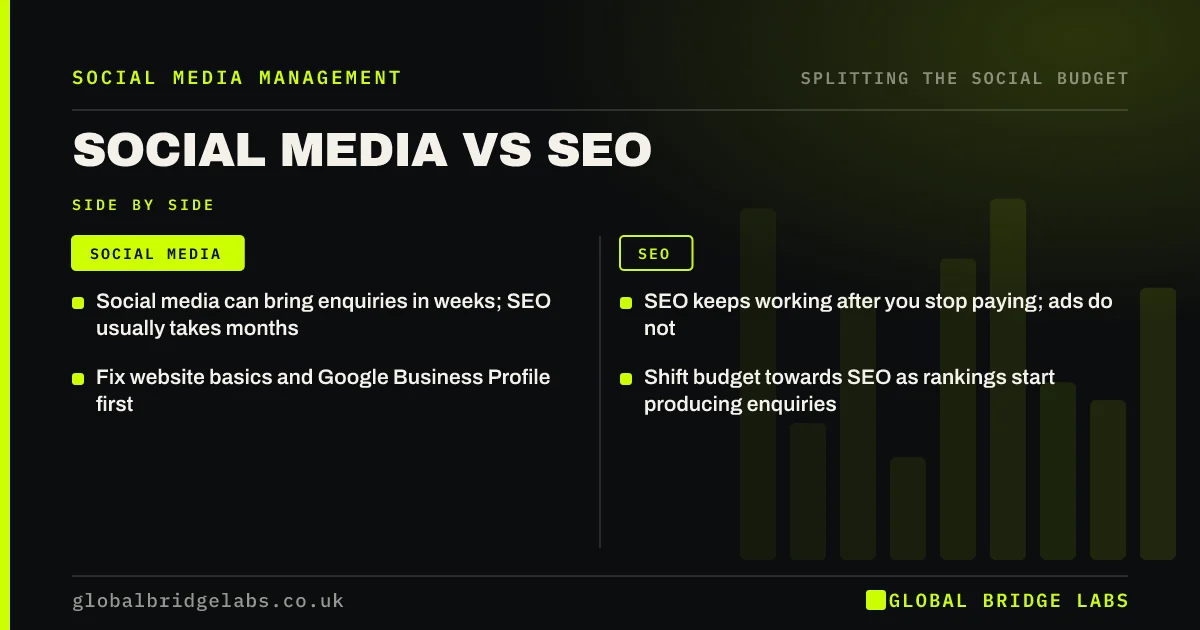
Social media vs SEO budget is a trade between speed and compounding. Social media can bring enquiries within weeks but stops when you stop. SEO, search engine optimisation, takes months but keeps working. On a small budget, fix your website basics and Google Business Profile first, then split the rest by how buyers find you.
- Social media can bring enquiries in weeks; SEO usually takes months.
- SEO keeps working after you stop paying; ads do not.
- Fix website basics and Google Business Profile first.
- Shift budget towards SEO as rankings start producing enquiries.
Want a search and social plan for your budget? Message us on WhatsApp.
Chat on WhatsApp →What is the difference in how they pay back?
Social media spend, especially ads, produces results while it runs. SEO work, such as better service pages, local listings and helpful content, builds visibility slowly, but a page that ranks can bring enquiries for years. Most small businesses need the quick channel while the slow one grows.
What should a small budget fund first?
A website that loads quickly and explains your services clearly, plus a complete Google Business Profile with reviews. These serve both channels: social media sends people to your site, and search sends people who check your profiles. Without them, every other pound works harder for less.
How should the budget shift over a year?
Illustrative plan on £800 a month: months one to three, £500 social and £300 on website and local SEO fixes; months four to nine, £450 and £350 as content builds; months ten to twelve, rebalance towards whichever channel brings enquiries at the lower cost.
- Months 1–3: social carries enquiries while SEO basics are fixed.
- Months 4–9: steady SEO content alongside social.
- Months 10–12: rebalance on cost per enquiry.
Send us your monthly budget on WhatsApp and we will discuss your requirements.
Chat on WhatsApp →When should SEO get most of the budget?
When buyers search for what you sell, competitors rank with weak pages, and you can wait several months. Professional services, trades and B2B specialists often fit. When buyers rarely search, such as for new products or impulse purchases, social media should keep the larger share.
What does this look like in practice?
A pattern we see: a firm spends steadily on social ads for years while its website ranks for nothing. Putting a share into service pages and local SEO often builds a second, cheaper source of enquiries, and the social budget can then focus on what search cannot reach.
SEO and social checklist
- Check your website speed and service pages first.
- Complete your Google Business Profile and ask for reviews.
- Use social media for enquiries while SEO grows.
- Track enquiries from search and social separately.
- Rebalance after six to twelve months.
Next step
Search for your main service and town. Note where you appear and who ranks above you. That tells you how much room SEO has to help.
Message us on WhatsApp with what you found, or book a 30-minute consultation.
Chat on WhatsApp →Sources and further reading
- SEO Starter Guide · Google Search Central
- Tips to improve your local ranking on Google · Google Business Profile Help
Frequently asked questions
Is SEO or social media better for a small business?
It depends on how buyers find you. If they search for your service, SEO builds long-lasting visibility. If they discover products by seeing them, social media is stronger. Most small businesses benefit from both, using social for quicker enquiries while SEO grows over months.
How long does SEO take to work?
Usually several months for meaningful results, depending on competition and the state of your website. Local SEO, such as a complete Google Business Profile and reviews, can show results sooner. Plan for social media or paid search to carry enquiries in the meantime.
Does social media help SEO?
Not directly as a ranking factor, but it helps indirectly. Social posts can send visitors to your site, get your content seen by people who may link to it, and build searches for your brand name. Treat them as partners, not substitutes.
Written by

Global Bridge Labs (GBL) is a UK–Sri Lanka partner for social media, websites and BPO. Everything here comes from client delivery, not theory.