On this page
Key takeaways
A good new competitor marketing response starts with facts, not panic. Check their ads and offers, look after your existing customers, and spend on proof of what makes you different before matching their budget. A short, time-limited increase in visibility can help, but price wars and copycat ads usually cost more than they protect.
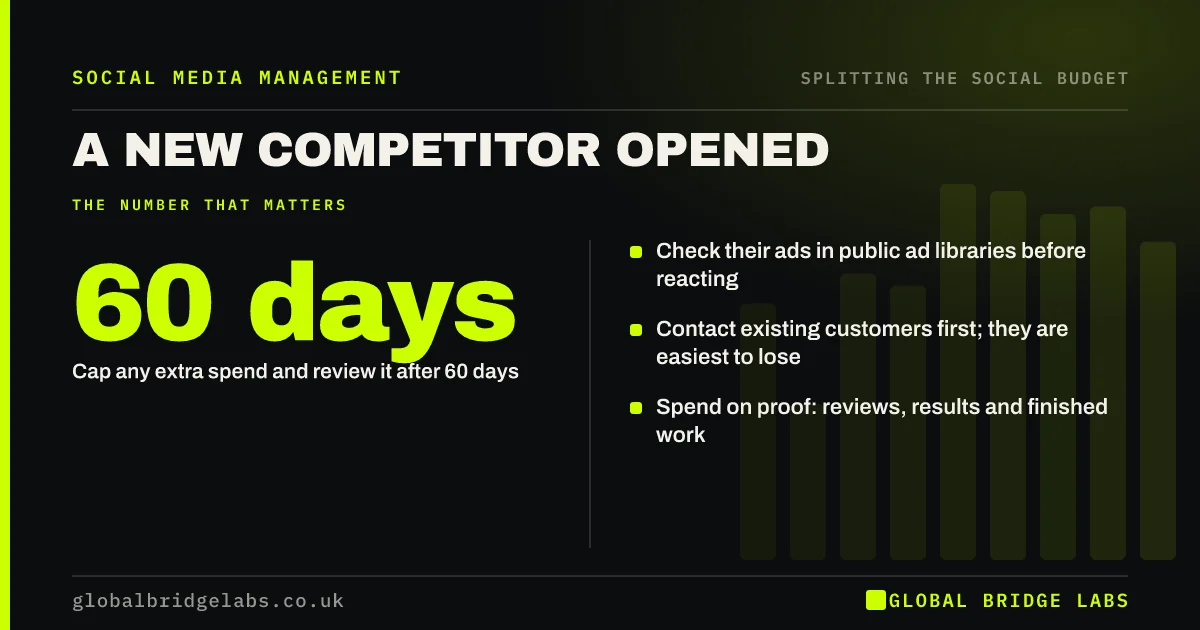
- Check their ads in public ad libraries before reacting.
- Contact existing customers first; they are easiest to lose.
- Spend on proof: reviews, results and finished work.
- Cap any extra spend and review it after 60 days.
Worried about a new competitor? Message us on WhatsApp.
Chat on WhatsApp →What should you check first?
Look up their active ads in the Meta Ad Library, their offers, prices and reviews, and the customers they are targeting. A launch burst of ads and discounts often fades within weeks. Knowing whether they compete on price, convenience or quality tells you where you are actually exposed.
Why protect existing customers first?
New competitors often win by tempting your regular customers with an introductory offer. A thank-you message, a loyalty reward or a reminder of what you do well costs little and keeps them. Organic posts and email reach them without extra ad spend.
What is worth spending more on?
Proof that a newcomer cannot have yet: years of reviews, finished work, known staff and local reputation. As a GBL rule of thumb, a temporary rise of 20–30% in ad spend for 60 days, aimed at your best customer type with that proof, is a reasonable response. Review it against enquiries before extending.
Send us your current spend on WhatsApp and we will discuss your requirements.
Chat on WhatsApp →What responses usually backfire?
Matching their discounts, criticising them publicly and copying their ads. Discounts train customers to wait for offers, and public criticism looks defensive. Any comparison with a competitor in an ad must be accurate and fair under the CAP Code. Compete on what you do well.
What does this look like in practice?
A pattern we see: a long-established local business cuts prices when a competitor opens nearby and loses margin for months. Holding prices, thanking regular customers and showing years of reviews in a short campaign usually keeps the core customers while the newcomer's launch offers fade.
Competitor response checklist
- Check the competitor's ads, offers and reviews.
- Message regular customers before they are tempted.
- Promote proof the newcomer cannot match.
- Cap any extra ad spend at 60 days.
- Keep comparisons accurate, or avoid them.
Next step
List three things you offer that a new competitor cannot claim yet. Build next month's posts and any extra ads around those three.
Message us on WhatsApp with your list, or book a 30-minute consultation.
Chat on WhatsApp →Sources and further reading
Frequently asked questions
Should I lower my prices when a competitor opens?
Usually not straight away. Introductory offers from new businesses are often temporary, and matching them cuts your margin and teaches customers to wait for deals. Protect regular customers with service and loyalty, and show proof of quality before considering any price change.
Can I mention a competitor in my ads?
Comparative advertising is allowed in the UK if it is accurate, verifiable, compares like with like and does not mislead or denigrate. Check the CAP Code rules before running any comparison. Most small businesses do better promoting their own strengths without naming rivals.
How long should I spend extra after a competitor arrives?
Set a fixed period, such as 60 days, with a clear measure such as enquiries or bookings from your best customer type. Review at the end and return to your normal budget unless the extra spend is clearly bringing profitable work.
Written by

Global Bridge Labs (GBL) is a UK–Sri Lanka partner for social media, websites and BPO. Everything here comes from client delivery, not theory.